
SYNTHESIS, CHARACTERIZATION, AND BIOLOGICAL ACTIVITY OF ORGANOTIN(IV) COMPLEXES DERIVED FROM N-PHTHALOYLAMINE LIGANDS
DOI:
https://doi.org/10.33003/fjs-2026-1002-4426Keywords:
N-phthaloylamine derivatives; Organotin(IV) complexes; Bidentate ligands; Infrared spectroscopy; Antimicrobial activity; Six-coordinate geometry; Ligand complexationAbstract
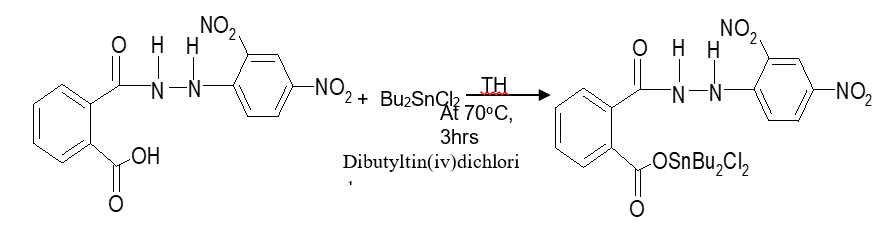
N-Phthaloylamine derivatives were synthesized through the condensation of an equimolar amount of phthalic anhydride with 2,4-dinitrophenylhydrazine, aniline, and hydrazine (1:1 molar ratio) in glacial acetic acid using excess tetrahydrofuran (THF) as solvent. The reactions afforded the corresponding ligands in good yields (60–68.6%) after purification by column chromatography and recrystallization. The synthesized ligands were subsequently complexed with organotin(IV) compound, including dibutyltin(IV) dichloride, to afford stable organotin(IV) complexes. The compounds were characterized by melting point determination, thin-layer chromatography (TLC), column chromatography, and Fourier Transform Infrared (FT-IR) spectroscopy. The IR spectra of the free ligands exhibited characteristic imide carbonyl bands in the 1715–1730 cm⁻¹ region and N–H stretching bands at 3200–3300 cm⁻¹. Upon complexation, the carbonyl stretching frequencies shifted to lower wavenumbers (1680–1700 cm⁻¹), indicating coordination through the carbonyl oxygen atom. The appearance of new bands in the 450–550 cm⁻¹ region, assignable to Sn–O and Sn–N vibrations, supports ligand coordination. Changes in the N–H region suggest possible involvement of the amide nitrogen in bonding, suggesting coordination through oxygen donor atoms. Antimicrobial screening against Klebsiella pneumoniae, Escherichia coli, and Staphylococcus aureus revealed enhanced activity of the complexes compared to the free ligands. The ligands exhibited inhibition zones of 12–18 mm, whereas the organotin(IV) complexes showed larger zones of 16–22 mm, with maximum activity observed against Klebsiella pneumoniae. These findings demonstrate that complexation with organotin(IV) significantly enhances the antimicrobial efficacy of the ligands.
References
Abed-Al Zahra, M. A., & Hadi, A. G. (2025). Synthesis, characterization, and antioxidant activity of novel diorganotin(IV) complexes derived from ibuprofen–5-aminosalicylic acid ligand. Bulletin of the Chemical Society of Ethiopia, 39(1), 101–110.
Abuel-Wafa, E., & Ahmed, F. H. (1986). Formation of metformin complexes with some transition metal ions and their biological activity. Inorganic Chemistry, 136, 127–131.
Adeyemi, J. O., & Onwudiwe, D. C. (2020). Antimicrobial and cytotoxicity studies of some organotin(IV) N-ethyl-N-phenyl dithiocarbamate complexes. Polish Journal of Environmental Studies, 29(4), 2525–2532.
Affan, M. A., Dayang Norafizan, A. C., Fasihuddin, B. A., Ismail, J., Bohari, M. Y., & Ramli, B. H. (2010). Synthesis, characterization and biological activities of organotin(IV) complexes with vitamin K3-2-hydrazinopyridine: X-ray crystal structure of vitamin K3-2-hydrazinopyridine (VHzP). Research Journal of Pharmaceutical, Biological and Chemical Sciences, 1(4), 158–172.
Affan, M. A., Foo, I. P. P., Fasihuddin, B. A., Sim, E. U. H., & Hapipah, M. A. (2009). Synthesis, structural characterization and toxicity studies of novel organotin(IV) complexes derived from benzoylacetone isonicotinylhydrazone: X-ray crystal structure of [Me₂Sn(BAS)]₂. The Malaysian Journal of Analytical Sciences, 13(1), 73–85.
Arraq, R. R., & Hadi, A. G. (2023). Synthesis, identification, and antioxidant activity of diorganotin(IV)–cephalexin complexes. Journal of Medicinal and Chemical Sciences, 6(2), 392–401. https://doi.org/10.26655/JMCHEMSCI.2023.2.19
Awang, N., & Baba, I. (2012). Diorganotin(IV) alkylcyclohexyldithiocarbamate compounds: Synthesis, characterization and biological activities. Sains Malaysiana, 41(8), 977–982.
Awang, N., Baba, I., Yamin, B. M., Othman, M. S., & Kamaludin, N. F. (2011). Synthesis, characterization and biological activities of organotin(IV) methylcyclohexyldithiocarbamate compounds. American Journal of Applied Sciences, 8(4), 310–317.
Chee, D. N. A., & Rodis, M. L. (2015). Synthesis, characterization and antibacterial activity of organotin(IV) complexes with benzoylacetone benzhydrazone ligand. In Proceedings of the 3rd International Conference on Biological, Chemical & Environmental Sciences (BCES-2015). https://doi.org/10.15242/IICBE.C0915063
Dolan, N., McGinley, J., Stephens, J. C., Kavanagh, K., Hurley, D., & Maher, N. J. (2014). Synthesis, characterisation and antimicrobial studies of organotin(IV) complexes with 1,10-phenanthroline derivatives. Inorganica Chimica Acta, 409, 276–284. https://doi.org/10.1016/j.ica.2013.09.038
Farina, Y., Graisa, A., Kassem, M., & Yousif, E. (2008). Preparation and spectroscopic studies of diorganotin(IV) complexes of N-phenyl-m-nitrobenzohydroxamic acid. European Journal of Scientific Research, 22(4), 602–607.
Fuentes-Martínez, J. P., Toledo-Martínez, I., Román-Bravo, P., García y García, P., Godoy-Alcántar, C., López-Cardoso, M., & Morales-Rojas, H. (2009). Diorganotin(IV) dithiocarbamate complexes as chromogenic sensors of anion binding. Polyhedron, 28, 3953–3966.
Graisa, A., Farina, Y., Yousif, E., & Saad, E. E. (2009). Organotin(IV) derivatives of N-tolyl-m-methoxybenzohydroxamic acid: Synthesis and structural elucidation. International Journal of Chemistry, 1(2), 34–41.
Hadi, A. G., Jawad, K., Ahmed, D. S., & Yousif, E. (2019). Synthesis and biological activities of organotin(IV) carboxylates: A review. Systematic Reviews in Pharmacy, 10(1), 26–31. https://doi.org/10.5530/srp.2019.1.5
Iornumbe, E. N., Iortyom, S. D., Amua, Q. M., Iorungwa, M. S., & Chia, M. (2021). Analysis of the biological property of some synthesized organotin(IV) complexes of hexanedioic acid. Journal of the Chemical Society of Nigeria, 46(3), 583–593.
Iornumbe, E. N., Yiase, S. G., & Sha’Ato, R. (2016). Studies on the synthetic and biological activity of some organotin(IV) derivatives of hexanedioic acid. IOSR Journal of Applied Chemistry, 9(7), 23–32. https://doi.org/10.9790/5736-0907012332
Iornumbe, E. N., Yiase, S. G., Sha’Ato, R., & Tor-Anyiin, T. A. (2015). Synthesis, characterization and antifungal activity of some organotin(IV) derivatives of octanedioic acid. International Journal of Science and Research, 4(5), 2095–2101.
Javed, F., Ali, S., Munawar, K. S., Haider, A., Shah, N. A., & Rashid, Z. (2023). Synthesis, structural elucidation, and therapeutic screening of organotin(IV) derivatives of oxo-ethyl carbonodithioate. Journal of the Chemical Society of Pakistan, 45(4), 345–358.
Jimaa, R. B., & Al-Zinkee, J. M. M. (2021). A review on organotin(IV) thiosemicarbazone complexes: Synthesis, characterization and biological activity. Journal of University of Anbar for Pure Science, 15(2), 66–73.
Priyanka, Kumar, M., Sharma, H. K., & Soni, S. (2020). Synthesis, characterization and biological studies of some organotin compounds: A review. Oriental Journal of Chemistry, 36(5), 871–878. https://doi.org/10.13005/ojc/360511
Rehman, W., Badshah, A., Baloch, M. K., Ali, S., Gulzar, H., & Khan, K. M. (2004). Synthesis, characterization and biological screening of tribenzyltin(IV) complexes of some Schiff bases. Journal of the Chinese Chemical Society, 51, 929–934.
Salam, M. A., Affan, M. A., Saha, R., Fasihuddin, B. A., & Norrihan, S. (2012). Synthesis, characterization and in vitro antibacterial studies of organotin(IV) complexes with 2-hydroxyacetophenone-2-methylphenylthiosemicarbazone (H₂dampt). Bioinorganic Chemistry and Applications, 2012, 1–8. https://doi.org/10.1155/2012/824561
Shah, F. A., Ali, S., & Shahzadi, S. (2010). Spectral and biological studies of newly synthesized organotin(IV) complexes of 4-([(E)-(2-hydroxyphenyl) methylidene]amino}methyl) cyclohexane carboxylic acid Schiff base. Journal of the Iranian Chemical Society, 7(1), 59–68.
Shahzadi, S., Ali, S., Shahid, K., Yousaf, M., Sharma, S. K., & Qanungo, K. (2010). Interaction of di- and triorganotin(IV) compounds with carboxylate ligand: Synthesis, spectral characterization, semi-empirical study and in vitro antimicrobial activities. Journal of the Chinese Chemical Society, 57(4), 659–670. https://doi.org/10.1002/jccs.201000093
Singh, R., & Kaushik, N. K. (2006). Organotin(IV) complexes of thiohydrazides and thiodiamines: Synthesis, spectral and thermal studies. Spectrochimica Acta Part A: Molecular and Biomolecular Spectroscopy, 65, 950–954.
Win, Y.-F., Teoh, S.-G., Vikneswaran, M. R., Ha, S.-T., & Ibrahim, P. (2010). Synthesis and characterization of organotin(IV) complexes derived from 4-(diethylamino) benzoic acid: In vitro antibacterial screening activity. International Journal of the Physical Sciences, 5(8), 1263–1269.
Win, Y.-F., Teoh, S.-G., Ha, S.-T., & Tengku-Muhammad, T.-S. (2012). Preliminary in vitro cytotoxic assay of human liver carcinoma cells (HepG2) of organotin(IV) complexes. African Journal of Biotechnology, 11(67), 13140–13146.
Yang, F., Graisa, A., & Yousif, E. (2009). Synthesis, structure and biological activity of some organotin(IV) compounds with benzamidomethionine. Modern Applied Science, 3(4), 215–218.
Downloads
Published
Issue
Section
Categories
License
Copyright (c) 2026 Olurotimi Olutimehin Demokun, Abdulgafar Omeiza Zubair, Ekundayo Timi Areh, IBRAHIM ABDULKARIM

This work is licensed under a Creative Commons Attribution 4.0 International License.


