
CHOLERA RESEARCH LANDSCAPE IN NIGERIA, 2010-2025: A SCOPING REVIEW
DOI:
https://doi.org/10.33003/fjs-2026-1008-5344Keywords:
Cholera, research landscape, surveillance, WASH, Nigeria, Vibrio choleraeAbstract
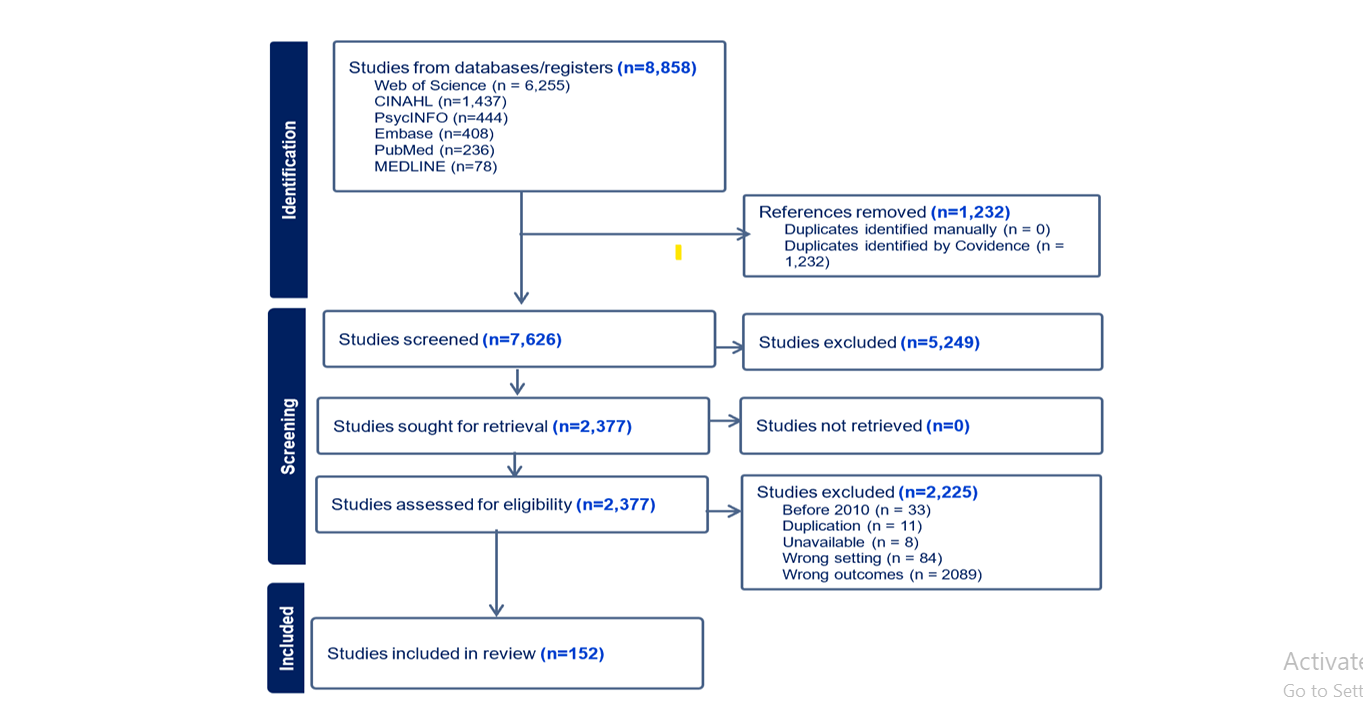
Nigeria is one of the countries most affected by cholera in sub-Saharan Africa, experiencing recurrent outbreaks despite ongoing prevention and control efforts. Although numerous studies have examined various aspects of cholera in Nigeria, no study has systematically examined the characteristics, evolution, and gaps in the national cholera research landscape. This research aimed to fill this gap. A scoping review was conducted using the Arksey and O'Malley framework and reported in accordance with the Preferred Reporting Items for Systematic Reviews and Meta-Analyses Extension for Scoping Reviews guidelines. Literature searches were performed across Web of Science, CINAHL, PsycINFO, Embase, Medline, PubMed and African Journals Online (AJOL) between January 2010 and July 2025. Eligibility was defined as a primary focus on cholera or Vibrio cholerae in Nigeria. Data extraction was performed in Covidence and analysed descriptively. One hundred and fifty-two (152) records met the predefined inclusion criteria. Of these, the majority were original research articles (83.6%), and over half (57.6%) were published between 2020 and 2025, suggesting significant growth in cholera research activity. Epidemiology (surveillance and laboratory) (11.8%; 18/152), bacteriology/molecular/genomics (5.9%; 9/152), and cross-cutting (61.8%; 94/152) were the most frequently represented thematic areas. However, descriptive and cross-sectional studies dominated the evidence-base. Nearly half of the included studies did not report funding sources. In conclusion, cholera research in Nigeria has expanded considerably over the past 15 years, reflecting national research capacity and scientific attention to the disease; however, there is a dearth of evidence in intervention, implementation, and policy-relevant research.
References
Adebajo, G. O., Alabi, G. J., Oladele, O. C., Ayowole, D. J., Ogedengbe, I. T., & Abati, S. O. (2025). Review of public health preparedness and response to cholera; lessons from Nigeria’s 2024 outbreak. Discover Public Health 2025 22:1, 22(1), 184-. https://doi.org/10.1186/S12982-025-00583-W
Ali, M., Nelson, A. R., Lopez, A. L., & Sack, D. A. (2015). Updated global burden of cholera in endemic countries. PLoS Neglected Tropical Diseases, 9(6), e0003832. https://doi.org/https://dx.doi.org/10.1371/journal.pntd.0003832
Arksey, H., & O’Malley, L. (2005). Scoping studies: towards a methodological framework. International Journal of Social Research Methodology, 8(1), 19–32. https://doi.org/10.1080/1364557032000119616
Dalhat, M. M., Isa, A. N., Nguku, P., Nasir, S.-G., Urban, K., Abdulaziz, M., Dankoli, R. S., Nsubuga, P., & Poggensee, G. (2014). Descriptive characterisation of the 2010 cholera outbreak in Nigeria. BMC Public Health, 14(1), 1167. https://doi.org/10.1186/1471-2458-14-1167
Elimian, K. O., Mezue, S., Musah, A., Oyebanji, O., Fall, I. S., Yennan, S., Yao, M., Abok, P. O., Williams, N., Omar, L. H., Balde, T., Ampah, K., Okudo, I., Ibrahim, L., Jinadu, A., Alemu, W., Peter, C., & Ihekweazu, C. (2020). What are the drivers of recurrent cholera transmission in Nigeria? Evidence from a scoping review. BMC Public Health, 20(1), 1–13. https://doi.org/10.1186/s12889-020-08521-y
Elimian, K. O., Musah, A., Mezue, S., Oyebanji, O., Yennan, S., Jinadu, A., Williams, N., Ogunleye, A., Fall, I. S., Yao, M., Eteng, W.-E., Abok, P., Popoola, M., Chukwuji, M., Omar, L. H., Ekeng, E., Balde, T., Mamadu, I., Adeyemo, A., & Ihekweazu, C. (2019). Descriptive epidemiology of cholera outbreak in Nigeria, January-November, 2018: implications for the global roadmap strategy. BMC Public Health, 19(1), 1264. https://doi.org/https://dx.doi.org/10.1186/s12889-019-7559-6
Elimian, K., Yennan, S., Musah, A., Cheshi, I. D., King, C., Dunkwu, L., Mohammed, A. L., Ekeng, E., Akande, O. W., Ayres, S., Gandi, B., Pembi, E., Saleh, F., Omar, A. N., Crawford, E., Olopha, O. O., Nnaji, R., Muhammad, B., Luka-Lawal, R., & Adetifa, I. (2022). Epidemiology, diagnostics and factors associated with mortality during a cholera epidemic in Nigeria, October 2020-October 2021: a retrospective analysis of national surveillance data. BMJ Open, 12(9). https://doi.org/10.1136/bmjopen-2022-063703
Ending Cholera: A Global Roadmap to 2030, 32 (2017). https://www.who.int/cholera/publications/global-roadmap.pdf
European Centre for Disease Prevention and Control. (2026). Geographical distribution of cholera cases reported worldwide from February 2025 to February 2026. ECDC. https://www.ecdc.europa.eu/en/publications-data/geographical-distribution-cholera-cases-reported-worldwide-february-2025-february
Levac, D., Colquhoun, H., & O’Brien, K. K. (2010). Scoping studies: advancing the methodology. Implementation Science 2010 5:1, 5(1), 1–9. https://doi.org/10.1186/1748-5908-5-69
Mengel, M. A., Delrieu, I., Heyerdahl, L., & Gessner, B. D. (2014). Cholera outbreaks in Africa. Current Topics in Microbiology and Immunology, 379, 117–144. https://doi.org/10.1007/82_2014_369
Mike-Ogburia, M. I., Eze, C. C., Okoli, M. O., Ekada, I., Uhegbu, C. U., Ugwu, C., Ogbakiri, P. A., Alozie, F. C., Ideozu, N. O., Amesi, A. W., & Ifeanyi, M. A. (2024). Cholera in Nigeria: A review of outbreaks, trends, contributing factors, and public health responses. Nigerian Medical Journal : Journal of the Nigeria Medical Association, 65(6), 824–843. https://doi.org/https://dx.doi.org/10.60787/nmj.v65i6.584
Ngwa, M. C., Wondimagegnehu, A., Okudo, I., Owili, C., Ugochukwu, U., Clement, P., Devaux, I., Pezzoli, L., Ihekweazu, C., Jimme, M. A., Winch, P., & Sack, D. A. (2020). The multi-sectorial emergency response to a cholera outbreak in Internally Displaced Persons camps in Borno State, Nigeria, 2017. BMJ Global Health, 5(1), 2000. https://doi.org/10.1136/bmjgh-2019-002000
Ogunniyi, T. J., Muoneke, A. P., Nimo, F., Yisa, S. S., & Olorunfemi, O. A. (2025). Cholera in Nigeria: a five-decade review of outbreak dynamics and health system responses. Journal of Health, Population and Nutrition 2025 44:1, 44(1), 329-. https://doi.org/10.1186/S41043-025-01096-7
Onwunta, I. E., Ozota, G. O., Eze, C. A., Obilom, I. F., Okoli, O. C., Azih, C. N., Okoye, C. O., & Agbo, E. L. (2025). Recurrent cholera outbreaks in Nigeria: A review of the underlying factors and redress. Decoding Infection and Transmission, 3, 100042. https://doi.org/10.1016/J.DCIT.2025.100042
Rebaudet, S., Sudre, B., Faucher, B., & Piarroux, R. (2013). Environmental determinants of cholera outbreaks in inland Africa: a systematic review of main transmission foci and propagation routes. The Journal of Infectious Diseases, 208 Suppl 1(SUPPL. 1). https://doi.org/10.1093/infdis/jit195
Siamalube, B., Ehinmitan, E., Runo, S., Ngotho, M., & Onguso, J. (2025). Cholera in Sub-Saharan Africa: Unveiling neglected drivers and pathways to elimination. PLOS Neglected Tropical Diseases, 19(4), e0013029. https://doi.org/10.1371/JOURNAL.PNTD.0013029
World Health Organization. (2019). Cholera: Key Facts. WHO.
Downloads
Published
Issue
Section
Categories
License
Copyright (c) 2026 Kelly Elimian, Stephen Ohize

This work is licensed under a Creative Commons Attribution 4.0 International License.


