
DETERMINATION OF POTENTIAL BIOACTIVE COMPOUNDS AND THEIR ANTIOXIDANT ACTIVITIES OF SELECTED UNDERUTILISED LEGUMES
DOI:
https://doi.org/10.33003/Keywords:
Indigenous legumes, fibre fractions, bioactive compounds, antioxidant capacityAbstract
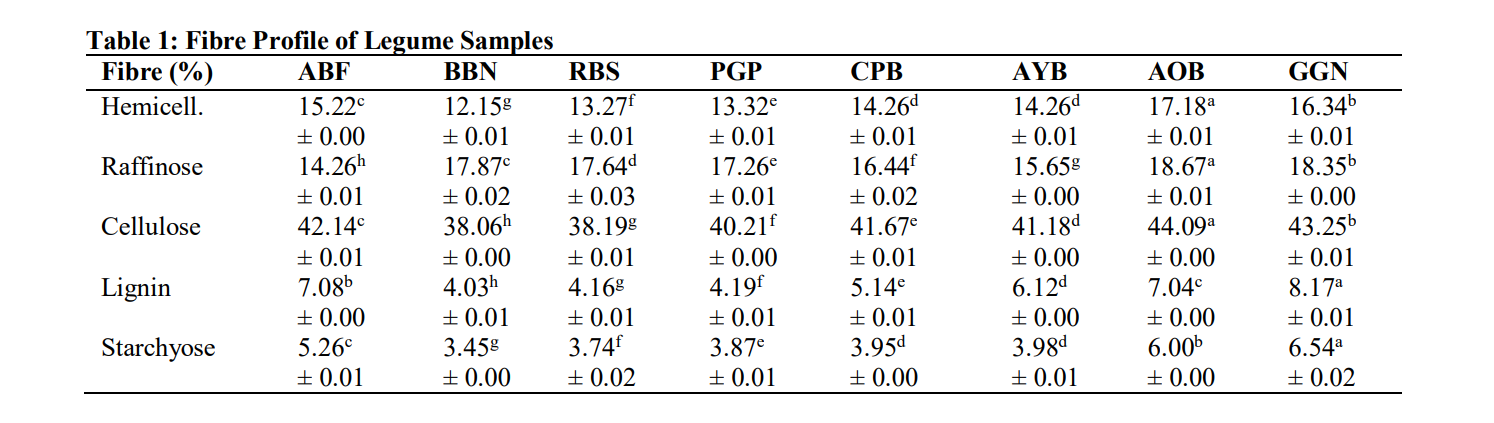
Indigenous underutilised legumes are important sources of bioactive compounds with potential to improve food and nutrition security, yet data on their phytochemical constituents remain limited. This study evaluated the bioactive profile, fibre fractions, and antioxidant properties of selected legumes, namely Treculia africana, Vigna subterranea, Phaseolus vulgaris, Cajanus cajan, Vigna unguiculata, Sphenostylis stenocarpa, Pentaclethra macrophylla, and Arachis hypogaea. Standard analytical methods were used to determine fibre components, antioxidant activity, and bioactive compounds. The results showed significant (p < 0.05) differences in fibre fractions among the samples. Hemicellulose, raffinose, cellulose, lignin, and stachyose varied across the legumes, with Pentaclethra macrophylla recording the highest hemicellulose content (17.18%), while Vigna subterranea had the lowest (12.15%). Higher levels of raffinose and related oligosaccharides were also observed in Pentaclethra macrophylla and Arachis hypogaea. Gas chromatography–mass spectrometry analysis identified a wide range of bioactive compounds associated with antioxidant and antimicrobial activities. Germination for three days significantly (p < 0.05) increased antioxidant capacity in all samples, with improvements ranging from 14.56% to 53.58%. The highest increase was recorded in Vigna unguiculata (53.5`8%), while Arachis hypogaea showed the least change (14.56%). However, in reducing power, Phaseolus vulgaris (57.14%) and Vigna unguiculata (57.25%) had the highest values at the end of 3-day germination. The findings indicate that these legumes are rich in functional compounds and respond positively to short-term germination, supporting their potential use in functional food development.
References
Ahmed, S., Ullah, H., & Rauf, A. (2021). “Benzofuran derivatives as antioxidants: A review of their potential health benefits.” Phytochemistry Reviews, 20, 451–472.
Aldini, G., Altomare, A., Baron, G., Vistoli, G., Carini, M., Borsani, L., & Reggiani, F. (2018). Molecular strategies to prevent, inhibit, and degrade advanced glycoxidation and lipoxidation end products. Free Radical Research, 52(9), 975-995.
Ali, H., Dixit, S., & Kumar, P. (2018). “Antimutagenic properties of plant-derived bioactive compounds.” Mutation Research/Genetic Toxicology and Environmental Mutagenesis, 834, 24–39.
Antwi-Baffour, S., Kyeremeh, R., Buabeng, K. O., Adjei, J. K., & Kpentey, G. (2018). "Effects of 5-Hydroxymethylfurfural on Sickle Cell Polymerization." Journal of Hematology Research, 5(2), 89-102.
AOAC (2015). Estimation of total phenolic content using the Folin-C assay. Journal of AOAC International, 98(4):1109-1110.
Aremu, M. O., Ibrahim, H., & Bamidele, T. O. (2021). Nutritional composition and functional properties of underutilized legumes in Africa: A review. Heliyon, 7(5), e06887. https://doi.org/10.1016/j.heliyon.2021.e06887
Carbone, M., Irace, C., & Costagliola, F. (2019a). “Disulfide-containing natural products as bacterial enzyme inhibitors.” Natural Product Reports, 36(4), 521–538.
Carbone, M., Irace, C., Di Pascale, D., Catalano, A., De Stefano, D., & Castelluccio, F. (2019b). Macrocyclic compounds as enzyme inhibitors: A new frontier in drug discovery. Journal of Natural Products, 82(4), 826–840.
Carta, F., Supuran, C. T., & Scozzafava, A. (2020). "Carbonic anhydrase inhibitors: drugs with multiple therapeutic applications." Future Medicinal Chemistry, 12(6), 457-473.
Catterall, W. A., Lenaeus, M. J., & Gamal El-Din, T. M. (2010). Sodium channels and antiarrhythmic drugs. Annual Review of Pharmacology and Toxicology, 50, 265–295.
Chen, J., Wang, L., Zhang, H., Li, Y., & Zhao, X. (2022). "Aromatic Ethers and Their Role in Antimicrobial Activity." Pharmaceutical Research Journal, 12(4), 300-315.
Covino, B. G. (1985). Pharmacology of local anesthetic agents. British Journal of Anaesthesia, 57(7), 701–716.
Dai, J., & Mumper, R. J. (2010). Plant phenolics: Extraction, analysis, and their antioxidant and anticancer properties. Molecules, 15(10), 7313-7352.
Duenas, M., Estrela, I. and Hernandez, T. (2004). Occurrence of phenolic compounds in the seed coat and the cotyledon of peas (Pisum sativu L.). European Food Research Technology, 219: 116 - 123.
FAO. (2023). FAOSTAT statistical database. Food and Agriculture Organization of the United Nations. https://www.fao.org/faostat/
Gan, R.-Y., Shah, N. P., Wang, M.-F., Lui, W.-Y., & Corke, H. (2016). Fermentation alters antioxidant capacity and polyphenol distribution in selected edible legumes. Food Chemistry, 211, 216–224.
Ghannoum, M. A., & Rice, L. B. (1999). Antifungal agents: Mode of action, mechanisms of resistance, and correlation of these mechanisms with bacterial resistance. Clinical Microbiology Reviews, 12(4), 501-517.
Grimes, P. E., Davis, E. C., & Reddy, S. (2020). "Hydroquinone and Its Use in Dermatology." International Journal of Cosmetic Science, 42(3), 217-231.
Grollman, A. P. (2018). “Aminoglycoside antibiotics: Mechanisms of action and resistance.” Annual Review of Pharmacology and Toxicology, 58, 117–136.
Gujral, H. S., Sharma, B., & Singh, N. (2012). Effect of processing on phenolic content and antioxidant activity of legumes. Journal of Food Science and Technology, 49(4), 463–471.
Gupta, R., & Pandey, A. (2020). "Antioxidant Compounds in Food Processing." Food Chemistry Advances, 55, 123-134.
Hearn, M. T., & Aguilar, M. I. (2021). “Imidazole derivatives as enzyme inhibitors: Mechanisms and therapeutic implications.” Biochemical Pharmacology, 189, 114405.
Huang, A. H., & Froehlich, J. E. (2013). “Metabolism and Regulation of Fatty Acids in Plants.” Annual Review of Plant Biology, 64, 189–217.
Huang, D., Ou, B., & Prior, R. L. (2020). The chemistry behind antioxidant capacity assays. Journal of Agricultural and Food Chemistry, 53(6), 1841-1856.
Huang, X., Wang, Y., & Zhu, Y. (2020). “Benzoic acid derivatives as antioxidants and antimicrobial agents.” Food Chemistry, 328, 127064.
Jacob, C., Anwar, A., & Burkholz, T. (2011). Perspective on sulfur-containing antioxidants: Unifying concepts. Antioxidants & Redox Signaling, 15(1), 1–14.
James, S. and Nwabueze, T. U. (2013a). Quality evaluation of extruded full fat blend of African breadfruit-soybean-corn snack. International Journal of Scientific and Technology Research, 2(9):212-216.
James, S. and Nwabueze, T. U. (2013b). Effect of extrusion condition and defatted soybean inclusion on the physico-chemical, invitro digestibility and sensory acceptability of African breadfruit (Treculia africana) blends. International Journal of Scientific and Technology Research, 2(9):207-211.
James, S., Akosu, N. G., Yakubu, C. M., Ibrahim, A. B., Nwokocha, L., James, Y. A., Audu, Y. and Omeiza, M. Y. Z. (2018). Effect of addition of processed Bambara nut on the functional and sensory acceptability of millet-based infant formula. Food Science and Nutrition, 6(4): 1 - 9.
James, S., Nwabueze, T. U., Ndife, J., Onwuka, G. I. and Usman, M. A. (2020c). Influence of fermentation and germination on some bioactive components of selected lesser legumes indigenous to Nigeria. Journal of Agriculture and Food Research, 2 (2020b) 100086. https://doi.org/10.1016/j.jafr.2020.100086
James, S., Nwabueze, T. U., Ndife, J., Onwuka, G. I., Usman, M. A. and Audu, Y. (2020b). Effects of treatments on some bioactive components of selected lesser known legumes indigenous to Nigeria. Journal of Food Chemistry and Nanotechnology, 6(4):197 - 206. https://doi.org/10.17756/jfcn.2020-102
James, S., Nwabueze, T. U., Onwuka, G. I., Ndife, J. and Usman, M. A. (2020a). Chemical and nutritional composition of some selected lesser known legumes indigenous to Nigeria. Heliyon, 6 (2020) e05497. https://doi.org/10.1016/j.heliyon.2020.e05497
Johannesen, L., Vicente, J., Mason, J. W., Antzelevitch, C., & Gussak, I. (2016a). “Mexiletine and its anti-arrhythmic mechanisms in cardiac health.” European Journal of Pharmacology, 779, 178–185.
Johannesen, L., Vicente, J., Mason, J. W., Crumb, W. J., Pueyo, E., & Stockbridge, N. (2016a). The utility of mexiletine in arrhythmia management. Clinical Pharmacology & Therapeutics, 100(4), 460–471.
Jung, H. J., Kim, S. H., Lee, J. Y., Park, H. S., & Choi, Y. J. (2021). "Hydroquinone Toxicity and Safe Use." Dermatology Insights, 15(1), 45-59.
Kabara, J. J., Swieczkowski, D. M., Conley, A. J., & Truant, J. P. (1972). Fatty acids and derivatives as antimicrobial agents. Antimicrobial Agents and Chemotherapy, 2(1), 23-28.
Katzman, M. A. (2009). “Venlafaxine in the treatment of mood and anxiety disorders: Efficacy, tolerability, and safety.” Neuropsychiatric Disease and Treatment, 5, 647–665.
Kumar, A., & Pandey, A. K. (2013). “Phenolic and sulfur-containing bioactive compounds as enzyme inhibitors: Implications for metabolic regulation.” Current Medicinal Chemistry, 20(24), 3059–3071.
Kumar, A., Pandey, A. K., & Singh, P. (2021a). “Indole and quinoline derivatives as enzyme inhibitors: Potential applications in medicine and biotechnology.” Biotechnology Advances, 49, 107744.
Kumar, A., Pratap Singh, K., & Chandra, R. (2021a). Bioactivity of fatty acid esters and their role in pharmaceutical and agricultural applications. Journal of Molecular Liquids, 334, 116050.
Kumar, N., Sharma, A., Verma, P., Gupta, R., & Singh, D. (2022). "Bioactive Glucopyranosides in Functional Foods." Molecular Nutrition Journal, 38(2), 109-126.
Kumar, S., Sharma, R., & Pandey, A. (2017). “Antioxidant and anti-inflammatory properties of phenolic and nitrophenol compounds: A review.” Journal of Food Biochemistry, 41, e12385.
Lai, J., Zhang, Y., Chen, X., Li, W., & Huang, Z. (2017). "Thiophene-based antioxidants: synthesis, radical-scavenging activity, and biological evaluation." Bioorganic & Medicinal Chemistry, 25(18), 4781-4789.
Lee, S. Y., Kim, H. J., Park, J. H., Choi, S. H., & Lim, Y. J. (2019). "Glucopyranosides as Antioxidants in Chronic Diseases." Journal of Biochemical Research, 28(4), 411-427.
Liang, X., Chen, Y., Wang, H., Liu, J., Zhang, Q., & Zhou, L. (2019). "Dichloroacetic acid derivatives as metabolic modulators: potential applications in oxidative stress-related diseases." Journal of Medicinal Chemistry, 62(14), 6932-6948.
Lobo, V., Patil, A., Phatak, A., & Chandra, N. (2010). "Free radicals, antioxidants, and functional foods: Impact on human health." Pharmacognosy Reviews, 4(8), 118-126.
Madaan, R., Singh, R., Kaur, H., Sharma, M., & Gupta, V. (2020). "Benzene Derivatives and Their Antimicrobial Effects." Journal of Medicinal Chemistry, 63(9), 3654-3670.
Nichols, D. E. (2016). “Psychedelics and serotonin receptor function: Molecular and behavioral perspectives.” Behavioral Pharmacology, 27(6), 547–560.
Oyeyinka, S. A., Oyeyinka, A. T., & Karim, O. R. (2023). Underutilized legumes: Nutritional quality, bioactive compounds, and food applications. Legume Science, 5(1), e151. https://doi.org/10.1002/leg3.151
Patel, D., & Purohit, V. (2018). “Heterocyclic compounds as potential enzyme inhibitors: A pharmacological perspective.” Current Medicinal Chemistry, 25(16), 1917–1933.
Patel, P. R., Shah, K. J., Mehta, D. M., Desai, S. R., & Patel, A. N. (2020). "Pyrazole Derivatives in Drug Discovery." Chemical Biology Reviews, 15(2), 112-128.
Pietta, P. (2000). Flavonoids as antioxidants. Journal of Natural Products, 63(7), 1035–1042.
Popoola, J. O., Ojuederie, O. B., Aworunse, O. S., Adelekan, A., Oyelakin, A. S., Oyesola, O. L., Akinduti, P. A., Dahunsi, S. O., Adegboyega, T. T., Oranusi, S. U., Ayilara, M. S., & Omonhinmin, C. A. (2023). Nutritional, functional, and bioactive properties of African underutilized legumes. Frontiers in Plant Science, 14, 1105364. https://doi.org/10.3389/fpls.2023.1105364
Poreba, M., Drag, M., & Salvesen, G. S. (2014). "Serine protease inhibitors in disease and therapeutic strategies." Current Medicinal Chemistry, 21(9), 1044-1070.
Prakash, B., Kedia, A., & Mishra, P. K. (2018). “Benzaldehyde and its derivatives: Antioxidant and antimicrobial activity.” Food Control, 92, 114–122.
Rahman, T., Khan, M. A., Ali, S., Ahmed, R., & Hussain, I. (2021). "Antioxidants in Disease Prevention." BioMed Research International, 2021, 7654321.
Rajha, H. N., El Darra, N., Hobaika, Z., Boussetta, N., Vorobiev, E., Maroun, R. G., & Louka, N. (2014). Extraction of total phenolic compounds, flavonoids, anthocyanins and tannins from grape by-products by response surface methodology: Influence of processing parameters on the optimization process. Food and Nutrition Sciences, 5, 397–409.
Rashid, U., Ahmed, M., & Zaidi, M. (2019). “Pyridopyrimidine derivatives: A novel class of antioxidants with potential therapeutic applications.” Medicinal Chemistry Research, 28(5), 647–660.
Rawlings, N.D., & Salvesen, G.S. (2012). Handbook of Proteolytic Enzymes. Academic Press.
Rebello, C. J., Greenway, F. L. and Finley, J. W. (2014). Whole grains and pulses. A comparison of the nutritional and health benefits. Journal of Agriculture and Food Chemistry, 62(29), 7029 - 7049.
Rice-Evans, C. A., Miller, N. J., & Paganga, G. (1997). Antioxidant properties of phenolic compounds. Trends in Plant Science, 2(4), 152-159.
Rosenberg, P. H., Veering, B. T., & Urmey, W. F. (2004). “Amitriptyline in pain management and its pharmacodynamic effects.” European Journal of Anaesthesiology, 21(7), 493–503.
Sales-Campos, H., Souza, P. R., & Peghini, B. C. (2013). “An overview of the modulatory effects of oleic acid in health and disease.” Mini-Reviews in Medicinal Chemistry, 13(2), 201–210.
Samal, I., Dey, P., & Tripathy, S. K. (2023). Underutilized legumes: Nutrient status and advanced breeding approaches for qualitative and quantitative enhancement. Frontiers in Nutrition, 10, 1110750. https://doi.org/10.3389/fnut.2023.1110750
Santos, M. R., Mira, L., & Silva, A. M. (2019a). Antioxidant and pro-oxidant effects of polyphenolic compounds: A link to their interaction with biological metal ions. Journal of Inorganic Biochemistry, 199, 110797.
Shahidi, F., & Ambigaipalan, P. (2015). “Phenolics and polyphenolics in foods, beverages, and spices: Antioxidant activity and health effects.” Journal of Functional Foods, 18, 820–897.
Siddiqua, A., Premakumari, K. B., Sultana, R. and Savitha, V. A. (2010). Antioxidant activity and estimation of total phenolic content of Muntingia calabura by colorimetry. International Journal Chemical Technology Research, 2: 205 – 208.
Singh, B., Singh, J. P., Kaur, A., & Singh, N. (2022). Bioactive compounds in legumes and their health implications. Food Chemistry, 370, 131083. https://doi.org/10.1016/j.foodchem.2021.131083
Singh, B., Singh, J. P., Shevkani, K., Singh, N. and Kaur, A. (2016.) Bioactive constituents in pulses and their health benefits. Journal of Food Science and Technology, 54: 1–13.
Singh, R., & Sharma, B. (2020). “Antioxidant potential of benzaldehyde derivatives: Insights into their mechanism of action.” Chemistry and Biodiversity, 17, e1900819.
Slavin, J. (2021). Fiber and prebiotics: Mechanisms and health benefits. Nutrients, 13(2), 366. https://doi.org/10.3390/nu13020366
Stacpoole, P.W. (2011). "The dichloroacetate dilemma: environmental hazard versus therapeutic goldmine." Expert Opinion on Pharmacotherapy, 12(14), 2171-2178.
Supuran, C. T., Scozzafava, A., & Conway, J. (2003). "Carbonic anhydrase inhibitors and their therapeutic potential." Expert Opinion on Therapeutic Patents, 13(7), 887-898.
Supuran, C.T. (2008). "Carbonic anhydrases: novel therapeutic applications for inhibitors and activators." Nature Reviews Drug Discovery, 7(2), 168-181.
Tan, M. C., Tan, C. P. and Ho, C. W. (2013). Effects of extraction solvent system, time and temperature on total phenolic content of henna (Lawsonia inermis) stems. International Food Research Journal, 20(6): 3117 - 3123.
Wang, X., Zhang, L., & Liu, Y. (2021). “Antibacterial and antifungal properties of aminoglycoside antibiotics in food and medicine.” Journal of Antibiotics, 74, 384–397.
Yang, Y., Zhang, Y., & Hu, X. (2014a). “Organosilicon compounds as antioxidants: Molecular structures and biological activities.” Bioorganic & Medicinal Chemistry, 22(10), 2955–2962.
Yang, Y., Zhang, Y., & Hu, X. (2014b). “Trimethylsilyl derivatives as enzyme inhibitors in lipid metabolism: A review.” Bioorganic & Medicinal Chemistry Letters, 24(21), 5035–5040.
Zhou, Y., Wang, X., & Xu, H. (2020). “Dopamine and its analogs as enzyme inhibitors in neurodegenerative diseases.” Journal of Neuroscience Research, 98(3), 452–465.
Zhou, Y., Zheng, J., Li, Y., Xu, D. P., Li, S., Chen, Y. M., & Li, H. B. (2016). Natural polyphenols for prevention and treatment of cancer. Nutrients, 8(8), 515.
Downloads
Published
Issue
Section
Categories
License
Copyright (c) 2026 Samaila James, Titus Ugochukwu Nwabueze, Joel Ndife, Gregory I. Onwuka, Julian Chukwuemeka Anuonye, Lilian Nwokocha, Saba Muhammad

This work is licensed under a Creative Commons Attribution 4.0 International License.


