
IMPACT OF HEPATITIS B GENOTYPES AND TIME OF VACCINE LAST DOSE ON VACCINE BREAKTHROUGH INFECTIONS AMONG VACCINATED SUBJECTS IN BAUCHI STATE, NIGERIA
DOI:
https://doi.org/10.33003/Keywords:
Hepatitis B virus, Breakthrough infection, Hepatitis B genotype, VaccineAbstract
Abstract
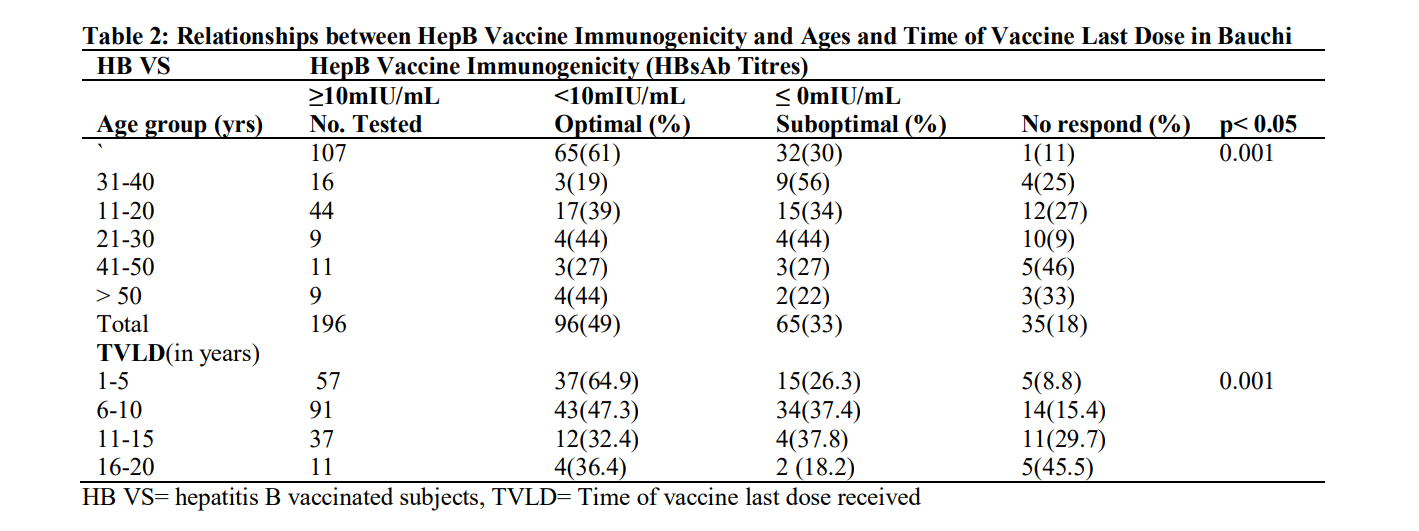
Hepatitis B Virus (HBV) infection is a major global public health concern. It contributes significantly to liver cirrhosis/hepatocellular carcinoma. The introduction of HBV vaccination into the national immunization program has reduced its incidence. Despite the vaccination, breakthrough infections remain a challenge. A cross-sectional study was carried out on one hundred and ninety-six vaccinated subjects within the ages of 1 year to 50 years, among both sexes who had received at least 2 doses of HB vaccine. The aim was to investigate the pattern of HB vaccine breakthrough infections with a focus on the relationship between immunogenicity and time of last dose of vaccine. The vaccine immunogenicity titre was determined by ELISA. The samples were screened for seromarkers; those positive for HBsAg were tested for HBV DNA and subsequently genotyped by Polymerase chain reaction. The result indicated that vaccinated individuals between the ages of 1-10 years had 61% vaccine optimal vaccine response, while subjects above 10 years had the lowest rate of vaccine response. Additionally, subjects who received the vaccine 1-5 years ago had 64.9% optimal vaccine response, whereas those who received their last dose more than 5 years ago showed a lower rate. Similarly, 3.5% vaccine breakthrough infection was detected, and all had mixed genotypes B and E. This implies that exposure to HBV genotypes B and E may cause breakthrough infection among vaccinated subjects. There is a need for diagnosing hepatitis B infection at the genotype level.
References
Abegaz, S. B. (2021). Human ABO Blood Groups and their Associations with Different Diseases. Biomedical Research International, 66(4), 41-50.
Ahmad, A. E., Bakari, A. G., Musa, B. O., Mustapha, S. K., Jamoh, B. Y., Abdullahi, I. N., Olatunji A. O., Maishanu, S. H., Suleman, A. B., Tolulupe, A., Hawkins, C., Sagay A. S., Zoakah, A. & Olayinka K. (2019). Pattern of prevalent hepatitis B viru genotypes in Zaria, Nigeria. Nigerian Postgraduate Medical Journal, 26(2), 80-86.
Centers for Diseases Control and Prevention. (2022). Universal Hepatitis B vaccination in adults Aged 19-59 years: Updated Recommendations of the Advisory Committee on Immunization Practices United States, Morbidity and mortality weekly Reports, 71(13); 477-483.
Chitnis, A. S., and Wong, R. J. (2024). Review of updated hepatitis B vaccine recommendations and potential challenges with implementation. Gastroenterology & Hepatology.
Cooling, L. (2015). Blood groups in infection and host susceptibility. Journal of Clinical Microbiology Review, 28(80), 850-870
El-Mowafy, M., Elegezy, M., El-Mesery, M., and Elgaml, A. (2024). Characterization of a breakthrough vaccine escape strain associated with overt hepatitis B virus Infection Virus Genes, 60(2), 235-239.
Esteve, Z. C., Betancourt A. A., Muzio Gonzalez V., Baile N. F., Silva, C. V., Bernal, F.H., Arias, E. P., Delhanty Fernandez, A. and Olazabal, N. M. (2019). Antibody Status. Psychosom Medicine, 64, 287-293.
Gong, X., Zheng, C., Fang, Q., Xu, W., and Yin, Z. (2024). Survey of hepatitis B vaccination coverage and surface antibody–positive rates in people aged 1–59 years in 2006 and 2024. Open Forum Infectious Diseases, 11(1), 45-51.
Inoue, T., and Tanaka, Y. (2020). Cross-protection of hepatitis B vaccination among different genotypes. Vaccines, 8(3), 456.
Konopleva, M. V., Borisova, V. N., Sokolova, M. V., Semenenko, T. A., & Suslov, A. P. (2022).Recombinant HBsAg of the wild type and the G145R escape mutant, included in the new multivalent vaccine against hepatitis B virus, dramatically differ in their effects on leukocytes from healthy donors in vitro. Vaccines, 10(2), 235.
Mahmood, M., Anwar M. A., Khanum, A., Zaman, N. and Raza A. (2016). Distribution and clinical significance of hepatitis B virus genotypes in Pakistan. BM Gastroenterology,16, 104.
Mironova, M., and Ghany, M. G. (2024). Hepatitis B vaccine: Four decades on. Vaccines, 12(4), Article 439. Olumuyiwa, O., Odusanya, Ewan Alufohai, Francois, P., Meurice & Vincent, I. Ahonkhai, (2011). Five-Year Post Vaccination Efficacy of Hepatitis B Vaccine in Rural Nigeria. Human Vaccines. 7(6), 625-629.
Oyinloye, S. O. and Bukbuk D. N. (2021). Molecular identification of genotypes of Hepatitis B virus in Borno State, Nigeria. African Journal of Microbiology Research, 15(2),101-106.
Oyinloye, S. O., Bukbuk, D. N. and Sanda, F. A. (2019). Surveillance of Hepatitis B Biomarkers in Borno State, Nigeria. Journal of Advances in Medicine and Medical Research, 28(10), 1-8.
Patel, E. U., Thio, C. L., Boon, D., Thomas, D. L. and Tobian, A. A. R. (2019). Prevalence of Hepatitis B and Hepatitis D Virus Infections in the United States, 2011-2016. Clinical Infectious Diseases, 2019 Jan 3.
Qiu, J., Zhang, S., Feng, Y., Su, X., Cai, J., Chen, S., Liu, J., Huang, S., Huang, H., Zhu, S., Wen, H., Li, J., Yan, H., Diao, Z., Liang, X., and Zeng, F. (2024). Efficacy and safety of hepatitis B vaccine: An umbrella review of meta analyses. Expert Review Review of Vaccines, 23(1), 69-81
Usman, A. B., Andrew, G. S., Safiyya, M., Sabo, E. F., Maryam, T., Abdullahi, H., and Hamid, K.M. (2024). Assessment of HBV breakthrough infection and anti-HBs antibody development among vaccinated individuals attending Specialist Hospital Sokoto. Bayero Journal of Medical Laboratory Science, 9(2), 45–53.
Wong, R. J., Brosgart, C. L. and Welch, S. (2021). An Updated Assessment of Chronic Hepatitis B Prevalence among Foreign Born Persons Living in the United States. Hepatology, 74, 607-26.
World Health Organization. (2018). Immunization surveillance, assessment and monitoring: Vaccine preventable diseases. Available at: http://apps.who.int/immunization monitoring/ diseases/en/.Accessed May, 2020.
World Health Organization. (2021). Fact sheet on Hepatitis B Global Immunization Coverage, (94)12-15.
Yang, S., Tian, G., Cui, Y., Ding, C., Deng, M., Yu, C., Xu, K., Ren, J., Yao, J., Li, Y., Cao, Q., Chen, P., Xie, T., Wang, C, Wang B, Mao C, Ruan B, Jiang T. and Li, L. (2016). Factors influence
Ye, X. (2023). Neutralization of hepatitis B virus with vaccine escape mutations by a large HBsAg vaccine construct. Nature. (Study demonstrating neutralization of escape variants by next generation constructs).
Zadeh Mehrizi, T., Eshrati, B., and Shahmabadi, H. E. (2025). Evaluation of recent pre booster studies on hepatitis B vaccine effectiveness across WHO regions with HBV prevalence above 1%. Archives of Virology, 170(193), 1-12.
Downloads
Published
Issue
Section
Categories
License
Copyright (c) 2026 Kyauta Mallam Thomas, Joshua B Bitrus, Mispha Titus, John Anthony

This work is licensed under a Creative Commons Attribution 4.0 International License.


