
EFFECTS OF LAND-BASED STRATEGIES FOR CLIMATE CHANGE MITIGATION, ADAPTATION ON MAIZE FARMER’S PRODUCTION: A STUDY OF WORLD BANK INTERVENTION IN NORTHWEST, NIGERIA
DOI:
https://doi.org/10.33003/fjs-2026-1008-4738Keywords:
sustainable land management, World Bank Intervention projects, Mitigation, Adaptation Climate Change, Technology AdoptionAbstract
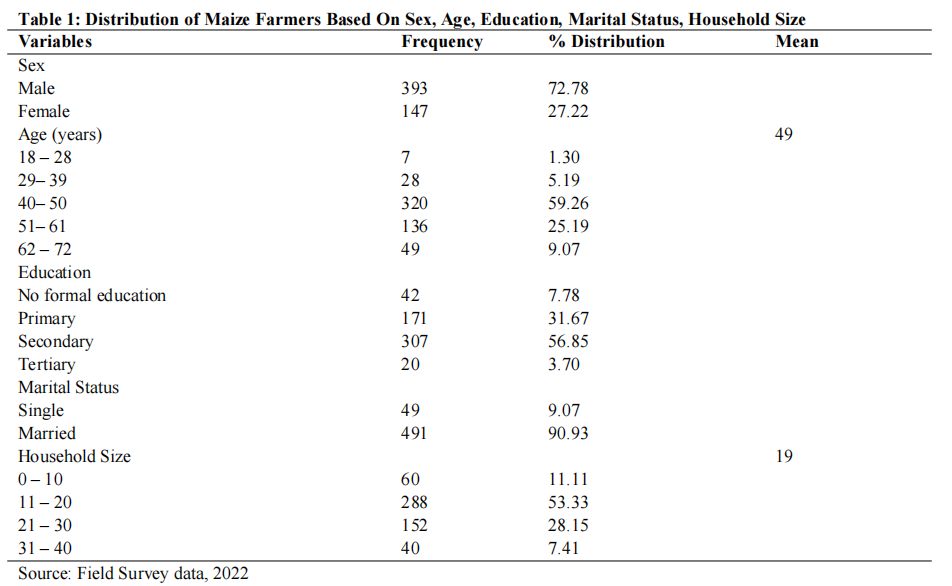
Farmers’ land-based decisions relating to climate change mitigation and adaptation depend on the major production motive: land conservation or revenue maximization. This study evaluates the effectiveness of World Bank-led land management strategies in mitigating climate change effects and enhancing adaptation among maize farmers in Northwest Nigeria. Multi-stage and purposive sampling techniques were employed; 540 maize farmers were randomly selected. The specific objectives; describe the sociocultural, determine the effects on maize farmer’s production output. Results showed that the decision option of 61% of the farmers with a mean farm size of 2.54 hectares and maize value of N3,071,185.70k were classified unsustainable, while the decision option of the remaining 39.44% were classified sustainable, with a mean farm size of 1.57 hectares and maize value of N1,209,461.95k. The percentage outputs as normalized by 1.56 hectares were 0% for sustainable land-based option and 56.95% for unsustainable land-based option. The coefficients of labour (-1.147) and amount spent on manual weeding (-3.926) of the estimated SUR equations for sustainable land-based decision option were negative and statistically significant at 1% level. Thus, stakeholders in sustainable land management in collaboration with World Bank should develop simple labour-saving, sustainable motorized weeding tools to encourage sustainable land-based practices in maize farming. Considering the high value of maize generated under unsustainable land-based decision option due to inorganic fertilizer use and the need to reduce greenhouse gas emission, extension workers and stakeholders in agronomy and soil management should educate farmers on yield enhancement through appropriate and efficient use of organic manure.
References
Adimassu, Z., Langan, S. & Johnston, R. (2016) Understanding determinants of farmers’ investments in sustainable land management practices in Ethiopia: review and synthesis. Environment, Development and Sustainability. (18), 1005-1023
Afolabi, E. A., Omokore, D. F., Yusuf, H. O., Oladimeji, Y. U., & Adejoh, S. O. (2025). Awareness of smart-media tools for agricultural extension utilisation among maize farmers in Nigeria. Nigerian Journal of Agriculture and Agricultural Technology (NJAAT), 5(1B), 10-18. ISSN (Online): 2811-1893. https://doi.org/10.59331/njaat.v5i3A
Ahmed, S., Kumar, V., Alam, M., Dewan, M.R., Bhuiyan, K.A., Miajy, A.A., Saha, A., Singh, S., Timsina, J. & Krupnik, T.J. (2021) Integrated weed management in transplanted rice: options for addressing labor constraints and improving farmers’ income in Bangladesh. Weed Technol. (35), 697–709. doi: 10.1017/ wet.2021.50
Altieri, M. A. & Nicholls, C. I. (2017) The adaptation and mitigation potential of traditional agriculture in a changing climate. Climatic Change 140(1), 33-45.
Amanchukwu, R.N., Amadi-Ali, T. & Ololube, N.P. (2015) Climate change education in Nigeria: The role of curriculum review. Education, 5(3), 71-79.
Amikuzuno, J. & Donkoh, S.A. (2012) Climate variability and yields of major staple food crops in Northern Ghana. African Crop Science Journal, 20(2), 349-360.
Amponsah, S. K., Addo, A., Dsisi, K., Asante B., & Afona, D. (2018). Assessment of rice farmers’ knowledge and perception of harvest and postharvest losses in Ghana. Cogent Food & Agriculture, 4(1). https://doi.org/10.1080/23311932.2018.1471782
Anyola, N.O., Nnadi, F.N., Chikaire, J., Echetama, J.A., Utazi, C.O. & Iheanacho, R. A. (2013) Socio-economic Factors Influencing Climate Change Adaptation among Crop Farmers in Umuahia South Area of Abia State, Nigeria. Net Journal of Agricultural Science,1(2), 42-47.
Awoyemi A. O., & Aderinoye-Abdulwahab S. A. (2019). Assessment of the use of cocoa production management practices among cocoa farmers in Ekiti State, Nigeria Agro- Science, Journal of Tropical Agriculture, Food, Environment and Extension,18(2), 37- 41. https://dx.doi.org/10.4314/as.v18i2.7
Bolarin, O., Adebayo, S. A., Akubo, R. A., & Komolafe, S. E. (2022). Perceived effectiveness of Japan international cooperation agency– rice processing technologies utilisation among rice processors in Kogi State, Nigeria. SVU-International Journal of Agricultural Sciences, 4(3), 58-67. doi:10.21608/svuijas.
Branca, G., Lipper, L., McCarthy, N. & Jolejole, M.C. (2013). Food security, climate change, and sustainable land management: A review. Agronomy for Sustainable Development, 33(4):635–650.
Ciscar, J.C., Ruiz, D.I., Ramirez, A.S. & Dosio, A. Climate impacts in Europe: Final report of the JRC PESETA III project, JRC Science for Policy Report, Publications Office of the European Union, Luxembourg. 2018. Available at: http://doi.org/10.2760/93257 (Last accessed 29 November 2018)
Eagle, A.J., Olander, P.L., Henry, L.R., Haugen-Kozyra, K., Millar, N. & Robertson, G.P. (2012). Greenhouse gas mitigation potential of agricultural land management in the united states: A synthesis of the literature, Nicholas Institute for Environmental Policy Solutions, Duke University, North Carolina
Eririogu, I. H., Mevayekuku, E. D., Echebiri, R. N., Atama, A., Amanze, P. C. & Olumba, U. M. (2019). Income Diversification and Sustainable Land Management Practices among Rural Cassava-based Farmers in Imo State. Journal of Agriculture and Ecology Research International, 18(3), 1-14
Eyshi Rezaei, E., Webber, H., Gaiser, T., Naab, J. & Ewert, F. (2015) Heat stress in cereals: Mechanisms and modelling. European Journal of Agronomy, (64), 98 113.
Food and Agriculture Organization (2021). FAOSTAT. Food and Agriculture Organization, Database Results. Available at: https://www.fao.org/faostat/en/#data/QCL
Gambo, A., Gwadabe, B.K. & Kwanga, C.N. (2015) Economic analysis of dry season maize production in Kano and Kaduna States. Available at: https://www.saa- safe.org/elfiles/GIAnlFQJ/Economic%20analysis%20of%20dry%20season%20maize%2 0production%20in%20Kano%20and%20Kaduna%20States.pdf
Islam, A. K. M. M., Hia, M. A. U. H., Sarkar, S. & Anwar, M.P. (2018) Herbicide based weed management in aromatic rice of Bangladesh. Journal of Bangladesh Agric. University. (16), 31-40
Jaja, E.T. & Barber, L. I. (2017). Organic and Inorganic Fertilizers in Food Production System in Nigeria. Journal of Biology, Agriculture and Healthcare, 7 (18), 51-55
Kassie, G.W. (2016) The nexus between livelihood diversification and farmland management strategies in rural Ethiopia. Cogent Economics and Finance. 5:1275087.
Available at: http://dx.doi.org/10.1080/23322039.2016.1275087.
Khanal, U., Clevo, W., Boon, L. & Viet-Ngu. H. (2018). Do Climate Change Adaptation Practices Improve Technical Efficiency of Smallholder Farmers? Evidence from Nepal. Climatic Change, 147, 3–4:507–21.
Kolade, O., & Harpham, T. (2014). Impact of cooperative membership on farmers' uptake of technological innovations in Southwest Nigeria. Development Studies Research, 1(1), 340-353. https://doi.researchgate.net/publication/266911641
Liava, V., Karkanis, A., Danalatos, N., Tsiropoulos, N. (2022) Effects of Two Varieties and Fertilization Regimes on Growth, Fruit, and Silymarin Yield of Milk Thistle Crop. Agronomy, (12), 105: 1-13. https:// doi.org/10.3390/agronomy12010105
Liniger, H. P., Gurtner, M., Studer, R. M., & Hauert, C. Sustainable land management in practice - Guidelines and best practices for Sub-Saharan Africa. TerrAfrica, World Overview of Conservation Approaches and Technologies (WOCAT) and Food and Agriculture Organization of the United Nations (FAO). 2011. Rome, Italy, FAO.
Lokonon, B. O. K., & Mbaye A. A. (2018). Climate change and adoption of sustainable land management practices in the Niger basin of Benin. Natural Resources Forum, (42), 42–53
Mengistu, D., Bewket, W., & Lal, R. (2015). Conservation Effects on Soil Quality and Climate Change Adaptability of Ethiopian Watersheds. Land Degradation and Development, 10.1002/ldr.2376, n/a-n/a.
Mohammed, U. A., Ibrahim, S., Hayatu, M., & Mohammed, F. A. (2019) Rice (Oryza Sativa L.) Production in Nigeria: Challenges and prospects. Dutse Journal of Pure and Applied Sciences (DUJOPAS), 5 (2b), 67-75
National Agricultural Research Strategy Plan (NARSP). (1997). Nigerian National Agricultural Research Strategy Plan: 1996-2010. Bukar, S., Adamu, A and Bakshi, J.S. (Eds.). Department of Agricultural Sciences, Federal Ministry of Agriculture and Natural Resources. Abuja. Nigeria. Ibadan, African Intec Printers 335.
Ndagana, M. K., Salihu, I. T., & Dauda, U. (2020). Determinants of adoption of improved sorghum varieties (Sorghum Bicolor) among households in Niger State, Nigeria. Nigerian Agricultural Journal, 51(1), 189-194. http://www.ajol.info/index.php/naj
Nedessa, B., Yirga, A., Seyoum, L., & Gebrehawariat, G. (eds.). (2015). A Guideline on Documentation of Sustainable Land Management Best Practices in Ethiopia. Ministry of Agriculture, Natural Resource Sector. Addis Ababa, Ethiopia, Addis Ababa, Ethiopia: Ministry of Agriculture, Natural Resource Sector.
Nenna, M. G. (2020). Assessment of information and communication technologies (ICTs) among cassava farmers in Anambra State, Nigeria. British Journal of Research. 3(2), 2394 – 3718.
Nkonya, E., Mirzabaev, A., & von Braun. J. (2016). Economics of land degradation and improvement: An introduction and overview. Economics of Land Degradation and Improvement: A Global Assessment for Sustainable Development. Washington, DC. IFPRI, 2016.
Olaniyi, O. A., & Ismaila, K. (2016). Information and communication technologies (ICTS) usage and household food security status of maize crop farmers in Ondo State, Nigeria: Implication for sustainable development. Library Philosophy and Practice (e-journal), 1446. https://doi.researchgate.net/publication/309853548
Oseni, T. O., & Masarirambi, M. T. (2011). Effect of climate change on maize (Zea mays) production and food security in Swaziland. American-Eurasian Journal of Agriculture and Environment Science, 11(3),385-391.
Omoare, A. M., & Oyediran, W. O. (2015). A Survey on the perception of residents of iwajowa L.G.A. of Oyo state on the contribution of charcoal production to deforestation and environmental degradation. Journal of Changes in the Environment: Strategies for its Sustainability, A Production of Department of Biology, Adeyemi College of Education, Ondo State
Oyerinde, O.V., & Osanyande, O.V. (2010). Farmers adaptation strategies and Idanre Forest Resources, Ondo State, Nigeria. In: Climate Change and Forest Resources Management: the way forward. A Proceeding of the 2nd Biennial National Conference of the Forest and Forest Product Society, Federal University of Technology, Akure, Nigeria, 233-237.
Price, A. J., & Norsworthy, J. K. (2013). Cover crops for weed management in Southern reduced-tillage vegetable cropping systems. Weed Technology, 27(1),212–17.
Raimi, A., Adeleke, R. & Ashira, R.A. (2017) Soil fertility challenges and Bio fertilizer as a viable alternative for increasing smallholder farmer crop productivity in sub-Saharan Africa. Cogent Food & Agriculture, 3(1), 1400933
Rosegrant, M. W., Ewing, M., Yohe, G., Burton, I., Huq, S., & Valmonte-Santos, R. (2008). Climate change and agriculture: Threats and opportunities Deutsche Gesellschaftfür TechnischeZusammenarbeit (GTZ) GmbH Climate Protection Programme for Developing Countries Postfach 5180 65760 Eschborn / Germany. pp 1-32
Shrestha, M., Garcia, J. E., Bulkovac, Z., Dorin, A., & Dyer, A. G. (2018). Pollination in a new climate: Assessing the potential influence of flower temperature variation on insect pollinator behaviour', Plos one 13(8), e0200549. https://doi.org/10.1371/ journal. pone.0200549).
Sultana, M., Jahiruddin, M., Islam, M. R., Rahman, M. M., Abedin, M. A., & Solaiman, Z. M. (2021). Nutrient enriched municipal solid waste compost increases yield, nutrient content and balance in rice. Sustainability, (13), 1047.
Tangonyire, D. F., & Akuriba, G. A. (2020). Socioeconomic factors influencing farmers’ specific adaptive strategies to climate change in Talensi district of the Upper East Region of Ghana. Ecofeminism and Climate Change, 2633-4062
United Nations Environment Programme (UNEP). (2016). Annual report empowering people to protect the planet, United Nations Environment Programme. Available at: https://wedocs.unep.org/bitstream/handle/20.500.11822/19529/UN%20Environment%20 2016%20Annual%2 0Report. pdf?sequence=1and isAllowed=y).
Urmi, T. A., Rahman, M. M., Islam, M. M., Islam, M. A., Jahan, N. A., Mia, M. A. B, Akhter, S., Siddiqui, M. H., & Kalaji, H. M. (2022). Integrated nutrient management for rice yield, soil fertility, and carbon sequestration. Plants, (11), 138: 1-17.
Woodfine, A. (2009). Using sustainable land management practices to adapt to and mitigate climate change in sub-Saharan Africa: Resource guide version 1.0. TerrAfrica. Available at: www.terrafrica.org.
Yegbemey, R. N., Kabir, H., Awoye, H. R., Yabi, J. A., & Paraiso, A.A. (2014) Managing the agricultural calendar as coping mechanism to climate variability: A case study of maize farming in northern Benin, West Africa', Climate Risk Management, (3), 13 23.
Zaman, M. M., Rahman, M. A., Chowdhury, T., & Chowdhury, M. A. H. (2018). Effects of combined application of chemical fertilizer and vermicompost on soil fertility, leaf yield and stevioside content of stevia. Journal of Bangladesh Agric. University, (16), 73–81
Zellner, A. (2006). Seemingly unrelated regressions H. G. B. Alexander Research Foundation Graduate School of Business University of Chicago. Prepared for the International Encyclopedia of Social Sciences. Paper 0601.
Zhou, Z., Zhai, P., Chen, Y., & Rong Yu. (2018). Projected changes of thermal growing season over Northern Eurasia in a 1.5 °C and 2 °C warming world, Environmental Research Letters 13, 3.
Downloads
Published
Issue
Section
Categories
License
Copyright (c) 2026 Alexander Abine Atama, OTARU, A. O., Amanabo, S. O., Akuh, O. I., Afolabi, E. A.

This work is licensed under a Creative Commons Attribution 4.0 International License.


