
Occurrence and Characterisation of Microplastics in Fish Tissues and Water from Yusuf Bage River, Unguwar Rimi, Kaduna State, Nigeria
DOI:
https://doi.org/10.33003/fjs-2026-1020-6266Keywords:
Microplastics, Polyethylene, Yusuf Bage River, Nigeria, Polymer identification, Freshwater fishAbstract
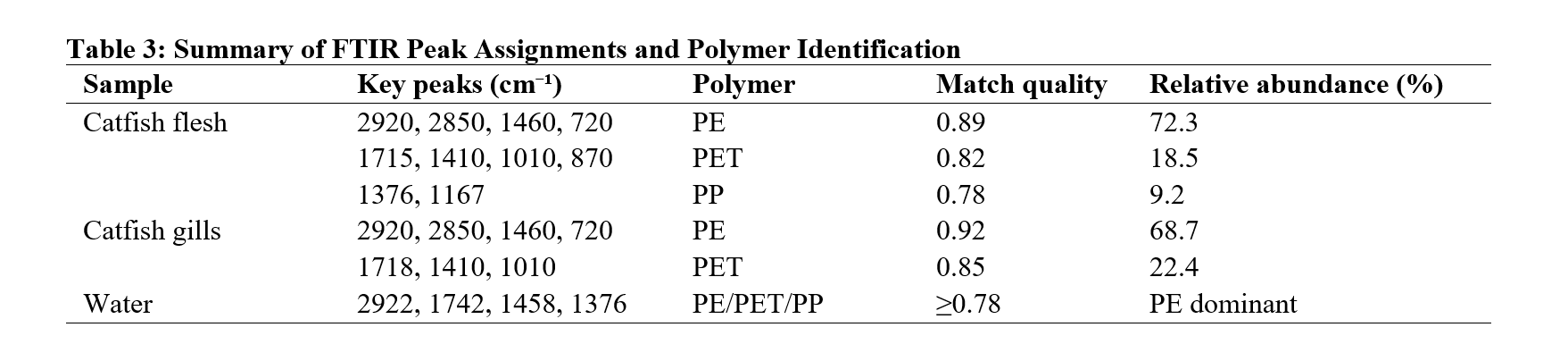
Microplastic pollution in freshwater systems is a growing environmental concern with potential implications for aquatic organisms and human consumers through the food chain. This study assessed the occurrence and characteristics of microplastics (MPs) in fish tissues and water samples collected from Yusuf Bage River, near Unguwar Rimi, Kaduna State, Nigeria. A total of 18 fish specimens (n = 6 per species) comprising African catfish (Clarias gariepinus), Nile tilapia (Oreochromis niloticus) and silver moony (Monodactylus sebae), together with six water samples, were collected in May 2025. Fish tissues (flesh, gills and intestine) and water samples were subjected to potassium hydroxide (KOH) digestion, density separation, stereomicroscopic enumeration, Attenuated Total Reflectance Fourier Transform Infrared (ATR-FTIR) spectroscopy and Scanning Electron Microscopy (SEM). FTIR spectra indicated dominant polyethylene (PE) signatures (CH₂ rocking at 720–730 cm⁻¹), with contributions from polyethylene terephthalate (PET) and polypropylene (PP), confirmed by library match quality factors ≥ 0.75. SEM revealed irregular fragments, fibres and sheet-like particles with sharp edges and weathering features. Microplastics were present in all tissues and water, with mean abundances ranging from 2.3 ± 0.8 to 8.7 ± 2.1 particles/g wet weight in fish tissues and 45.3 ± 12.6 particles/L in water. Higher abundances were observed in gills (5.8–8.7 particles/g) and intestine (4.2–7.1 particles/g) compared with flesh (2.3–3.8 particles/g). Findings document measurable microplastic contamination in this urban-influenced river and provide a baseline for future monitoring and management.
References
Adewuyi, A. (2024). Emergence of microplastics in African environmental drinking water sources. Water Resources and Industry, 31, Article 100066. https://doi.org/10.1016/j.wri.2024.100066
Akindele, E. O., Ehlers, S. M., & Koop, J. H. E. (2019). First empirical study of freshwater microplastics in West Africa using gastropods from Nigeria as bioindicators. Limnologica, 78, Article 125708. https://doi.org/10.1016/j.limno.2019.125708
Akindele, E. O., Ehlers, S. M., & Koop, J. H. E. (2020). Freshwater insects of different feeding guilds ingest microplastics in two Gulf of Guinea tributaries in Nigeria. Environmental Science and Pollution Research, 27, 30463–30474. https://doi.org/10.1007/s11356-020-08763-8
Andrady, A. L. (2011). Microplastics in the marine environment. Marine Pollution Bulletin, 62(8), 1596–1605. https://doi.org/10.1016/j.marpolbul.2011.05.030
Cox, K. D., Covernton, G. A., Davies, H. L., Dower, J. F., Juanes, F., & Dudas, S. E. (2019). Human consumption of microplastics. Environmental Science & Technology, 53(12), 7068–7074. https://doi.org/10.1021/acs.est.9b01517
Dahms, H. T., van Rensburg, G. J., & Greenfield, R. (2020). The microplastic burden in selected fish species from the Vaal River, South Africa. Water, Air, & Soil Pollution, 231, Article 1–12. (Adapted from related South African river studies.)
Dawson, A. L., Santana, M. F. M., Miller, M. E., & Kroon, F. J. (2020). Solving a sticky situation: Microplastic analysis of lipid-rich fish tissues. Frontiers in Environmental Science, 8, Article 563565. https://doi.org/10.3389/fenvs.2020.563565
Deng, Y., Zhang, Y., Lemos, B., & Ren, H. (2017). Tissue accumulation of microplastics in mice and biomarker responses suggest widespread health risks of exposure. Scientific Reports, 7, Article 46687. (Note: related oxidative-stress literature.)
Ehlers, S. M., Manz, W., & Koop, J. H. E. (2019). Microplastics of different characteristics are incorporated into the larval cases of the freshwater caddisfly Lepidostoma basale. Aquatic Biology, 28, 67–77. https://doi.org/10.3354/ab00711
Food and Agriculture Organization of the United Nations. (2020). The state of world fisheries and aquaculture 2020. FAO. https://doi.org/10.4060/ca9229en
Foekema, E. M., De Gruijter, C., Mergia, M. T., van Franeker, J. A., Murk, A. J., & Koelmans, A. A. (2013). Plastic in North Sea fish. Environmental Science & Technology, 47(15), 8818–8824. https://doi.org/10.1021/es4009317
Hassan, S., et al. (2025). Distribution and abundance of microplastics in the water, sediment, and some freshwater animals, Nile River, Upper Egypt. Water, Air, & Soil Pollution, 236, Article 8653. https://doi.org/10.1007/s11270-025-08653-0
Lusher, A. L., Welden, N. A., Sobral, P., & Cole, M. (2017). Sampling, isolating and identifying microplastics ingested by fish and invertebrates. Analytical Methods, 9(9), 1346–1360. https://doi.org/10.1039/C6AY02415G
Ndibe, L., et al. (2023). Abundance and seasonal variation of microplastics detected in edible fish sold in Lagos State, Nigeria. African Journal of Environment and Natural Science Research, 6(3), 158–168.
Olarinmoye, O. M., et al. (2020). Microplastic pollution in Osun River, Nigeria. Journal of Environmental Chemical Engineering, 8(5), Article 104215.
Rochman, C. M., Hoh, E., Kurobe, T., & Teh, S. J. (2013). Ingested plastic transfers’ hazardous chemicals to fish and induces hepatic stress. Scientific Reports, 3, Article 3263. https://doi.org/10.1038/srep03263
Thompson, R. C., Olsen, Y., Mitchell, R. P., Davis, A., Rowland, S. J., John, A. W. G., McGonigle, D., & Russell, A. E. (2004). Lost at sea: Where is all the plastic? Science, 304(5672), 838. https://doi.org/10.1126/science.1094559
Veerasingam, S., Ranjani, M., Venkatachalapathy, R., Bagaev, A., Mukhanov, V., Litvinyuk, D., & Vethamony, P. (2021). Contributions of Fourier transform infrared spectroscopy in microplastics research. Critical Reviews in Environmental Science and Technology, 51(23), 2681–2710. https://doi.org/10.1080/10643389.2020.1807450
Wright, S. L., Thompson, R. C., & Galloway, T. S. (2013). The physical impacts of microplastics on marine organisms: A review. Environmental Pollution, 178, 483–492. https://doi.org/10.1016/j.envpol.2013.02.031
Wright, S. L., & Kelly, F. J. (2017). Plastic and human health: A micro issue? Environmental Science & Technology, 51(12), 6634–6647. https://doi.org/10.1021/acs.est.7b00423
Downloads
Published
Issue
Section
Categories
License
Copyright (c) 2026 Saidu Garba, Ummu-Khulsum, Karege, Malumfashi

This work is licensed under a Creative Commons Attribution 4.0 International License.