
Suitability Evaluation of Selected Soils for Rice Cultivation in Riggi, Lau Local Government Area, Taraba State, Nigeria
DOI:
https://doi.org/10.33003/fjs-2026-1020-6251Keywords:
Soil properties, Rice production, Land suitability, FAO framework, Bulk density, Soil fertility, Taraba StateAbstract
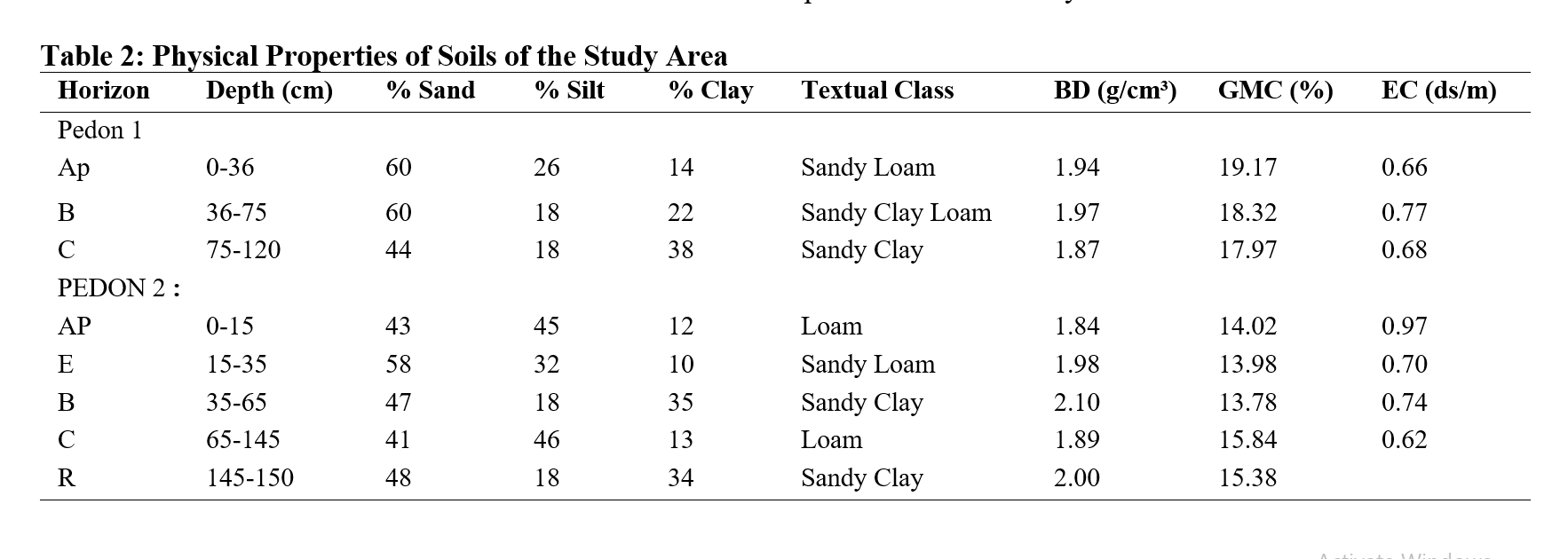
This study evaluated the suitability of selected soils for rice cultivation in Riggi, Lau Local Government Area, Taraba State, Nigeria. Two representative pedons were examined for their morphological, physical, and chemical properties to determine their potential for sustainable rice production. Results revealed significant variability between the pedons. Pedon 3 exhibited a near-neutral slightly acidic pH (6.00-6.20), moderate organic carbon, and very high cation exchange capacity (95.49-99.10 cmol/kg), but was severely constrained by critically low available phosphorus (1.18-3.41 mg/kg), dominance of exchangeable acidity (over 95% of ECEC), and high bulk density (1.87-1.97 g/cm³). Pedon 6 slightly showed alkaline pH (7.23-7.38), very low organic matter and total nitrogen, low available phosphorus (1.54-7.37 mg/kg), and severe compaction (bulk density up to 2.10 g/cm³). Electrical conductivity values were low across both pedons, indicating no salinity constraints. Based on the FAO framework, both pedons were classified as marginally suitable (S3) for rice cultivation due to multiple physical and chemical limitations. The study concludes that while the soils have potential for rice production, they require site-specific management interventions including phosphorus fertilization, organic matter incorporation, liming for Pedon 3, and amelioration of alkalinity for Pedon 6 to achieve sustainable productivity of the crop.
References
Adamu, A., & Aliyu, B. (2012). Land evaluation for irrigated rice production in Argungu area of Kebbi State, Nigeria. Savanna Journal of Agriculture, 7(1), 23–32.
Adeboye, O. B., Osunbitan, J. A., Adekalu, K. O., & Okunade, D. A. (2011). Evaluating the effects of irrigation systems on soil and rice yield in Nigeria. Agricultural Water Management, 98(9), 1517–1521. https://doi.org/10.1016/j.agwat.2011.04.005
Adejuwon, J. O., Ekanade, O., & Ibe, A. C. (2011). Effects of land use on soil properties in southwestern Nigeria. Journal of Soil Science and Environmental Management, 2(5), 132–138.
Akinbola, G. E., & Adetunji, M. T. (2002). Land suitability classification of some soils for rainfed rice production in south western Nigeria. Moor Journal of Agricultural Research, 3(2), 196–203.
Akinrinde, E. A., & Obigbesan, G. O. (2000). Evaluation of the fertility status of selected soils for crop production in five ecological zones of Nigeria. In Proceedings of the 26th Annual Conference of the Soil Science Society of Nigeria (pp. 279–288).
Aliyu, A., & Tanimu, M. A. (2021). Land suitability evaluation for rice production in Lau Local Government Area, Taraba State, Nigeria. Journal of Agronomy and Soil Science, 9(2), 112–120.
Aliyu, L., Ibrahim, S., Abubakar, I. U., & Bello, A. (2016). Suitability evaluation and fertility status of some soils for lowland rice production in Sokoto State, Nigeria. Nigerian Journal of Soil and Environmental Research, 14, 96–103.
Aondover, P., Amana, S. M., & Tyohemba, R. L. (2020). Soil suitability assessment for rice and maize production in parts of Benue State, Nigeria. Nigerian Journal of Soil Science, 30(1), 15–22.
Ayanlade, A., Drake, N., & Oloyede, M. O. (2015). GIS-based land suitability analysis for rice production in Nigeria. Journal of Environmental Management, 154, 131–141. https://doi.org/10.1016/j.jenvman.2015.02.028
Bouman, B. A. M., Humphreys, E., Tuong, T. P., & Barker, R. (2007). Rice and water. Advances in Agronomy, 92, 187–237. https://doi.org/10.1016/S0065-2113(04)92004-4
Brady, N. C., & Weil, R. R. (2016). The nature and properties of soils (15th ed.). Pearson.
Buresh, R. J., & De Datta, S. K. (1991). Nitrogen dynamics and management in rice–legume cropping systems. Advances in Agronomy, 45, 1–59. https://doi.org/10.1016/S0065-2113(08)60070-1
Dobermann, A., & Fairhurst, T. H. (2000). Rice: Nutrient disorders and nutrient management. International Rice Research Institute and Potash & Phosphate Institute.
Esu, I. E. (1999). Fundamentals of pedology. University of Ibadan Press.
Esu, I. E. (2010). Soil characterization, classification and survey. HEBN Publishers Plc.
Ezeaku, P. I. (2011). Methodologies for agricultural land-use planning: Sustainable soil management and productivity. Great AP Express Publishers.
Ezeaku, P. I., & Asadu, C. L. A. (2010). Soil quality and sustainable crop production in the Nigerian Guinea Savanna: Challenges and prospects. *Agro-Science, 9*(1), 15–22. https://doi.org/10.4314/as.v9i1.61155
Fageria, N. K. (2007). Green manuring in crop production. Journal of Plant Nutrition, 30(4), 691–719. https://doi.org/10.1080/01904160701289529
Fageria, N. K., Slaton, N. A., & Baligar, V. C. (2003). Nutrient management for improving lowland rice productivity and sustainability. Advances in Agronomy, 80, 63–152. https://doi.org/10.1016/S0065-2113(03)80003-9
FAO. (1976). A framework for land evaluation (Soils Bulletin No. 32). Food and Agriculture Organization of the United Nations.
FAO. (2006). Guidelines for soil description (4th ed.). Food and Agriculture Organization of the United Nations.
FAO. (2020). Conservation agriculture for sustainable intensification. Food and Agriculture Organization of the United Nations. https://www.fao.org
Gee, G. W., & Bauder, J. W. (1986). Particle-size analysis. In A. Klute (Ed.), Methods of soil analysis: Part 1. Physical and mineralogical methods (2nd ed., pp. 383–411). American Society of Agronomy, Soil Science Society of America.
Gee, G. W., & Or, D. (2002). Particle-size analysis. In J. H. Dane & G. C. Topp (Eds.), Methods of soil analysis: Part 4. Physical methods (pp. 255–293). Soil Science Society of America.
Ghosh, A., Saha, B., & Nath, C. P. (2016). Soil conservation practices in rice-based systems: Implications for sustainable productivity. Soil and Tillage Research, 157, 172–180. https://doi.org/10.1016/j.still.2015.11.008
Haefele, S. M., Nelson, A., & Hijmans, R. J. (2014). Soil quality and constraints in global rice production. Geoderma, 235–236, 250–259. https://doi.org/10.1016/j.geoderma.2014.07.019
Harris, R. W. (1990). Root growth in relation to soil physical conditions. In B. A. Stewart (Ed.), Advances in soil science (Vol. 12, pp. 23–57). Springer.
IRRI. (2018). Rice knowledge bank. International Rice Research Institute. https://www.irri.org
IUSS Working Group WRB. (2015). World reference base for soil resources 2014, update 2015: International soil classification system for naming soils and creating legends for soil maps (World Soil Resources Reports No. 106). FAO.
Jagadamma, S., Lal, R., & Hoeft, R. G. (2009). Nitrogen fertilization and cropping system impacts on soil organic carbon and total nitrogen pools under chisel–disk tillage in Illinois. Soil and Tillage Research, 102(1), 120–128. https://doi.org/10.1016/j.still.2008.08.004
Kato, Y., Okami, M., & Katsura, K. (2011). Yield potential and water use efficiency of aerobic rice: Responses to nitrogen application in different water regimes. Field Crops Research, 122(1), 34–39. https://doi.org/10.1016/j.fcr.2011.02.003
Lal, R. (1997). Degradation and resilience of soils. Philosophical Transactions of the Royal Society B: Biological Sciences, 352(1356), 997–1010.
Lal, R. (2001). Soil degradation by erosion. Land Degradation & Development, 12(6), 519–539. https://doi.org/10.1002/ldr.472
Lal, R. (2006). Enhancing crop yields in the developing countries through restoration of soil organic carbon pool in agricultural lands. Land Degradation & Development, 17(2), 197–209. https://doi.org/10.1002/ldr.696
Landon, J. R. (Ed.). (1991). Booker tropical soil manual: A handbook for soil survey and agricultural land evaluation in the tropics and subtropics. Longman Scientific and Technical.
Meek, B. D., Rechel, E. A., Carter, L. M., DeTar, W. R., & Urie, A. L. (1992). Infiltration rate as affected by traffic and soil bulk density. Soil Science Society of America Journal, 56(3), 908–913.
Mohammed, U., Abubakar, S. M., & Tanko, A. (2019). Evaluation of upland rice varieties under rainfed conditions in Lafia, Nasarawa State. Tropical Agriculture Research Journal, 10(2), 60–68.
Morris, L. A., & Lowery, R. F. (1988). Influence of site preparation on soil conditions affecting stand establishment and tree growth. Southern Journal of Applied Forestry, 12(3), 170–178.
Nwaka, E. C., Okonkwo, C. I., & Igwe, C. A. (2014). Suitability of acid soils of southeastern Nigeria for upland rice production. Journal of Agriculture and Environment, 15(2), 88–96.
Ogban, P. I., & Babalola, O. (2003). Characteristics and rice suitability of some inland valley soils in Cross River State, Nigeria. Nigerian Agricultural Journal, 34, 1–9.
Ogunwale, J. A., Olaniyan, J. O., & Aduloju, M. O. (2002). Morphological, physicochemical and clay mineralogical properties of soils overlying basement complex rocks in Ilorin East, Nigeria. Moor Journal of Agricultural Research, 3(2), 147–154.
Ojeniyi, S. O. (2000). Effects of land use on soil properties in a tropical Alfisol. Journal of Soil Science and Environmental Management, 1(1), 1–6.
Okogun, J. A., Chude, V. O., & Ayeni, A. O. (2015). Integrated soil fertility management for rice production in Benue State, Nigeria. African Journal of Agricultural Research, 10(12), 1450–1460. https://doi.org/10.5897/AJAR2014.9321
Okon, M. A., Udo, I. A., & Akpan, U. S. (2020). Effects of fertilizer management on rice yield and soil fertility. Nigerian Journal of Agriculture, Food and Environment, 16(1), 101–107.
Pathak, H., Tewari, A. N., Sankhyan, S., Dubey, D. S., Mina, U., & Singh, V. K. (2011). Direct-seeded rice: Potential, performance and problems – A review. Current Advances in Agricultural Sciences, 3(2), 77–88.
Prasad, R., & Power, J. F. (1997). Soil fertility management for sustainable agriculture. CRC Press.
Rhoades, J. D. (1982). Cation exchange capacity. In A. L. Page, R. H. Miller, & D. R. Keeney (Eds.), Methods of soil analysis: Part 2. Chemical and microbiological properties (2nd ed., pp. 149–157). American Society of Agronomy.
Safo-Kantanka, O., & Ofori, C. S. (2012). Water management practices and rice yield in Northern Ghana. Ghana Journal of Agricultural Science, 45, 21–30.
Soil Survey Staff. (2014). Keys to soil taxonomy (12th ed.). USDA-Natural Resources Conservation Service.
Sys, C. (1985). Land evaluation. State University of Ghent.
Sys, C., Van Ranst, E., & Debaveye, J. (1991). Land evaluation: Part I. Principles in land evaluation and crop production calculations (Agricultural Publications No. 7). General Administration for Development Cooperation.
Timsina, J., & Connor, D. J. (2001). Productivity and management of rice–wheat cropping systems: Issues and challenges. Field Crops Research, 69(2), 93–132. https://doi.org/10.1016/S0378-4290(00)00143-X
Tuong, T. P., & Bouman, B. A. M. (2003). Rice production in water-scarce environments. In J. W. Kijne, R. Barker, & D. Molden (Eds.), Water productivity in agriculture: Limits and opportunities for improvement (pp. 53–67). CABI Publishing.
Usman, J., Mohammed, A., & Iliya, A. (2020). Soil suitability evaluation for rice production in Lau Local Government Area of Taraba State. Nigerian Journal of Soil Science, 30(1), 145–155.
Vanlauwe, B., Bationo, A., Chianu, J., Giller, K. E., Merckx, R., Mokwunye, U., Ohiokpehai, O., Pypers, P., Tabo, R., Shepherd, K. D., Smaling, E. M. A., Woomer, P. L., & Sanginga, N. (2010). Integrated soil fertility management: Operational definition and consequences for implementation and dissemination. Outlook on Agriculture, 39(1), 17–24. https://doi.org/10.5367/000000010791169998
Vanlauwe, B., Descheemaeker, K., Giller, K. E., Huising, J., Merckx, R., Nziguheba, G., & Zingore, S. (2015). Integrated soil fertility management in sub-Saharan Africa: Unravelling local adaptation. Soil, 1(1), 491–508. https://doi.org/10.5194/soil-1-491-2015
Van Reeuwijk, L. P. (2002). Procedures for soil analysis (6th ed.). International Soil Reference and Information Centre.
Zhang, H., Wang, B., Xu, M., Fan, M., & Zhang, F. (2012). Crop yield and soil carbon responses to tillage and fertilization in a rice–wheat rotation system. Plant and Soil, 361(1), 181–191.
Downloads
Published
Issue
Section
Categories
License
Copyright (c) 2026 Adamu Aliyu Muhammad, Yaseer Khallah Ibrahim, James Mono Galadima

This work is licensed under a Creative Commons Attribution 4.0 International License.