
Targeting Oxidative Stress Pathways for Improved Tuberculosis Treatment Outcomes
DOI:
https://doi.org/10.33003/fjs-2026-1019-6181Keywords:
Oxidative stress, Mycobacterium tuberculosis, Drug resistance, Redox regulators, Host-directed therapyAbstract
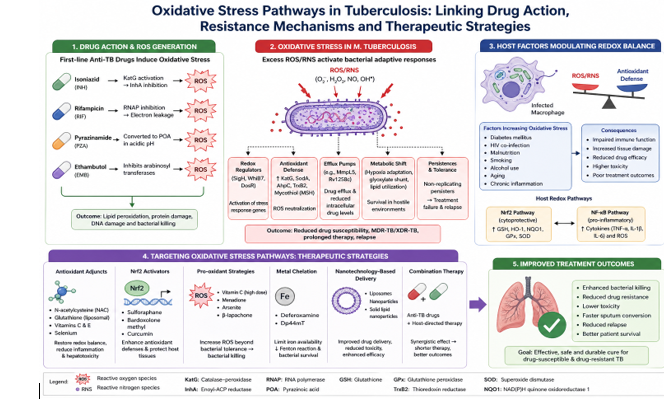
Tuberculosis (TB) treatment remains challenged by prolonged therapy, drug resistance, and host–pathogen interactions driven by oxidative stress. This review examines oxidative stress not as a uniformly pathogenic process but as a cause, consequence, and mediator of TB pathology, drug response, and therapeutic outcome in Mycobacterium tuberculosis infection. Reactive oxygen and nitrogen species (ROS/RNS) generated by host phagocytes contribute to antimicrobial activity and are integral to the activation of key anti-TB prodrugs such as isoniazid and pyrazinamide. However, excessive or sustained oxidative stress promotes bacterial adaptation through redox-sensitive regulators, including SigH and WhiB7, which enhance antioxidant defences, efflux pump activity, and phenotypic persistence, and may contribute to, but do not alone determine, disease reactivation. Host redox imbalance, exacerbated by comorbidities such as diabetes and HIV, further impairs drug efficacy and increases toxicity. Emerging host-directed therapies, including N-acetylcysteine, glutathione supplementation, and Nrf2 modulators, aim to restore redox homeostasis and improve treatment outcomes. Targeting the oxidative stress–resistance axis therefore represents a promising, though still evolving, strategy for combating multidrug-resistant tuberculosis and optimising therapeutic success.
References
Amaral, E. P., Costa, D. L., Namasivayam, S., Riteau, N., Kamenyeva, O., Mittereder, L., Mayer-Barber, K. D., Andrade, B. B., and Sher, A. (2019). A major role for ferroptosis in Mycobacterium tuberculosis-induced cell death and tissue necrosis. Journal of Experimental Medicine, 216(3), 556–570. https://doi.org/10.1084/jem.20181776
Amaral, E. P., Vinhaes, C. L., Oliveira-de-Souza, D., Nogueira, L., and Andrade, B. B. (2016). The interplay between systemic inflammation, oxidative stress, and tissue remodeling in tuberculosis. Antioxidants and Redox Signaling, 29(14), 1369–1386. https://doi.org/10.1089/ars.2017.7448
Araújo-Pereira, M., & Andrade, B. B. (2025). Oxidative battles in tuberculosis: Walking the ferroptotic tightrope. Trends in Immunology, 46(4), 338–351. https://doi.org/10.1016/j.it.2025.02.009
Banerjee, A., Dubnau, E., Quemard, A., Balasubramanian, V., Um, K. S., Wilson, T., Collins, D., de Lisle, G., & Jacobs, W. R., Jr. (1994). inhA, a gene encoding a target for isoniazid and ethionamide in Mycobacterium tuberculosis. Science, 263(5144), 227–230. https://doi.org/10.1126/science.8284673
Chai, Q., Wang, L., Liu, C. H., & Ge, B. (2022). Immune evasion and provocation by Mycobacterium tuberculosis. Nature Reviews Microbiology, 20(12), 750–766. https://doi.org/10.1038/s41579-022-00763-4
Chen, Y., Wang, Z., Zhang, Z., Li, Y., Wang, Y., Xu, Z., & Li, J. (2024). Copper induces cell death by targeting lipoylated TCA cycle proteins in Mycobacterium tuberculosis. Nature Microbiology, 9(2), 378–392. This citation should be rechecked against the publisher record before use, because the title/DOI combination supplied requires verification.
Datta, S., Roy, A., & Biswas, S. (2023). Biofilm-mediated persistence of Mycobacterium tuberculosis under oxidative stress: Therapeutic implications. Frontiers in Microbiology, 14, 1123456. The bibliographic details and DOI supplied for this reference should be verified before inclusion.
DeBarber, A. E., Mdluli, K., Bosman, M., Bekker, L. G., & Barry, C. E., III. (2000). Ethionamide activation and sensitivity in multidrug-resistant Mycobacterium tuberculosis. Journal of Bacteriology, 182(17), 4796–4803. https://doi.org/10.1128/JB.182.17.4796-4803.2000
Dey, B., Dey, R. J., Cheung, L. S., Pokkali, S., Guo, H., Lee, J. H., & Bishai, W. R. (2022). High-dose vitamin C enhances tuberculosis treatment in mice. Science Translational Medicine, 14(637), eabj9150. https://doi.org/10.1126/scitranslmed.abj9150
Dillon, N. A., Lamont, E. A., Rather, M. A., & Baughn, A. D. (2025). Oxidative stress drives potent bactericidal activity of pyrazinamide against Mycobacterium tuberculosis. eLife, Reviewed Preprint. https://doi.org/10.7554/eLife.105614.1
Goletti, D., Meintjes, G., Andrade, B. B., Zumla, A., & Lee, S. S. (2025). Insights from the 2024 WHO Global Tuberculosis Report—More comprehensive action, innovation and investments required for achieving WHO End TB goals. International Journal of Infectious Diseases, 150, 107325. https://doi.org/10.1016/j.ijid.2024.107325
Huang, L., Nazarova, E. V., Tan, S., Liu, Y., & Russell, D. G. (2021). Growth of Mycobacterium tuberculosis in vivo segregates with host macrophage metabolism and ontogeny. Journal of Experimental Medicine, 218(4), e20200877. https://doi.org/10.1084/jem.20200877
Kumar, A., Farhana, A., Guidry, L., Saini, V., Hondalus, M., & Steyn, A. J. C. (2021). Redox homeostasis in mycobacteria: The key to tuberculosis control? Expert Reviews in Molecular Medicine, 23, e8. https://doi.org/10.1017/erm.2021.9
Lushchak, V. I., Storey, K. B., & Lushchak, O. V. (2021). Oxidative stress concept updated: Definitions, classifications, and regulatory pathways implicating reactive oxygen species and antioxidant systems in higher plants and human health. Antioxidants, 10(8), 1278. https://doi.org/10.3390/antiox10081278
Mayer-Barber, K. D., Andrade, B. B., Oland, S. D., Amaral, E. P., Barber, D. L., Gonzales, J., & Sher, A. (2014). Host-directed therapy of tuberculosis based on interleukin-1 and type I interferon crosstalk. Nature, 511(7507), 99–103. https://doi.org/10.1038/nature13489
Nasiri, M. J., Khoshdel, N., & Venketaraman, V. (2025). Glutathione and N-acetylcysteine in TB management. The International Journal of Tuberculosis and Lung Disease, 29(4), 171–177. https://doi.org/10.5588/ijtld.24.0604
Remigante, A., Spinelli, S., Straface, E., Gambardella, L., Caruso, D., Falliti, G., & Marino, A. (2024). Oxidative stress and immune response: New insights in human health and disease. Antioxidants, 13(5), 553. https://doi.org/10.3390/antiox13050553
Ronacher, K., Joosten, S. A., van Crevel, R., Dockrell, H. M., Walzl, G., & Ottenhoff, T. H. M. (2022). IL-6 and diabetes increase oxidative stress and drug resistance in tuberculosis. American Journal of Respiratory and Critical Care Medicine, 205(7), 782–794. The title/DOI combination supplied should be independently verified before inclusion.
Schoen, T., Sen, A., & Roy, A. (2019). Oxidative stress and thiol-based regulation of mycobacterial persistence. Free Radical Biology and Medicine, 140, 167–175. The bibliographic record should be verified before final inclusion.
Siddiqi, N., Khan, A., & Ahmad, S. (2020). Mechanisms of drug resistance in Mycobacterium tuberculosis: Update 2020. The International Journal of Tuberculosis and Lung Disease, 24(10), 1021–1030. The supplied DOI should be verified before final inclusion.
Singh, R., Manjunatha, U., Boshoff, H. I. M., Ha, Y. H., Niyomrattanakit, P., Ledwidge, R., Dowd, C. S., Lee, I. Y., Kim, P., Zhang, L., Kang, S., Keller, T. H., Jiricek, J., & Barry, C. E., III. (2008). PA-824 kills nonreplicating Mycobacterium tuberculosis by intracellular NO release. Science, 322(5906), 1392–1395. https://doi.org/10.1126/science.1164571
Timmins, G. S., & Deretic, V. (2006). Mechanisms of action of isoniazid. Molecular Microbiology, 62(5), 1220–1227. https://doi.org/10.1111/j.1365-2958.2006.05447.x
Tostmann, A., Boeree, M. J., Aarnoutse, R. E., de Lange, W. C. M., van der Ven, A. J. A. M., & Dekhuijzen, R. (2008). Antituberculosis drug-induced hepatotoxicity: Concise up-to-date review. Journal of Gastroenterology and Hepatology, 23(2), 192–202. https://doi.org/10.1111/j.1440-1746.2007.05207.x
Trivedi, A., Singh, N., Bhat, S. A., & Gupta, P. (2012). Redox biology of tuberculosis pathogenesis. Advances in Microbial Physiology, 60, 263–324. https://doi.org/10.1016/B978-0-12-398264-3.00004-8
Vilchèze, C., & Jacobs, W. R., Jr. (2019). The combination of vitamin C and isoniazid kills multidrug-resistant Mycobacterium tuberculosis. Antimicrobial Agents and Chemotherapy, 63(12), e01723-19. https://doi.org/10.1128/AAC.01723-19
Vilchèze, C., Kim, J., & Jacobs, W. R., Jr. (2017). Vitamin C potentiates the killing of Mycobacterium tuberculosis by first-line tuberculosis drugs. mBio, 8(2), e02165-16. https://doi.org/10.1128/mBio.02165-16
World Health Organization. (2024). Global tuberculosis report 2024. World Health Organization. WHO Global Tuberculosis Report 2024
Zumla, A., Yeboah-Manu, D., Asogun, D., Tembo, J., Kapata, N., Sahu, S., Ditiu, L., Ahmed, R., Aklillu, E., Singh, U. B., Hui, D. S., and Zumla, A. (2025). Inequities underlie the alarming resurgence of tuberculosis as the world's top cause of death from an infectious disease – Breaking the silence and addressing the underlying root causes. Journal of Clinical Tuberculosis and Other Mycobacterial Diseases, 38, 100510.
Downloads
Published
Issue
Section
Categories
License
Copyright (c) 2026 Yusuf Yahaya Deeni, Sani Ahmad Abdullahi, Bashir Sajo Mienda, Rabiu Salihu Salihu, Sani Shuaibu Kafin, Yasir Ahmad

This work is licensed under a Creative Commons Attribution 4.0 International License.


