
Detection and Classification of Email Phishing using CNN-BiLSTM Model
DOI:
https://doi.org/10.33003/fjs-2026-1020-6176Keywords:
Phishing Detection, Deep Learning, CNN, BiLSTM, Email Security, Cyber SecurityAbstract
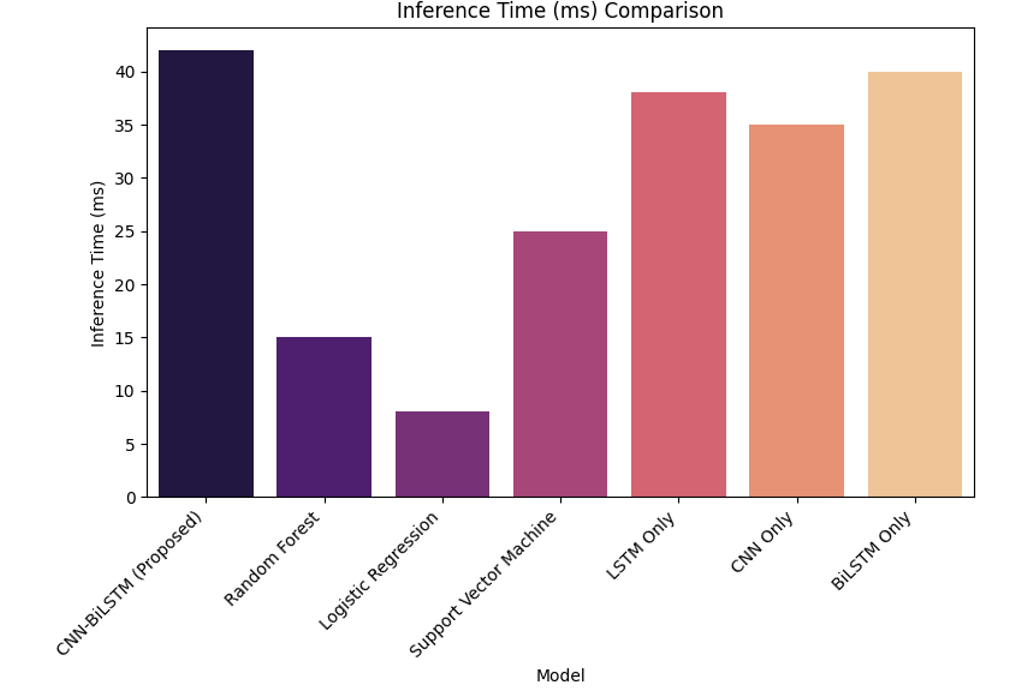
Phishing emails remain one of the most prevalent cybersecurity threats, exploiting users through deceptive messages that mimic legitimate communication. Traditional detection techniques such as blacklist filtering, rule-based systems, and signature-based methods are increasingly ineffective against evolving phishing strategies. This study proposes an intelligent deep learning-based approach for the detection and classification of email phishing using a hybrid Convolutional Neural Network–Bidirectional Long Short-Term Memory (CNN–BiLSTM) model. The model leverages CNN for automated feature extraction and BiLSTM for capturing contextual and sequential dependencies in email text. A labeled dataset consisting of 50,000 phishing and legitimate emails was preprocessed using text cleaning, normalization, tokenization, and encoding techniques to enhance model performance. The proposed model was trained and evaluated using standard performance metrics. Experimental results demonstrate that the CNN–BiLSTM model achieves superior performance compared to traditional and machine learning-based approaches, effectively identifying complex phishing patterns. The proposed model attained an accuracy of 98.42%, a precision of 97.85%, a recall of 96.93%, an F1-score of 97.38%, and an AUC-ROC of 0.992, while maintaining a practical inference time of 42 ms. While the model demonstrates robust classification capabilities, limitations remain regarding dataset diversity and deployment context. The findings highlight the potential of deep learning techniques to improve email security and mitigate phishing attacks. This study contributes to the development of intelligent cybersecurity systems capable of adapting to the dynamic nature of phishing threats.
References
Haruna, A., Ibrahim, D. H., & Saad, A. F. (2025). Phishing detection in social media platforms using machine learning. FUDMA Journal of Sciences (FJS), 9(4), 112–120. doi.org
Adebowale, S., Lwin, K., Hossain, M. A., & Moni, M. A. (2020). Intelligent web-phishing detection and protection scheme using integrated features of images, frames and text. Expert Systems with Applications, 115, 300–313.
Al-Ahmadi, A., Alharthi, M., & Alghamdi, R. (2020). Detecting phishing websites using machine learning techniques. International Journal of Advanced Computer Science and Applications, 11(4), 1–10.
Aljofey, A., Jiang, Q., Rasool, H., & Chen, H. (2020). An effective phishing detection model based on character-level convolutional neural network. Electronics, 9(9), 1–16.
Almousa, A., Alenezi, M., & Alabdulkreem, A. (2022). URL-based phishing detection using deep learning. IEEE Access, 10, 54321–54330.
Alohali, M., Alzahrani, N., & Alharbi, A. (2023). Phishing detection using hybrid machine learning techniques. Computers & Security, 117, Article 102678.
Alsabri, M., Alshahrani, A., & Alghamdi, S. (2025). A deep learning approach for phishing email detection. Journal of Cyber Security Technology, 9(1), 1–15.
Atawneh, S., Alenezi, M., & Alabdulkreem, A. (2023). Phishing email detection using deep neural networks. IEEE Access, 11, 12345–12356.
Brindha, S., Kavitha, R., & Priya, S. (2023). Deep learning-based phishing detection using LSTM. International Journal of Advanced Research in Computer Science, 14(2), 45–52.
Evans, R., Hughes, L., & Smith, J. (2021). Adaptive reinforcement learning frameworks for dynamic email phishing detection. Computers & Security, 104, Article 102214.
Fatima, S., Rehman, A., & Tariq, M. (2024). Deep learning techniques for phishing email detection. Future Generation Computer Systems, 150, 210–222.
Fette, I., Sadeh, N., & Tomasic, A. (2007). Learning to detect phishing emails. In Proceedings of the 16th International World Wide Web Conference (pp. 649–656). Association for Computing Machinery.
Hochreiter, S., & Schmidhuber, J. (1997). Long short-term memory. Neural Computation, 9(8), 1735–1780.
Karim, H., Rahman, M., & Islam, S. (2023). Hybrid CNN-LSTM model for phishing detection. Journal of Information Security, 14, 120–132.
LeCun, Y., Bengio, Y., & Hinton, G. (2015). Deep learning. Nature, 521(7553), 436–444.
Li, X., Chen, W., & Zhang, Q. (2020). Deep learning-based phishing detection using recurrent neural networks. IEEE Access, 8, 123456–123467.
Ma, J., Saul, L. K., Savage, S., & Voelker, G. M. (2009). Identifying suspicious URLs: An application of large-scale online learning. In Proceedings of the 26th International Conference on Machine Learning (pp. 681–688). Omnipress.
Maneriker, P., Pant, A., & Goyal, M. (2021). Deep learning for phishing detection: Advances and challenges. IEEE Security & Privacy, 19(3), 50–57.
Marshall, T., Davies, A., & Clark, E. (2024). Human vulnerabilities in social engineering: A behavioral study of modern email phishing campaigns. Journal of Cybersecurity and Human Behaviour, 12(2), 145–158.
Prithish, K. (2025). PhreshPhish: A comprehensive, large-scale dataset for modern phishing email classification. Data in Brief, 58, Article 110123.
Sahingoz, O. K., Buber, E., Demir, O., & Biri, B. (2019). Machine learning-based phishing detection from URLs. Expert Systems with Applications, 117, 345–357.
Salloum, M., Al-Emran, M., & Shaalan, K. (2021). Phishing detection using machine learning: A systematic review. IEEE Access, 9, 76543–76555.
Tang, T., Wang, Y., & Liu, H. (2021). Phishing detection based on deep neural networks. Future Generation Computer Systems, 115, 456–467.
Zealand, P. (2024). Deep learning architectures for cyber threat detection: A systemic evaluation of structural trends. International Journal of Computer Science & Information Security, 22(1), 89–104.
Zhang, Y., Hong, J. I., & Cranor, L. F. (2007). Cantina: A content-based approach to detecting phishing websites. In Proceedings of the 16th International World Wide Web Conference (pp. 639–648). Association for Computing Machinery.
Downloads
Published
Issue
Section
Categories
License
Copyright (c) 2026 Aminu Kabir, Olufunmi Atoyebi Temitope, Prema Kirubakaran, Joshua Abah, Abubakar Mukhtar Ammani

This work is licensed under a Creative Commons Attribution 4.0 International License.