
Molecular Characterization and Evaluation of Bioactive Compounds from Selected Medicinal Plant Extracts against Mastitis-Causing Pathogens among Dairy Cattle in Minna Niger State, Nigeria
DOI:
https://doi.org/10.33003/fjs-2026-1017-6110Keywords:
Moringa oleifera, GC-MS, Molecular docking, Mastitis, Staphylococcus aureus, DNA gyrase, Penicillin-binding proteinAbstract
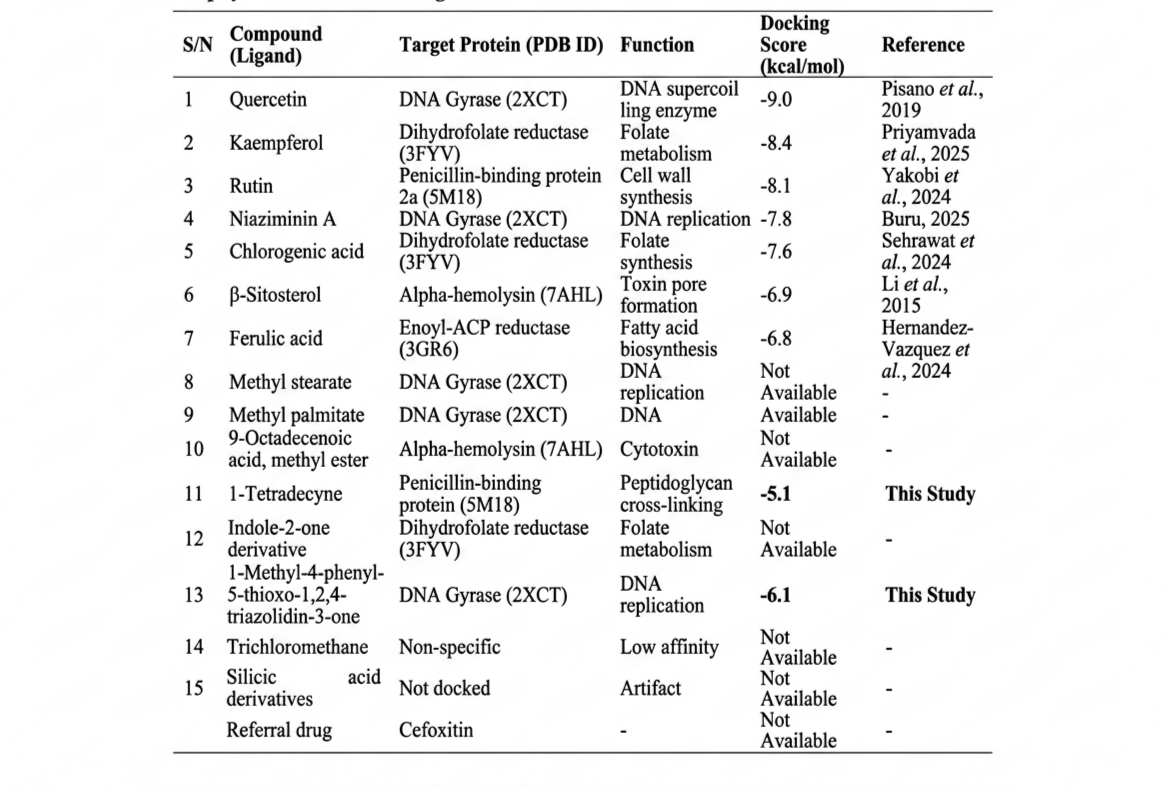
Mastitis is an important bacterial disease affecting dairy cattle and remains a challenge because of antimicrobial resistance and the limitations associated with conventional antibiotic treatment. This study isolated and identified mastitis-causing pathogens from cattle milk in Minna, Niger State, and subsequently characterized bioactive compounds in the most active plant extract using Gas Chromatography-Mass Spectrometry (GC-MS) and evaluated selected compounds through molecular docking. A total of 60 milk samples were collected from three locations, of which 15 tested positive for clinical mastitis. Five major bacterial groups were identified: Staphylococcus sp., Bacillus subtilis, Pseudomonas sp., Micrococcus luteus, and Neisseria sp. Staphylococcus sp. and B. subtilis were the most prevalent isolates, each accounting for 33.33%. Based on the antimicrobial activity observed in the study, Moringa oleifera was selected for GC-MS characterization. A total of 29 compounds were identified, with 9-octadecenoic acid, methyl ester (E) being the most abundant compound, accounting for 50.88% of the peak area. Other compounds included methyl stearate, hexadecanoic acid methyl ester, β-sitosterol, quercetin, kaempferol, rutin, chlorogenic acid, and ferulic acid. Molecular docking showed strong binding affinities for quercetin (−9.0 kcal/mol) against DNA gyrase (2XCT), kaempferol (−8.4 kcal/mol) against dihydrofolate reductase (3FYV), and rutin (−8.1 kcal/mol) against penicillin-binding protein 2a (5M18). Further docking of selected compounds demonstrated interactions between 1-methyl-4-phenyl-5-thioxo-1,2,4-triazolidin-3-one and DNA gyrase and between 1-tetradecyne and penicillin-binding protein 2a.These findings suggest that M. oleifera contains diverse bioactive compounds with potential activity against important bacterial targets and provides a basis for further experimental validation and development of plant-derived antimicrobial agents
References
Adji, A. S., Atika, N., Kusbijantoro, Y. B., Billah, A., Putri, A., & Handajani, F. (2022). A review of leaves and seeds Moringa oleifera extract: The potential Moringa oleifera as antibacterial, anti-inflammatory, antidiarrhoeal, and antiulcer approaches to bacterial gastroenteritis. Open Access Macedonian Journal of Medical Sciences, 10(F), 305–313. https://doi.org/10.3889/oamjms.2022.8894
Agu, P. C., Afiukwa, C. A., Orji, O. U., Ezeh, E. M., Ofoke, I. H., Ogbu, C. O., Ugwuja, E. I., & Aja, P. M. (2023). Molecular docking as a tool for the discovery of molecular targets of nutraceuticals in disease management. Scientific Reports, 13(1). https://doi.org/10.1038/s41598-023-40160-2
Cheng, W. N., & Han, S. G. (2020). Bovine mastitis: Risk factors, therapeutic strategies, and alternative treatments—A review. Asian-Australasian Journal of Animal Sciences, 33(11), 1699–1713. https://doi.org/10.5713/ajas.20.0156
Chikowe, I., Bwaila, K. D., Ugbaja, S. C., & Abouzied, A. S. (2024). GC–MS analysis, molecular docking, and pharmacokinetic studies of Multidentia crassa extracts’ compounds for analgesic and anti-inflammatory activities in dentistry. Scientific Reports, 14(1). https://doi.org/10.1038/s41598-023-47737-x
Elsaman, T., Mohamed, M. A., Mohamed, M. S., Eltayib, E. M., & Abdalla, A. E. (2025). Microbial-based natural products as potential inhibitors targeting DNA gyrase B of Mycobacterium tuberculosis: An in silico study. Frontiers in Chemistry, 13. https://doi.org/10.3389/fchem.2025.1524607
Frolova, N., Orlova, A., Popova, V., Bilova, T., & Frolov, A. (2026). Gas chromatography–mass spectrometry (GC–MS) in the plant metabolomics toolbox: Sample preparation and instrumental analysis. Biomolecules, 16(1). https://doi.org/10.3390/biom16010016
Khalid, A., Abdalgadir, E. A., Abdel Gadir, I. K., Abdalla, A. N., Homeida, H. E., Sultana, S., Rehman, Z. U., Hassani, R., Alqahtani, A. S., & Alhazmi, H. A. (2024). GC–MS profiling and therapeutic potentials of Prosopis juliflora (Sw.) DC: Cytotoxic and antimicrobial insights. Journal of Spectroscopy, 2024(1), 1121745.
Mohsen Ali, S. S., & Robin, P. (2025). Comprehensive phytochemical profiling of bioactive compounds from Barleria prattensis for their antioxidant and cytotoxic capacity and its characterization using GC–MS. Biochemistry and Biophysics Reports, 43, 102083. https://doi.org/10.1016/j.bbrep.2025.102083
Onuigbo, I. C., Suleyman, Z. A. T., Zitta, N., Odumosu, J. O., & Ibrahim, A. (2015). Route mapping and analysis within Gidan Kwano Campus, Federal University of Technology Minna, Niger State, Nigeria. IOSR Journal of Applied Physics, 7(3), 19–26.
Panda, S. R., Meher, A., Prusty, G., Behera, S., & Prasad, B. R. (2025). Antibacterial properties and therapeutic potential of few medicinal plants: Current insights and challenges. Discover Plants, 2(1). https://doi.org/10.1007/s44372-025-00097-4
Payandeh, J., & Volgraf, M. (2021). Ligand binding at the protein–lipid interface: Strategic considerations for drug design. Nature Reviews Drug Discovery, 20(9), 710–722.
Sahoo, C. R., Rout, M., Paidesetty, S. K., Dehury, B., Bhattacharya, D., & Pati, S. (2025). Molecular simulation of newly designed Mannich-based ciprofloxacin derivative as the promising scaffold for Escherichia coli dihydropteroate synthase and DNA gyrase inhibitor. Journal of Biomolecular Structure and Dynamics, 1–15.
Thangaiah, A., Gunalan, S., Velu, P., Chandirasekaran, D., Rajasekar, A., AlSalhi, M. S., Devanesan, S., & Malik, T. (2024). Augmenting phytochemical and phytomineral profiling of Moringa leaf extract: A contrastive study of solid–liquid extraction methodologies. Heliyon, 10(24).
Tommasoni, C., Fiore, E., Lisuzzo, A., & Gianesella, M. (2023). Mastitis in dairy cattle: On-farm diagnostics and future perspectives. Animals, 13(15). https://doi.org/10.3390/ani13152538
Vaou, N., Stavropoulou, E., Voidarou, C., Tsakris, Z., Rozos, G., Tsigalou, C., & Bezirtzoglou, E. (2022). Interactions between medical plant-derived bioactive compounds: Focus on antimicrobial combination effects. Antibiotics, 11(8). https://doi.org/10.3390/antibiotics11081014
Wizrah, M. S. I., Aldwsari, N. D., & Yahia, Z. A. (2026). Antibacterial activity of Moringa leaf extracts against Gram-negative bacteria from Wadi Ad-Dawasir, Saudi Arabia. Frontiers in Microbiology, 16, 1568105. https://doi.org/10.3389/fmicb.2025.1568105
Zadran, N. K., Bayan, A. M., Rahman, J., Stanikzai, N. K., Shirzadi, R., & Mosawi, S. H. (2025). Molecular insights into the binding affinity and inhibitory interactions of taxifolin, pachypodol, and camptothecin with enterotoxin B using docking and dynamics simulations. Journal of Molecular Structure, 142488.
Zahra, M., Abrahamse, H., & George, B. P. (2024). Flavonoids: Antioxidant powerhouses and their role in nanomedicine. Antioxidants, 13(8), 922.
Downloads
Published
Issue
Section
Categories
License
Copyright (c) 2026 Josephine Nathaniel, Sakinat Ifediorah, Musa Ibrahim Tukur

This work is licensed under a Creative Commons Attribution 4.0 International License.


