Nutritional, Functional, Anti-Nutritional and Sensory properties of Kwash Pap Enriched with Orange-Fleshed Sweet Potato, Soybean, and Groundnut
DOI:
https://doi.org/10.33003/fjs-2026-1018-6103Keywords:
Biofortification, Complementary Food, Provitamin A Carotenoids, Composite Flour, Kwash Pap, Orange-Fleshed Sweet PotatoAbstract
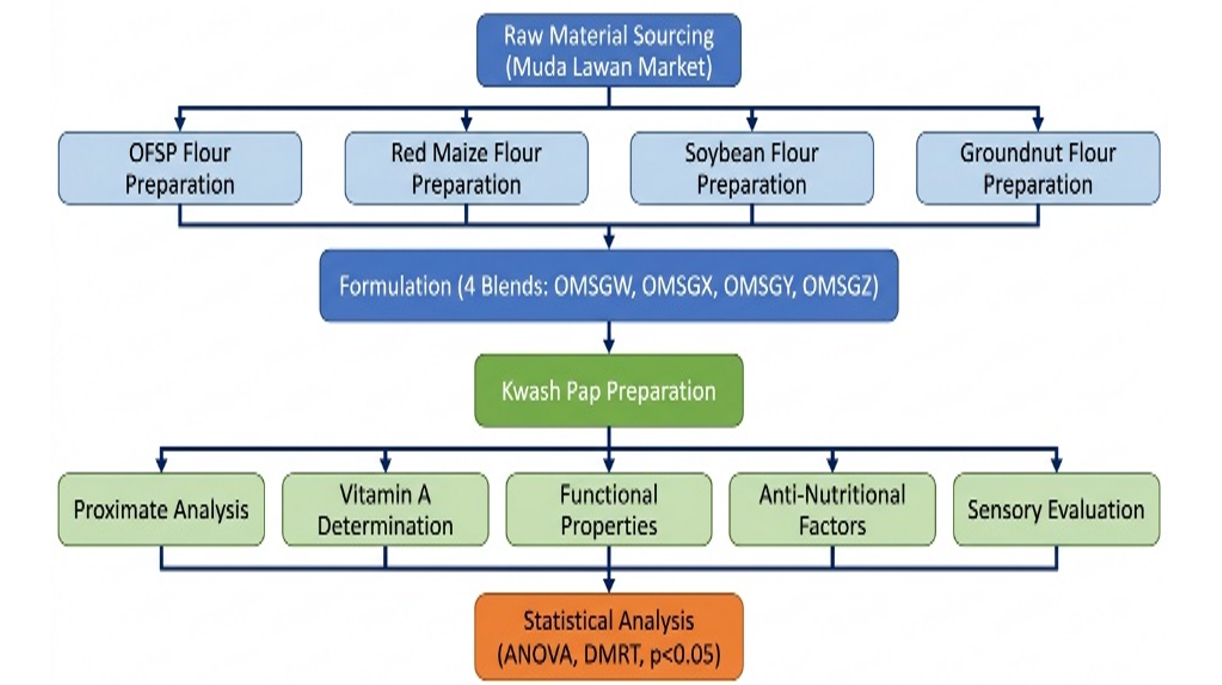
Vitamin A deficiency remains a significant public health challenge, particularly among children and vulnerable populations in developing countries. This study evaluated the effects of incorporating orange-fleshed sweet potato (OFSP), red maize, soybean, and groundnut on the nutritional, functional, antinutritional, and sensory properties of Kwash pap, a traditional cereal-based food. Four formulations were developed: OMSGW (70% maize, 0% OFSP), OMSGX (60% maize, 10% OFSP), OMSGY (50% maize, 20% OFSP), and OMSGZ (40% maize, 30% OFSP), with each containing 20% soybean and 10% groundnut. Vitamin A, proximate composition, antinutritional factors, functional properties, and sensory characteristics were determined using standard analytical procedures. Vitamin A content increased significantly (p < 0.05) from 0.1521 mg RE/100 g in OMSGW to 2.6517 mg RE/100 g in OMSGZ, demonstrating the contribution of OFSP to provitamin A enrichment. Protein content increased from 9.58% in OMSGW to 11.11% in OMSGY. OFSP incorporation also influenced functional properties, including water absorption capacity and emulsion stability. Processing significantly (p < 0.05) reduced phytate, tannin, oxalate, saponin, and alkaloid contents. Sensory evaluation involving 20 semi-trained panelists using a 9-point hedonic scale revealed that OMSGY achieved the highest scores for taste (7.90), appearance (8.15), and overall acceptability (8.00). Overall, OFSP, soybean, and groundnut incorporation improved the nutritional quality of Kwash pap while maintaining sensory acceptability. The 20% OFSP formulation demonstrated favourable sensory characteristics, while the 30% OFSP formulation achieved the highest vitamin A content, highlighting the potential of locally sourced ingredients to improve dietary vitamin A intake and nutritional quality among vulnerable populations
References
Abebe, W., Woldegiorgis, E., Banti, M., Habte, G., Tola, A., Abate, S., & Shimber, T. (2024). Proceedings of Food Science and Nutrition Completed Research 2020-2021. Ethiopian Institute of Agricultural Research (EIAR). DOI:10.13140/RG.2.2.30035.59687
Abera, S., Yohannes, W., & Chandravanshi, B. S. (2023). Effect of processing methods on antinutritional factors (oxalate, phytate, and tannin) and their interaction with minerals (calcium, iron, and zinc) in red, white, and black kidney beans. International Journal of Analytical Chemistry, 2023(1), 6762027. DOI: https://doi.org/10.1155/2023/6762027
Ahmed, S., Kumar, J., Garg, N., & Gahlaut, V. (2026). Chromatic grains: Revolutionizing nutrition with pigmented cereals and fortified foods. Journal of Food Measurement and Characterization, 20(1), 76-98. https://doi.org/10.1007/s11694-025-03681-0
Aloka, B., Ongeng, D., Amito, F. O., Omech, B., & Olum, S. (2026). Organoleptic drivers of caregiver-reported acceptability of locally formulated nutrient-dense products formulated from local ingredients for nutritional intervention in nodding syndrome in northern Uganda. BMC nutrition. https://doi.org/10.1186/s40795-026-01308-1
Alomatu, D. E., Yankey, S., Gyimah, L., & Eshun, G. (2025). Nutritional Profile and Functional Properties of Orange‐Fleshed Sweet Potato, Bambara Groundnut, and Brown Rice Blended Complementary Food. International Journal of Food Science, 2025(1), 5397972. https://doi.org/10.1155/ijfo/5397972
Amagloh, F. C., Atuna, R. A., & Amagloh, F. K. (2026). Leveraging orange-fleshed sweetpotato to advance childhood nutrition in Sub-Saharan Africa. World Nutrition, 17(1), 91-113. https://doi.org/10.26596/wn.202617191-113
Apaliya, M. T., Osae, R., Kwaw, E., Mahunu, G. K., Osei-Kwarteng, M., & Ahima, J. K. (2022). Fermented African cereal products. In A. M. Elhadi Sulieman & A. Adam Mariod (Eds.), African Fermented Food Products—New Trends (pp. 459–472). Springer International Publishing. https://doi.org/10.1007/978-3-030-82902-5_30 (Springer)
Ashraf, S. A. (2025). Food fortification as a sustainable global strategy to mitigate micronutrient deficiencies and improve public health. Discover Food, 5(1), 201. https://doi.org/10.1007/s44187-025-00512-5 (Springer)
Association of Official Analytical Chemists (AOAC). (2005). Official methods of analysis of AOAC International (18th ed.). AOAC International.
Association of Official Analytical Chemists (AOAC). (2012). Official Methods of Analysis, 19th edition. Washington, D.C., USA.
Cabal-Herrera, A., Kigen, B., Kapanga, E., Samia, A., Nabwera, H., & Samia, P. (2025). The impact of undernutrition and overnutrition on early brain development. Seminars in Pediatric Neurology, 55, 101212. https://doi.org/10.1016/j.spen.2025.101212
Carazo, A., Macáková, K., Matoušová, K., Krčmová, L. K., Protti, M., & Mladěnka, P. (2021). Vitamin A update: Forms, sources, kinetics, detection, function, deficiency, therapeutic use and toxicity. Nutrients, 13(5), 1703. https://doi.org/10.3390/nu13051703 (PubMed Central (PMC))
Condurso, C., Merlino, M., Miller, A., Di Rosa, A. R., Accetta, F., Leonardi, M., Cicero, N., & Gervasi, T. (2025). Developing novel plant-based probiotic beverages: A study on viability and physicochemical and sensory stability. Foods, 14(12), 2148. https://doi.org/10.3390/foods14122148
Day, R. A., & Underwood, A. L. (1986). Quantitative analysis (5th ed.). Prentice-Hall
Eke-Ejiofor, J. N., Ojimadu, A. E., Wordu, G. O., & Ofoedu, C. E. (2021). Functional properties of complementary food from millet (Pennisetum glaucum), African yam bean (Sphenostylis stenocarpa), and jackfruit (Artocarpus heterophyllus) flour blends: A comparative study. Asian Food Science Journal, 20(9), 45–62. https://doi.org/10.9734/afsj/2021/v20i930342 (Asian Food Science Journal)
Guo, F., Danielski, R., Santhiravel, S., & Shahidi, F. (2024). Unlocking the nutraceutical potential of legumes and their by-products: Paving the way for the circular economy in the agri-food industry. Antioxidants, 13(6), 636. https://doi.org/10.3390/antiox13060636 (MDPI)
Haug, W., & Lantzsch, H. J. (1983). Sensitive method for the rapid determination of phytate in cereals and cereal products. Journal of the Science of Food and Agriculture, 34(12), 1423–1426. https://doi.org/10.1002/jsfa.2740341217
Hiai, S., Oura, H., & Nakajima, T. (1976). Color reaction of some sapogenins and saponins with vanillin and sulfuric acid. Planta Medica, 29(2), 116–122. https://doi.org/10.1055/s-0028-1097639
Jenfa, M. D., Adelusi, O. A., Aderinoye, A., Coker, O. J., Martins, I. E., & Obadina, O. A. (2024). Physicochemical compositions, nutritional and functional properties, and color qualities of sorghum–orange-fleshed sweet potato composite flour. Food Science & Nutrition, 12(4), 2364–2378. https://doi.org/10.1002/fsn3.3922 (PubMed)
Kabeer, S., Mary, S. J., Govindarajan, N., Essa, M. M., & Qoronfleh, M. W. (2024). Traditional weaning foods and processing methods with fortification for sustainable development of infants to combat zero hunger: A review. Journal of Food Science and Technology, 61(12), 2263–2274. https://doi.org/10.1007/s13197-024-06065-2 (PubMed Central (PMC))
Kesharwani, R. K., Fatima, S., & Bajpai, M. (2024). Pediatric malnutrition and natural dietary supplementary food to overcome it: A review. Current Nutrition & Food Science, 20(5), 539–556. https://doi.org/10.2174/1573401319666230807152815 (benthamscience.com)
Obadoni, B. O., & Ochuko, P. O. (2002). Phytochemical studies and comparative efficacy of the crude extracts of some haemostatic plants in Edo and Delta States of Nigeria. Global Journal of Pure and Applied Sciences, 8(2), 203–208. https://doi.org/10.4314/gjpas.v8i2.16033 (African Journals Online)
Obinna-Echem, P. C., Eke-Ejiofor, J., Vito, M. B., & Wordu, G. O. (2021). Proximate composition, mineral and sensory properties of orange-flesh sweet potato starch, soybean and groundnut flour complementary food. Asian Food Science Journal, 20(9), 118–130. https://doi.org/10.9734/afsj/2021/v20i930347 (Asian Food Science Journal)
Oke, O. L. (1966). Chemical studies on the more commonly used vegetables in Nigeria. Journal of Food Science, 31(4), 529–535. https://doi.org/10.1111/j.1365-2621.1966.tb00551.x
Okwunodulu, I. N., Egbuta, G. N., Okwunodulu, F. U., Ojinnaka, C. M., & Onyeiwu, S. C. (2024). Gluten free sourdough breads from pearl millet-Bambara nut and pearl millet-soybean paste: Evaluation of the proximate, functional properties of the flour blends and the bread nutritional indexes. Food Chemistry Advances, 4, 100633. https://doi.org/10.1016/j.focha.2024.100633 (sciencedirect.com)
Oladele, A. K., & Aina, J. O. (2007). Chemical composition and functional properties of flour produced from two varieties of tigernut (Cyperus esculentus). African Journal of Biotechnology, 6(21), 2473–2476. https://doi.org/10.5897/AJB2007.000-2391 (Academic Journals)
Oresanya, T., Adebowale, A. R., Adegoke, A., Sobukola, O., Sanni, S., Olaleye, T., Oke, E., & Sanni, L. (2026). Nutritional, techno-functional and pasting properties of orange-fleshed sweet potato, Bambara groundnut and date seed composite flour. Cogent Food & Agriculture, 12(1), 2689648. https://doi.org/10.1080/23311932.2026.2689648 (Taylor & Francis Online)
Price, M. L., Van Scoyoc, S., & Butler, L. G. (1978). A critical evaluation of the vanillin reaction as an assay for tannin in sorghum grain. Journal of Agricultural and Food Chemistry, 26(5), 1214–1218. https://doi.org/10.1021/jf60219a031
Qin, N., Chen, L., Guo, J., Wang, J., & He, Y. (2025). Global, regional, and national burden of vitamin A deficiency (1990–2021) and projections to 2042: Associations with sociodemographic development. Frontiers in Nutrition, 12, 1689903. https://doi.org/10.3389/fnut.2025.1689903 (Frontiers)
Rodriguez-Amaya, D. B., & Kimura, M. (2004). HarvestPlus handbook for carotenoid analysis. International Food Policy Research Institute.
Sarabandi, K., Akbarbaglu, Z., Sarabandi, R., Tamjidi, F., Gharehbeglou, P., & Jafari, S. M. (2023). Improving the functionality and biological properties of Iranian date palm (Phoenix dactylifera L.) seeds protein with different proteases. Food and Humanity, 1, 675–683. https://doi.org/10.1016/j.foohum.2023.07.017 (sciencedirect.com)
Sosulski, F. W., Garratt, M. D., & Slinkard, A. E. (1976). Functional properties of ten legume flours. Canadian Institute of Food Science and Technology Journal, 9(2), 66–69. https://doi.org/10.1016/S0315-5463(76)73614-9 (EurekaMag)
Tumwegamire, S., Kapinga, R., Zhang, D., Crissman, C., & Agili, S. (2004). Opportunities for promoting orange-fleshed sweetpotato as a mechanism for combat vitamin A deficiency in sub-Saharan Africa. African Crop Science Journal, 12(3), 241–252. https://doi.org/10.4314/acsj.v12i3.27884. (PubMed Central (PMC))
Vicente, A., Villanueva, M., Muñoz, J. M., Caballero, P. A., & Ronda, F. (2025). The role of microwave absorption capacity and water mobility in the microwave treatment of grain vs. flour: Impact on the treated flour characteristics. Food Hydrocolloids, 159, 110680. https://doi.org/10.1016/j.foodhyd.2024.110680 (DOI)
World Health Organization. (2009). Global prevalence of vitamin A deficiency in populations at risk 1995–2005: WHO global database on vitamin A deficiency. World Health Organization. ISBN 978-92-4-159801-9 https://iris.who.int/handle/10665/44110 (World Health Organization)
Yasumatsu, K., Sawada, K., Moritaka, S., Misaki, M., Toda, J., Wada, T., & Ishii, K. (1972). Whipping and emulsifying properties of soybean products. Agricultural and Biological Chemistry, 36(5), 719–727. https://doi.org/10.1080/00021369.1972.10860321 (OUP Academic)
Younge, S., & Amoah, R. S. (2026). Addressing vitamin A deficiency in Ghana using orange-fleshed sweet potato as a food fortifier in composite flour development: A review. Journal of the Science of Food and Agriculture, 106(11), 6311–6325. https://doi.org/10.1002/jsfa.70520 (PubMed)
Downloads
Published
Issue
Section
Categories
License
Copyright (c) 2026 Esther Eduzor, Oluwatosin Dorothy Adesanya, Musa Hamisu, Ogbonnaya Gideon Onuoha, James Samaila Ladan, Zainab Aliyu, Idris Maryam Usman

This work is licensed under a Creative Commons Attribution 4.0 International License.