
Bayesian Analysis of Seasonal and Periodic Time Series: Evidence from Nigerian Monthly Rainfall, 1981–2024
DOI:
https://doi.org/10.33003/fjs-2026-1018-6086Keywords:
Bayesian Inference, Nigerian Rainfall, Whittle Likelihood, Spectral Density, Structural Time Series, Periodic Autoregression, Bayesian Model AveragingAbstract
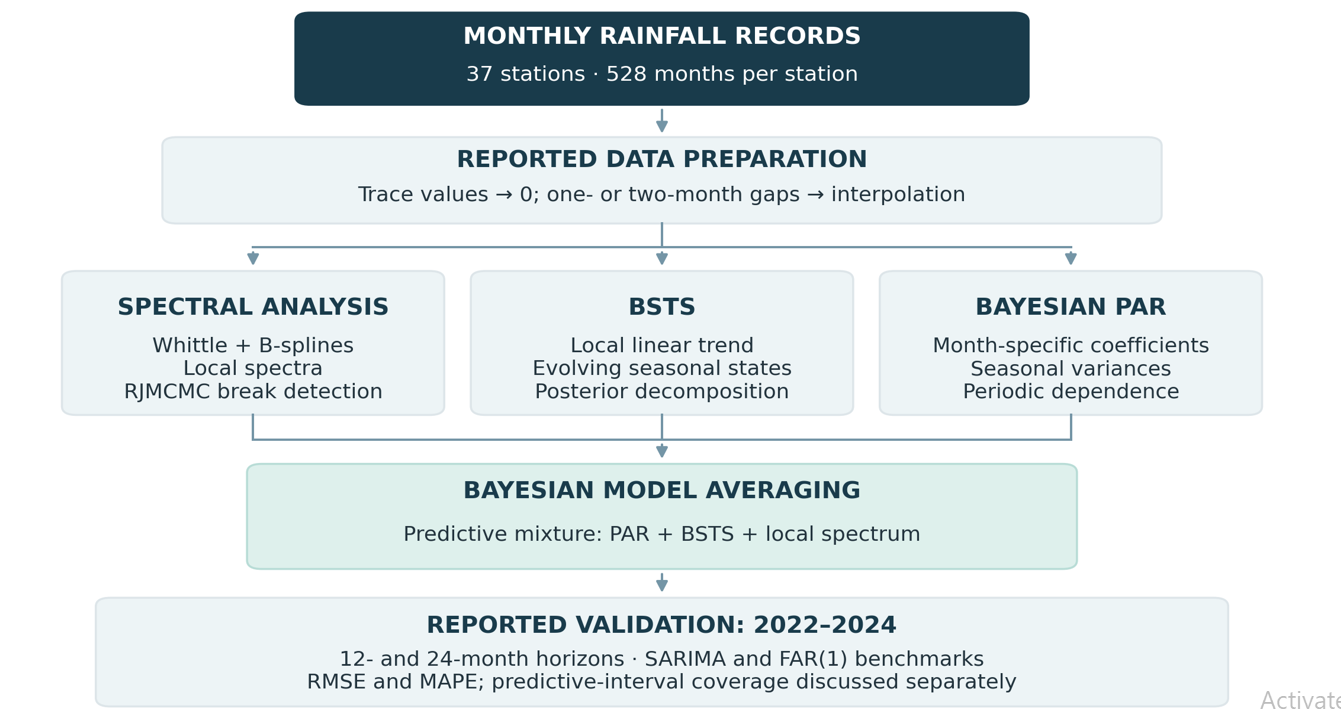
Monthly rainfall in Nigeria exhibits pronounced annual seasonality, season-dependent variability, and changes in temporal dependence that may not be adequately represented by a single fixed-parameter model. This study presents a Bayesian modelling framework for monthly rainfall records from 37 Nigerian Meteorological Agency stations spanning January 1981 to December 2024, a 44-year period comprising 528 monthly values per station. The framework combines Whittle-likelihood spectral estimation, B-spline modelling of the log-spectral density, Bayesian structural time series (BSTS) decomposition, periodic autoregression, locally stationary spectral analysis, and reversible-jump Markov chain Monte Carlo for structural-break detection. Predictive distributions from complementary specifications are combined through Bayesian model averaging (BMA). Reported validation results for 2022–2024 indicate that BMA reduces root mean squared error relative to SARIMA by 8.3% at a 12-month horizon and 15.0% at a 24-month horizon. BMA has the lowest reported mean absolute percentage error at both horizons and the lowest 24-month RMSE; however, BSTS has the lowest 12-month RMSE. Structural-break summaries identify modal break locations within 1987–1989 at 22 stations and within 2001–2004 at 19 stations. These findings support the use of complementary seasonal models, particularly for longer-horizon prediction, rather than establishing uniform superiority of model averaging. Interpretation remains conditional on the reported evaluation design, and further documentation of forecast origins, model weights, zero-rainfall treatment, and posterior diagnostics is required for independent verification.
References
Carter, C. K., & Kohn, R. (1996). Markov chain Monte Carlo in conditionally Gaussian state space models. Biometrika, 83(3), 589–601. https://doi.org/10.1093/biomet/83.3.589
Choudhuri, N., Ghosal, S., & Roy, A. (2004). Bayesian estimation of the spectral density of a time series. Journal of the American Statistical Association, 99(468), 1050–1059. https://doi.org/10.1198/016214504000000557
Dahlhaus, R. (1997). Fitting time series models to nonstationary processes. The Annals of Statistics, 25(1), 1–37.
Gneiting, T., & Raftery, A. E. (2007). Strictly proper scoring rules, prediction, and estimation. Journal of the American Statistical Association, 102(477), 359–378. https://doi.org/10.1198/016214506000001437
Green, P. J. (1995). Reversible jump Markov chain Monte Carlo computation and Bayesian model determination. Biometrika, 82(4), 711–732.
Lund, R. B., & Basawa, I. V. (2000). Recursive prediction and likelihood evaluation for periodic ARMA models. Journal of Time Series Analysis, 21(1), 75–93. https://doi.org/10.1111/1467-9892.00174
McAlinn, K., & West, M. (2019). Dynamic Bayesian predictive synthesis in time series forecasting. Journal of Econometrics, 210(1), 155–169. https://doi.org/10.1016/j.jeconom.2018.11.010
Nigerian Meteorological Agency (NIMET). (2024). Monthly rainfall records from 37 climatological stations in Nigeria, 1981–2024 [Data set]. NIMET. [Dataset attribution retained from the supplied manuscript; access details were not provided.]
Pagano, M. (1978). On periodic and multiple autoregressions. The Annals of Statistics, 6(6), 1310–1317. https://doi.org/10.1214/aos/1176344376
Rosen, O., Stoffer, D. S., & Wood, S. (2009). Local spectral analysis via a Bayesian mixture of smoothing splines. Journal of the American Statistical Association, 104(485), 249–262. https://doi.org/10.1198/jasa.2009.0118
Schwartz, L. (1965). On Bayes procedures. Zeitschrift für Wahrscheinlichkeitstheorie und Verwandte Gebiete, 4, 10–26.
Scott, S. L., & Varian, H. R. (2014). Predicting the present with Bayesian structural time series. International Journal of Mathematical Modelling and Numerical Optimisation, 5(1–2), 4–23.
Taiwo, A. I., Olatayo, T. O., Adedotun, A. F., & Adesanya, K. K. (2019). Modeling and forecasting periodic time series data with Fourier autoregressive model. Iraqi Journal of Science, 60(6), 1367–1373. https://doi.org/10.24996/ijs.2019.60.6.20
Vecchia, A. V. (1985). Maximum likelihood estimation for periodic autoregressive moving average models. Technometrics, 27(4), 375–384.
Vosseler, A., & Weber, E. (2018). Forecasting seasonal time series data: A Bayesian model averaging approach. Computational Statistics, 33(4), 1733–1765. https://doi.org/10.1007/s00180-018-0801-3
Whittle, P. (1957). Curve and periodogram smoothing. Journal of the Royal Statistical Society: Series B, 19(1), 38–63.
Downloads
Published
Issue
Section
Categories
License
Copyright (c) 2026 Augustine Yomi Oyenuga, Timothy Olabisi Olatayo, Abass Ishola Taiwo, Gabriel Olugbenga Obadina

This work is licensed under a Creative Commons Attribution 4.0 International License.