
Multi-Cyclic Persistence and Trend Structure of Atlantic and Pacific Climate Teleconnection Indices (AMO, ENSO/ONI, NAO), 1994-2022: Implications for Rainfall Variability in Nigeria
DOI:
https://doi.org/10.33003/fjs-2026-1018-5837Keywords:
AMO, ENSO, NAO, persistence, Hurst exponent, wavelet analysis, Nigeria rainfall teleconnectionsAbstract
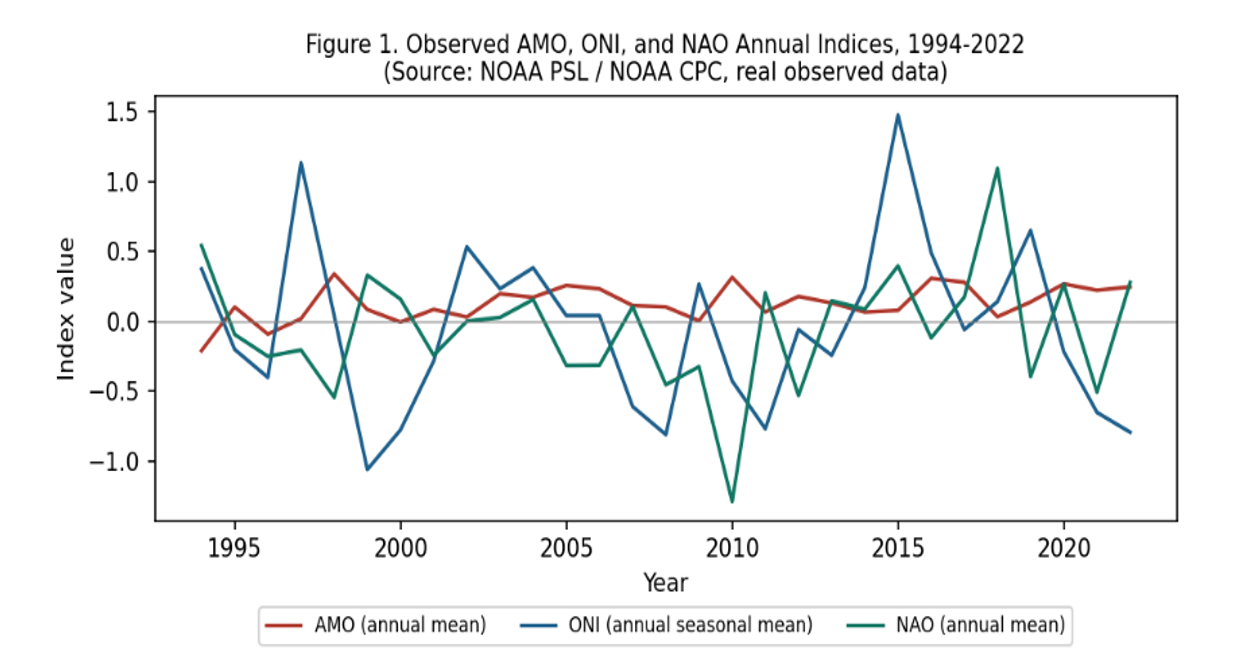
Rainfall variability across Nigeria is influenced by large-scale Atlantic and Pacific climate teleconnections, including the Atlantic Multidecadal Oscillation (AMO), El Niño-Southern Oscillation (ENSO), and North Atlantic Oscillation (NAO). Although rainfall–teleconnection relationships are well documented in West Africa, the statistical persistence and multi-cyclic structure of these climate drivers remain less commonly characterised within a unified framework. This study examines monthly AMO and NAO indices and the three-month overlapping-season ONI from January 1994 to December 2022 (n = 348), obtained from the NOAA Physical Sciences Laboratory and Climate Prediction Center. Mann-Kendall testing with Sen's slope, Hurst exponent analysis, detrended fluctuation analysis, and continuous Morlet wavelet transformation were applied. AMO exhibited a significant increasing trend (Z = 6.642, p < 0.001) and strong long-memory persistence (H = 0.749). ONI showed no significant trend (Z = 0.047, p = 0.963), confirming its predominantly oscillatory behaviour, while wavelet analysis identified a dominant ~3.3-year periodicity associated with major El Niño episodes. NAO also showed no significant trend (Z = 0.747, p = 0.455) but exhibited weaker persistence (H = 0.622). Cross-correlation indicated a moderate negative annual association between AMO and NAO (r = −0.412). These findings provide a quantitative characterisation of the persistence, trends, and periodic structures of major climate drivers relevant to Nigerian rainfall variability and provide a foundation for future station-level rainfall–teleconnection modelling
References
Abubakar, M.L., Abdussalam, A.F., Ahmed, M.S., & Wada, A.I. (2024). Spatiotemporal variability of rainfall and drought characterization in Kaduna, Nigeria. Discover Environment, 2(1), 72. https://doi.org/10.1007/s44274-024-00112-7
Adefolalu, D.O. (1986). Rainfall trends in Nigeria. Theoretical and Applied Climatology, 37, 205-219. https://doi.org/10.1007/BF00867578
Ati, O.F., Stigter, C.J., & Oladipo, E.O. (2002). A comparison of methods to determine the onset of the growing season in Northern Nigeria. International Journal of Climatology, 22(6), 731-742. https://doi.org/10.1002/joc.712
Cai, W., Reason, C., Mohino, E., et al. (2025). Climate impacts of the El Niño-Southern Oscillation in Africa. Nature Reviews Earth & Environment, 6, 503-520. https://doi.org/10.1038/s43017-025-00705-7
Emmanuel, I. (2022). Linkages between El Niño-Southern Oscillation (ENSO) and precipitation in West Africa regions. Arabian Journal of Geosciences, 15, 675. https://doi.org/10.1007/s12517-022-09942-2
Enfield, D.B., Mestas-Nuñez, A.M., & Trimble, P.J. (2001). The Atlantic multidecadal oscillation and its relation to rainfall and river flows in the continental U.S. Geophysical Research Letters, 28(10), 2077-2080. https://doi.org/10.1029/2000GL012745
Hurst, H.E. (1951). Long-term storage capacity of reservoirs. Transactions of the American Society of Civil Engineers, 116(1), 770-799.
Ibebuchi, C.C., & Abu, I.-O. (2023). Rainfall variability patterns in Nigeria during the rainy season. Scientific Reports, 13, 7888. https://doi.org/10.1038/s41598-023-34970-7
Johnson, A., & Idowu, A.S. (2026). Wavelet coherence between large-scale climate indices and precipitation variability over Nigeria (1961-2021). Nigerian Journal of Physics, 35(S), 217-227. https://doi.org/10.62292/njp.v35(s).2026.690
Knight, J.R., Folland, C.K., & Scaife, A.A. (2006). Climate impacts of the Atlantic Multidecadal Oscillation. Geophysical Research Letters, 33, L17706. https://doi.org/10.1029/2006GL026242
Mann, H.B. (1945). Nonparametric tests against trend. Econometrica, 13(3), 245-259. https://doi.org/10.2307/1907187
Odiana, S., & Yusuf, D.D. (2025). Trend analysis of rainfall in three cities in Nigeria as determinant of climate change. Dutse Journal of Pure and Applied Sciences (DUJOPAS), 11(2b), 252-264.
Okorie, F.C. (2021). North Atlantic Oscillation and rainfall variability in southeastern Nigeria: A statistical analysis of 30 year period. Journal of Atmospheric Science Research, 4(4), 42-49. https://doi.org/10.30564/jasr.v4i4.3843
Ologunorisa, T.E. (2004). An assessment of flood vulnerability zones in the Niger Delta, Nigeria. International Journal of Environmental Studies, 61(1), 31-38. https://doi.org/10.1080/0020723032000130061
Peng, C.-K., Buldyrev, S.V., Havlin, S., Simons, M., Stanley, H.E., & Goldberger, A.L. (1994). Mosaic organization of DNA nucleotides. Physical Review E, 49(2), 1685-1689. https://doi.org/10.1103/PhysRevE.49.1685
Salami, A.A. (2025). Rainfall variability and trends analyses in Nigeria using remotely sensed data and CMIP5 models. Earth Systems and Environment, 9, 2837-2865. https://doi.org/10.1007/s41748-024-00556-0
Sen, P.K. (1968). Estimates of the regression coefficient based on Kendall's tau. Journal of the American Statistical Association, 63(324), 1379-1389. https://doi.org/10.2307/2285891
Torrence, C., & Compo, G.P. (1998). A practical guide to wavelet analysis. Bulletin of the American Meteorological Society, 79(1), 61-78. https://doi.org/10.1175/1520-0477(1998)079<0061:APGTWA>2.0.CO;2
Umar, A.T., & Kehinde, M.O. (2020). Relationship of El Niño/Southern Oscillation to rainfall patterns in Nigeria. Open Journals of Environmental Research, 1(1), 1-20. https://doi.org/10.5281/zenodo.4818056
Zhang, R., & Delworth, T.L. (2006). Impact of Atlantic multidecadal oscillations on India/Sahel rainfall and Atlantic hurricanes. Geophysical Research Letters, 33, L17712. https://doi.org/10.1029/2006GL026267
Downloads
Published
Issue
Section
Categories
License
Copyright (c) 2026 Adensile Ridwan Raheem, Abass Ishola Taiwo, Timothy Olabisi Olatayo, Jubril Oluwatoyin Fantola

This work is licensed under a Creative Commons Attribution 4.0 International License.


