
Heavy Metals Contamination of Soils within Mining Sites in Ebonyi North Central Zone, Ebonyi State, Nigeria
DOI:
https://doi.org/10.33003/fjs-2026-1019-6085Keywords:
Heavy Metals, Mining Activities, Pollution Intensity, Soil QualityAbstract
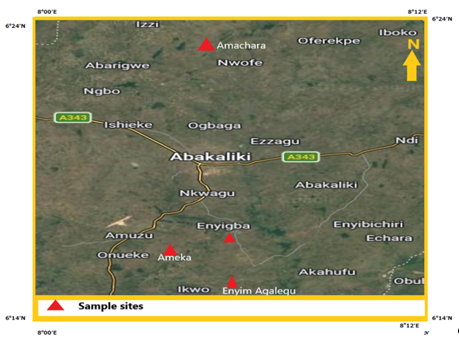
Mining activities adversely affect the qualities of the earth crust through accumulation of heavy metals in the soil. This study is planned to assess the heavy metal contamination within mining sites in Ebonyi north central zone, Ebonyi State, Nigeria. The study involves collection of three soil samples from different mining site within Ebonyi north central zone and a control. The soil samples were collected from a depth of 0-20 cm and taken to laboratory for analyses using Standard methods. The heavy metals (Mgkg-1) concentrations range from 0.021-2.217; 14.55-297.21; 31.50-182.668; 0.01-417.667; 0.01-3.564; 1.126-1.774 and 2.925-5.615 for Copper (Cu), Iron (Fe), Zinc (Zn), Lead (Pb), Cadmium (Cd), Nickel (Ni) and Chromium (Cr) respectively. The pollution intensity was assessed using geoaccumulation index which revealed Cu, Ni and Cr unpolluted in all the mining sites, Cd moderately polluted to strongly polluted in all the mining sites, Zn unpolluted to moderately polluted in all the mining sites while Fe was unpolluted in all the sites except in Enyim-Agalagu. Other exception is Pb having unpolluted in Obichie-Ameka, unpolluted to moderately polluted in Enyim-Agalegu and strongly polluted in Enyigba. The consequences of observed pollution include introduction of pollutants into the soil and its accumulation into microorganisms that live in the soil making the soil unproductive and unsafe for agricultural purposes. This study recommends appointment of community stakeholders from mining areas to relate with Ministry of Environment for continuous monitoring of mining sites. They should request for management approach for regulation of mining activities within the locations.
References
Adimalla, N & Wang, H. (2018). Distribution, contamination, and health risk assessment of heavy metals in surface soils from northern Telangana, India. Arabian Journal of Geosciences, 11: 684.
Ahmad, I., Hayat, S., Ahmad, A., Inam, A & Samiullah, I. (2005). Effect of heavy metal on survival of certain groups of Indigenous soil microbial population. Journal of Applied Science and Environmental Management, 9:115-121.
Alka, S (2002).“Environmental biochemistry.” In Chatterjea, M. N. & Rana, S.(Eds). Text Book of Medical Biochemistry. Jaypee Brothers Medical Publication Ltd. New Delhi India. 77-79.
Aloh, G. A., Aloh, H. E., Obasi, A. N & Chukwu, K. (2017). Evidence of heavy metal contamination of agricultural soil in Ameri, Abakaliki lead-zinc mining area, Ebonyi State Southeast Nigeria: An indication for phytoremediation. Nutrition and Food Technology Open Access, 3(3).https://doi.org/10.16966/2470-6086.145.
Amadi, S.O & Chigbu, T.O. (2020). An assessment of the Environmental Impact, Risk Challenges and Mitigation Strategies in Ameka illegal Mine Sites and Environs in Ebonyi State, Southheastern Nigeria. Environmental and Earth Sciences Research Journal 7(2):82-88
Anka, S.A., Sanda, A., Bello, T.S., Waziri, A.F., Muhammad, A.S., Bello, I & Nasiru, A.M (2020). Environmental Effect of Lead Combination of Mining Communities in Zamfara State, Nigeria: A Review. Journal of Biology and Today's World, (9)9:001-003 Arantzazu, U.., Vega, M & Angul, E. (2000). Deriving ecological risk-based soil quality values in the Barque country. The Science of the Total Environment, 247:279-284
Barceloux, D. G & Barceloux, D. (1999). Zinc. Journal of Toxicology, 37(2): 145–172.
Carrion-Paladines, V., Calva, J., Ochoa Perez, T., Ruiz, L. & Lopez-Rodriguez, F (2025). Heavy Metal Contamination in Arenillas Ecological Reserve Soils: Correlation and Conservation Impact. Land Degrad. Dev, 36: 3454–3471.
Chen, Y., Jiang, X., Wang, Y & Zhuang, D. (2018). Spatial Characteristics of Heavy Metal Pollution and the Potential Ecological Risk of a typical Mining Area: A Case Study in China. Process Saf. Environ. Protect. 113:204–219.
Eddy, N. O., Ndibuke, N. O & Ndibuke, E. O. (2004). Heavy metals in sediments from cross River at Oron. African Journal of Environmental Pollution and Health, 25-29.
European Union, (2002). Heavy Metals in Waste, European Commission on Environment. http://ec.europa.eu/environment/waste/studies/pdf/heavymetalsreport.pdf
Eyankware, M.O & Ephraim, B.E (2021). A comprehensive review of water quality monitoring and assessment in Delta State, Southern Part of Nigeria. Journal of Environmental and Earth Sciences. 13(1): 16-28. DOI: https://doi.org/10.30564/jees.v3i1.2900
FAO /WHO (2007). Summary of evaluations performed by the Joint FAO/WHO Food Standard Programme Codex Alimentarius Commission 13th Session. Report of the Thirty eight Session of the Codex Committee on Food Hygiene, Houston, United States of America,ALINORM 07/30/13
Faroon O, Ashizawa A, Wright S, Tucker P, Jenkins K, Ingerman L & Rudisill C (2012). Toxicological Profile for Cadmium, Agency for Toxic Substances and Disease Registry Toxicological Profile, Atlanta, Georgia.
Gilmur, J.T & Kittrick, J. A (1979).Solubility and equilibra of Zinc in a flooded soil. Soil Sci. Soc. Am. J., 43:890-892
Guan, Y., Shao, C & Ju, M (2014). Heavy metal contamination assessment and partition for industrial and mining gathering areas. International Journal of Environmental Research and Public Health, 11: 7286–7303. https://doi.org/10.3390/ijerph110707286.
Guo, K., Zhang, Z., Gensheng, L., Liu, H., Wang, Z., Fu, F & Wang, W(2025). Impact of Mining Methods and Mine Types on Heavy Metal (Loid) Contamination in Mine Soils: A Multi-Index Assessment. Minerals 15(986):1 – 18
Jaishankar, M., Tseten, T., Anbalagan, N., Mathew, B. B & Beeregowda, K. N. (2014). Toxicity, mechanism and health effects of some heavy metals. Interdisciplinary Toxicology, 7(2): 60–72.
Keller, C., McGrath, S. P & Dunham, S. J. (2002). Trace Metal Leaching through a soil- grassland system after sewage sludge application. Journal of Environmental Quality, 31: 1550-1560.
Krzyztof, L., Danutta, W & Irena, K. (2004). Metal contamination of farming soils affected by industry. Environment International, 30(2):159-165.
Levy, D. B., Barbarick, E. G., Siemer, E. G & Sommers, L. E. (1992). Distribution and portioning of trace metals in contaminated soils near Leadville Colorado, Journal of Environmental Quality, 21:185-195.
Müller, G. (1969). Index of geo accumulation in sediments of the Rhine River. Geology Journal, 2: 109–118.
Nagajyoti, P. C., Lee, K. D & Sreekanth, T. V. M. (2010). Heavy metals, occurrence and toxicity for plants: a review. Environmental Chemistry Letters, 8(3):199–216
Nwakanma, C., Nmecha, C & Onyeizu, R. U (2021). Assessment of Heavy Metal Concentration from a Lead-Zinc Mined Pit at Ebonyi State, Nigeria. .Nigerian Journal of Environmental Sciences and Technology (NIJEST) 5 (2 ):395 – 403 www.nijest.com
Obasi, N. A., Obasi, S. E., Elom, S. O., Kalu, K. M., Aloke, C., Igwenyi, I. O., Isienyi, C. C.& Attamah, J. C. (2017). Health risk assessment of heavy metals in Ameri Lead- zinc mining community via consumption of cassava (Manihot esculenta Cruz) in Ikwo L.G.A., Ebonyi State, Nigeria. American-Eurasian Journal of Sustainable Agriculture, 11(6):22–30
Obasi, N.A, Obasi, S.E., Nweze, E., Amadi, S.O., Aloke, C & Aloh, G.O. (2020). Metal pollution and human health risk assessment of soils and edible plants in farmlands around Enyigba lead-zinc mining site, Ebonyi State, Nigeria. Environ Monit Assess 192(292):1-15.
Ogunbanjo, O., Onawumi, O., Gbadamosi, M., Ogunlana, A & Anselem, O. (2016). Chemical speciation of some heavy metals and human health risk assessment in soil around two municipal dumpsites in Sagamu, Ogun State, Nigeria. Chemical Speciation and Bioavailability, 28(1–4): 142–151.
Okedeyi, O. O., Dube, S., Awofolu, O. R. & Nindi, M.M. (2014).Assessing the enrichment of heavy metals in surface soil and plant (Digitaria eriantha ) around coal-fired power plants in South Africa. Environmental Science and Pollution, Research, 21: 4686– 4696
Olanrewaju I. O., Adebayo A. E & Ogunleye O. O. (2022). Assessment of the Effects of Mining Activities on Soil Quality around Ijero, Ekiti State Nigeria. International Journal of Advances in Engineering and Management (IJAEM). 4(8):773-783 http://www.ijaem.net/
PennState Extension. “Lead in residential soils: Sources, testing and reducing exposure.” Pennsylvania State Extension Services, USA. (2010).
Peralta-Videa, J. R., Lopez, M. L., Narayan, M., Saupe, G. & Gardea-Torresdey, J. (2009). The biochemistry of environmental heavy metal uptake by plants: Implications for the food chain. International Journal of Biochemistry and Cell Biology, 41:1665–1677
Turekian, K. K. & Wedepohl, K. H. (1961). Distribution of elements in some major units of the earth’s crust. Geology Society American Bulletin, 72: 175–192.
Rahman, M. M., et al.(2013) Enhanced accumulation of copper and lead in Amaranth (Amaranthus paniculatus), Indian Mustard (Brassica juncea) and Sunflower (Helia nthus annuus). Plos One 8.5 :144-147.
United Nations Environment Program. “Toxic Chemicals.” (2003).
UNICEP, (2011). Blacksmith Institute. Program cooperation agreement. In: Environmental Remediation-Lead Poisoning in Zamfara. Final Report September, 2010 - March, 2011. Geneva, Switzerland:UNICEF;2011 p. 57.
United States Environmental Protection Agency (USEPA). (2006). Cadmium compounds: Hazard summary. Washington, DC: Integrated Risk Information System (IRIS).
Van-Bussel, C.G.J., Schroeder, J.P., Mahlmann, L & Schulz, C (2014).Aquatic accumulation of dietary metals (Fe, Zn, Cu Co, Mn) in re-circulating aquaculture systems (RAS) changes body composition but not performance and health of juvenile turbot (Psetta maxima). Aquatic Engineering, 61:35–42. https://doi.org/10.1016/j.aquaeng.2014.05.003
WHO (World Health Organization) (1996). Trace elements in human nutrition and health. World Health Organization, Geneva.
Downloads
Published
Issue
Section
Categories
License
Copyright (c) 2026 Stella Eberechukwu Obasi

This work is licensed under a Creative Commons Attribution 4.0 International License.


