
A Hybrid Local Tetra Pattern and Sift Approach for Copy-Move Forgery Detection and Localisation in Digital Images
DOI:
https://doi.org/10.33003/fjs-2026-1019-6082Keywords:
Copy-move forgery detection, local tetra pattern, image forenscisAbstract
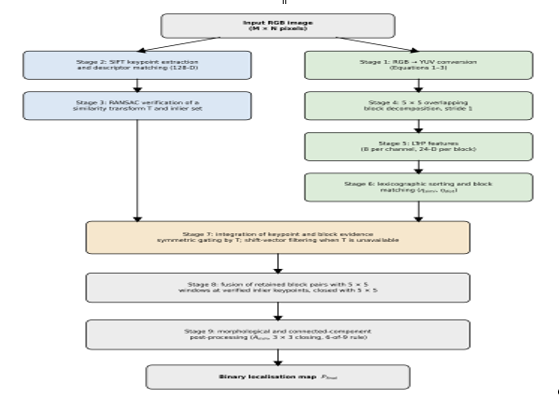
Copy-move forgery (CMF) remains one of the most prevalent forms of digital image manipulation, wherein regions of an image are copied and pasted elsewhere within the same image to conceal or fabricate visual content. While block-based methods using Local Tetra Pattern (LTrP) descriptors have demonstrated strong detection performance—achieving an F1 score of 0.9093 on the CoMoFoD dataset—they exhibit significant degradation when forged regions undergo geometric transformations such as rotation, scaling, or flipping. This paper proposes an enhanced Copy-Move Forgery Detection (CMFD) technique that combines the LTrP texture descriptor with the Scale Invariant Feature Transform (SIFT) keypoint descriptor in a hybrid framework. SIFT keypoints are first extracted for robust handling of geometric transformations, after which the image is converted to YUV colour space and divided into 5×5 overlapping blocks for LTrP feature extraction. Feature matching, shift-vector-based outlier removal, and morphological post-processing are applied to produce a final binary localization map. Evaluation on the standard CoMoFoD dataset using precision, recall, and F1 score demonstrates that the proposed method outperforms the baseline LTrP-only technique of Ganguly et al. (2023) under geometric post-processing conditions.
References
Amerini, I., Ballan, L., Caldelli, R., Del Bimbo, A., & Serra, G. (2011). A SIFT-based forensic method for copy-move attack detection and transformation recovery. IEEE Transactions on Information Forensics and Security, 6(3), 1099–1110.
Ardizzone, E., Bruno, A., & Mazzola, G. (2015). Copy-move forgery detection by matching triangles of keypoints. IEEE Transactions on Information Forensics and Security, 10(10), 2084–2094.
Barni, M., Phan, Q. T., & Tondi, B. (2021). Copy-move source-target disambiguation through multi-branch CNNs. IEEE Transactions on Information Forensics and Security, 16, 1825–1840.
Bi, X., Pun, C. M., & Yuan, X. C. (2016). Multi-level dense descriptor and hierarchical feature matching for copy-move forgery detection. Information Sciences, 345, 226–242.
Chen, B., Tan, W., Coatrieux, G., Zheng, Y., & Shi, Y. Q. (2020). A serial image copy-move forgery localization scheme with source/target distinguishment. IEEE Transactions on Information Forensics and Security, 23, 3506–3517.
Chen, L., Lu, W., Ni, J., Sun, W., & Huang, J. (2013). Region duplication detection based on Harris corner points and step sector statistics. Journal of Visual Communication and Image Representation, 24(3), 244–254.
Elaskily, M. A., Alkinani, M. H., Sedik, A., & Dessouky, M. M. (2021). Deep learning-based algorithm (ConvLSTM) for copy-move forgery detection. Journal of Intelligent & Fuzzy Systems, 40(3), 4385–4405.
Fridrich, J., Soukal, D., & Lukas, J. (2003). Detection of copy-move forgery in digital images. Proceedings of the Digital Forensic Research Workshop, 55–61.
Ganguly, S., Mandal, S., & Malakar, S. (2023). Copy-move forgery detection using local tetra pattern-based texture descriptor. Multimedia Tools and Applications, 82, 19621–19642.
Kumar, N., & Meenpal, T. (2022). Salient keypoint-based copy-move image forgery detection. Australian Journal of Forensic Sciences, 1–24.
Liao, X., Li, K., Zhu, X., & Liu, K. R. (2020a). Robust detection of image operator chain with two-stream convolutional neural network. IEEE Journal of Selected Topics in Signal Processing, 14(5), 955–968.
Lowe, D. G. (1999). Object recognition from local scale-invariant features. Proceedings of the IEEE International Conference on Computer Vision, 2, 1150–1157.
Pan, X., & Lyu, S. (2010). Region duplication detection using image feature matching. IEEE Transactions on Information Forensics and Security, 5(4), 857–867.
Ryu, S. J., Kirchner, M., Lee, M. J., & Lee, H. K. (2013). Rotation invariant localization of duplicated image regions based on Zernike moments. IEEE Transactions on Information Forensics and Security, 8(8), 1355–1370.
Sharma, S., & Dhavale, S. V. (2016). A review of passive forensic techniques for detection of copy-move attacks on digital videos. 3rd International Conference on Advanced Computing and Communication Systems (ICACCS), 1–6.
Tralic, D., Zupancic, I., Grgic, S., & Grgic, M. (2013). CoMoFoD — new database for copy-move forgery detection. Proceedings ELMAR-2013, 49–54.
Wu, Y., Abd-Almageed, W., & Natarajan, P. (2018). BusterNet: Detecting copy-move image forgery with source/target localization. Proceedings of the European Conference on Computer Vision (ECCV), 168–184.
Yang, J., Liang, Z., Gan, Y., & Zhong, J. (2021). A novel copy-move forgery detection algorithm via two-stage filtering. Digital Signal Processing, 113, 103032.
Zandi, M., Mahmoudi-Aznaveh, A., & Talebpour, A. (2016). Iterative copy-move forgery detection based on a new interest point detector. IEEE Transactions on Information Forensics and Security, 11(11), 2499–2512.
Downloads
Published
Issue
Section
Categories
License
Copyright (c) 2026 Amadi Muhammad Dikko, Mustapha Aminu Bagiwa, Mahmud Muhammad Yahaya, Aminu Haruna Rawayau, Rukayya Ibrahim Yahaya

This work is licensed under a Creative Commons Attribution 4.0 International License.


