
Comparative Structural, Optical, Morphological and Elemental Characterisation of Jujube-Mediated Silver and Zinc Oxide Nanoparticles
DOI:
https://doi.org/10.33003/fjs-2026-1019-6073Keywords:
jujube, nanoparticles, zinc oxide nanoparticles, silver nanopartilces, SEM, EDX, UV-Vis, XRD and FTIRAbstract
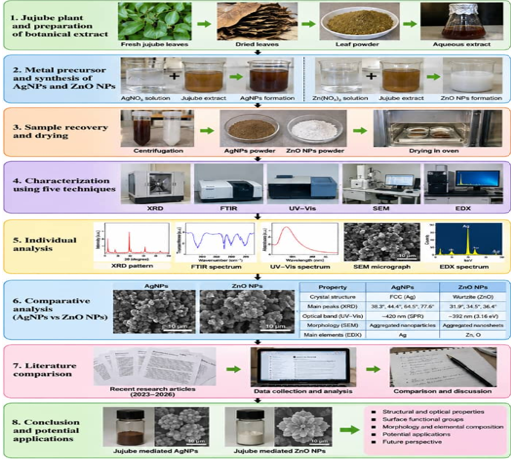
Plant extracts offer a practical route for nanoparticle synthesis because naturally occurring compounds can participate in particle formation and remain associated with the resulting material. In this study, jujube extract was used to prepare silver nanoparticles (AgNPs) and zinc oxide nanoparticles (ZnO NPs). Both products were examined using the same set of characterization techniques: X-ray diffraction (XRD), Fourier-transform infrared spectroscopy (FTIR), ultraviolet-visible (UV–Vis) spectroscopy, scanning electron microscopy (SEM), and energy-dispersive X-ray spectroscopy (EDX). The XRD results clearly differentiated the two materials. The Ag sample showed peaks at approximately 38.27°, 44.45°, 64.55°, and 77.57°, characteristic of face-centered-cubic Ag, while the ZnO sample displayed reflections at 31.91°, 34.55°, 36.38°, 47.60°, 56.78°, and 63.02°, consistent with hexagonal wurtzite ZnO. FTIR spectra from both samples contained bands associated with plant-derived functional groups, along with low-wavenumber features related to their respective inorganic phases. Their optical responses were also distinct. Ag showed the characteristic response of metallic nanoparticles, whereas ZnO exhibited an optical edge at about 392.5 nm, corresponding to approximately 3.16 eV. This value was calculated from the optical-edge wavelength and is not presented as a formal Tauc band gap. SEM images showed rough, uneven, and strongly aggregated surfaces in both samples. EDX further showed strong Ag signals in the silver sample and Zn and O as the main detected elements in the ZnO sample. Overall, the study compares two different nanomaterials produced using the same jujube-based approach and shows how their structural, optical, morphological, and elemental characteristics differ.
References
[1] S. Islam Sadia et al., “Green synthesis of crystalline silver nanoparticle by bio-mediated plant extract: A critical perspective analysis,” Nano-Structures & Nano-Objects, vol. 39, p. 101272, 2024, doi: 10.1016/j.nanoso.2024.101272.
[2] S. Peta and S. Singh, “Green synthesis of zinc oxide nanoparticles using plant extract for catalysis applications,” Nanoscale, vol. 17, pp. 3708–3713, 2025, doi: 10.1039/D4NR03581J.
[3] S. Aliannezhadi et al., “The physical properties and photocatalytic activities of green synthesized ZnO nanostructures using different ginger extract concentrations,” Scientific Reports, 2024, doi: 10.1038/s41598-024-52455-z.
[4] A. S. Abdelbaky et al., “Green approach for the synthesis of ZnO nanoparticles using Cymbopogon citratus aqueous leaf extract characterization and evaluation of their biological activities,” Chemical and Biological Technologies in Agriculture, 2023, doi: 10.1186/s40538-023-00432-5.
[5] W. Mushtaq et al., “Green synthesis of zinc oxide nanoparticles using Viscum album extracts unveiling bioactive compounds antibacterial potential and antioxidant activities,” Plants, vol. 12, 2023, doi: 10.3390/plants12112130.
[6] A. A. Al-Askar, A. H. Hashem, N. I. Elhussieny, and E. Saied, “Green biosynthesis of zinc oxide nanoparticles using Pluchea indica leaf extract antimicrobial and photocatalytic activities,” Molecules, vol. 28, 2023, doi: 10.3390/molecules28124679.
[7] Z. Zulfiqar et al., “Plant-mediated green synthesis of silver nanoparticles synthesis characterization biological applications and toxicological considerations,” Biocatalysis and Agricultural Biotechnology, 2024, doi: 10.1016/j.bcab.2024.103121.
[8] S. Akhter et al., “A systematic review on green synthesis of silver nanoparticles using plants extract and their bio-medical applications,” Heliyon, 2024, doi: 10.1016/j.heliyon.2024.e29766.
[9] S. Thomas et al., “Plant-based synthesis characterization approaches applications and toxicity of silver nanoparticles a comprehensive review,” Journal of Biotechnology, 2024, doi: 10.1016/j.jbiotec.2024.08.009.
[10] S. S. Dos Santos et al., “Green synthesis of silver nanoparticles mediated by plant extracts: A critical review and experimental insights on the integrated effects of pH temperature and concentration,” Bioscience Nanotechnology, 2026, doi: 10.1186/s44331-026-00033-7.
[11] S. Jadoun et al., “Recent advancements in sustainable synthesis of zinc oxide nanoparticles using various plant extracts for environmental remediation,” Environmental Science and Pollution Research, 2024, doi: 10.1007/s11356-024-32357-3.
[12] H. S. Kharde et al., “Green synthesis and characterization of zinc oxide nanoparticles by using numerous plants a review,” Journal of Advanced Scientific Research, 2024, doi: 10.55218/JASR.2024150303.
[13] R. Dhir et al., “Plant-mediated synthesis of silver nanoparticles unlocking their pharmacological potential a comprehensive review,” Frontiers in Bioengineering and Biotechnology, 2024, doi: 10.3389/fbioe.2023.1324805.
[14] F. N. Alharbi, Z. M. Abaker, and S. Z. A. Makawi, “Phytochemical substances mediated synthesis of zinc oxide nanoparticles,” Inorganics, vol. 11, 2023, doi: 10.3390/inorganics11080328.
[15] A. Alotaibi et al., “Green synthesis of uncoated and olive leaf extract-coated silver nanoparticles sunlight photocatalytic antiparasitic and antifungal activities,” International Journal of Molecular Sciences, vol. 25, 2024, doi: 10.3390/ijms25063082.
[16] S. Mehrotra et al., “Green synthesis and characterization of ginger-derived silver nanoparticles and evaluation of their antioxidant antibacterial and anticancer activities,” Plants, vol. 13, 2024, doi: 10.3390/plants13091255.
[17] M. Sundar et al., “Phyto-mediated green synthesis of silver nanoparticles using an aqueous leaf extract of Momordica cymbalaria antioxidant cytotoxic antibacterial and photocatalytic properties,” Processes, 2024, doi: 10.3390/pr1102061.
[18] N. Konappa et al., “Green synthesis of silver nanoparticles using Amomum nilgiricum leaf extracts preparation physicochemical characterization and ameliorative effect against human cancer cell lines,” Cytotechnology, vol. 77, p. 16, 2025, doi: 10.1007/s10616-024-00674-7.
[19] Vidyasagar et al., “Facile green synthesis of silver nanoparticles derived from the medicinal plant Clerodendrum serratum and its biological activity against Mycobacterium species,” Heliyon, vol. 10, e31116, 2024, doi: 10.1016/j.heliyon.2024.e31116.
[20] N. H. Ibrahim et al., “Green synthesis of silver nanoparticles and its environmental sensor ability to some heavy metals,” BMC Chemistry, 2024, doi: 10.1186/s13065-023-01105-y.
[21] M. Y. Al-darwesh, S. S. Ibrahim, and M. A. Mohammed, “A review on plant extract mediated green synthesis of zinc oxide nanoparticles and their biomedical applications,” Results in Chemistry, vol. 7, p. 101368, 2024, doi: 10.1016/j.rechem.2024.101368.
[22] S. S. Mohsen Ali et al., “Ecofriendly synthesis of silver nanoparticles using Barleria gibsonii and evaluation of antibacterial antioxidant cytotoxic and catalytic activities,” Scientific Reports, 2026, doi: 10.1038/s41598-026-37330-3.
[23] M. Fatima et al., “Green synthesis of silver nanoparticles from Buddleja asiatica L. and their multifunctional applications for industrial and bio-based products,” Scientific Reports, 2026, doi: 10.1038/s41598-026-57982-5.
[24] S. C. Bhattacharjee et al., “Green synthesis of silver nanoparticles using Catharanthus roseus leaf extract characterization and biological activities,” South African Journal of Chemical Engineering, 2026, doi: 10.1016/j.sajce.2026.100967.
[25] K. Palanivel et al., “Antibacterial and cytotoxic effect of green synthesized silver nanoparticles using Solanum torvum fruit pedicel waste extract,” Discover Biotechnology, 2026, doi: 10.1007/s44340-026-00049-y.
[26] D. K. Takcı, M. S. Ozdenefe, and S. Genc, “Green synthesis of silver nanoparticles with an antibacterial activity using Salvia officinalis aqueous extract,” Journal of Crystal Growth, vol. 614, p. 127239, 2023, doi: 10.1016/j.jcrysgro.2023.127239.
[27] T. Karan, Z. Gonulalan, R. Erenler, U. Kolemen, and O. Eminagaoglu, “Green synthesis of silver nanoparticles using Sambucus ebulus leaves extract characterization quantitative analysis of bioactive molecules antioxidant and antibacterial activities,” Journal of Molecular Structure, 2023, doi: 10.1016/j.molstruc.2023.136836.
[28] S. Veera, P. Chirumamilla, S. B. Dharavath, N. Maduru, and S. Taduri, “Facile green synthesis of silver nanoparticles using Corallocarpus epigaeus leaf extract: Structural, photoluminescence and antibacterial properties,” Chemical Data Collections, vol. 45, p. 101032, 2023, doi: 10.1016/j.cdc.2023.101032.
[29] A. Mishra, S. Kumar, and A. Singh, “Biosynthesis and characterization of Ocimum sanctum green silver nanoparticles and unravelling their enhanced anti-filarial activity through a HRAMS proteomics approach,” RSC Advances, vol. 14, no. 9, pp. 5893–5906, 2024, doi: 10.1039/D3RA08702F.
[30] Islam MF, Islam S, Miah MAS, Huq AKO, Saha AK, Mou ZJ, Mondol MMH, Bhuiyan MNI. Green synthesis of zinc oxide nano particles using Allium cepa L. waste peel extracts and its antioxidant and antibacterial activities. Heliyon. 2024 Jan 27;10(3):e25430. doi: 10.1016/j.heliyon.2024.e25430.
[31] S. A. Mousa, D. A. Wissa, H. H. Hassan, A. A. Ebnalwaled, and S. A. Khairy, “Enhanced photocatalytic activity of green synthesized zinc oxide nanoparticles using low-cost plant extracts,” Scientific Reports, vol. 14, p. 16713, 2024, doi: 10.1038/s41598-024-66975-1.
[32] R. Adhavan, K. Selvam, P. Prakash, P. Manimegalai, D. Kirubakaran, and M. S. Shivakumar, “Bioefficacy of zinc oxide nanoparticle synthesis and their biological, environmental applications from Eranthemum roseum,” Toxicology Reports, vol. 13, p. 101758, 2024, doi: 10.1016/j.toxrep.2024.101758.
[33] A. K. Tiwari, S. Jha, S. K. Tripathi, R. S. Shukla, R. R. Awasthi, A. K. Bhardwaj, A. K. Singh, and A. Dikshit, “Spectroscopic investigations of green synthesized zinc oxide nanoparticles (ZnO NPs): Antioxidant and antibacterial activity,” Discover Applied Sciences, vol. 6, p. 399, 2024, doi: 10.1007/s42452-024-06049-z.
[34] S. G. Bekele, D. D. Ganta, and M. Endashaw, “Green synthesis and characterization of zinc oxide nanoparticles using Monoon longifolium leaf extract for biological applications,” Discover Chemistry, vol. 1, p. 5, 2024, doi: 10.1007/s44371-024-00007-9.
[35] R. Singh, R. Singh, P. Parihar, and J. V. Mani, “Green synthesis of silver nanoparticles using Solanum sisymbriifolium leaf extract: Characterization and evaluation of antioxidant, antibacterial and photocatalytic degradation activities,” Process Biochemistry, vol. 143, pp. 337–352, 2024, doi: 10.1016/j.procbio.2024.04.026.
[36] N. Pugazhenthiran et al., “Sunlight assisted degradation of methylene blue dye by zinc oxide nanoparticles green synthesized using Vitex negundo plant leaf extract,” Results in Chemistry, vol. 7, p. 101315, 2024, doi: 10.1016/j.rechem.2024.101315.
[37] S. E. Dafalla et al., “Green and sustainable synthesis of the ZnONPs using leaf extract of Guazuma ulmifolia for antioxidant and antimicrobial activities,” Journal of Umm Al-Qura University for Applied Sciences, vol. 11, pp. 308–318, 2025, doi: 10.1007/s43994-024-00161-x.
[38] U. Khattak, S. Jan, R. Ullah, T. Haq, M. Khan, M. Iqbal, A. Kaplan, A. Rehman, M. F. Elsadek, and M. Ajmal Ali, “Green synthesis and physical characterization of zinc oxide nanoparticles (ZnO NPs) derived from the methanol extract of Euphorbia dracunculoides Lam. (Euphorbiaceae) with enhanced biosafe applications,” Green Processing and Synthesis, vol. 13, no. 1, p. 20240119, 2024, doi: 10.1515/gps-2024-0119.
[39] Yojana Sharma, Vikas Anand, Rajesh Kumar, Anup Kumar, Pawan Heera, Green synthesized ZnO nanoparticles using Jatropha curcas latex for antibacterial applications, Next Materials, Volume 8, 2025, 100869, ISSN 2949-8228, https://doi.org/10.1016/j.nxmate.2025.100869.
[40] D. A. Barretto, D. M. S., R. K. Chalannavar, Komalakshi, and A. A. Kamble, “Plant-mediated ZnO nanoparticles using Allophylus concanicus: Synthesis, characterization, and in vitro biological evaluation,” Nano-Structures & Nano-Objects, vol. 43, p. 101524, 2025, doi: 10.1016/j.nanoso.2025.101524.
[41] S. Sivakumar, B. Rangaswamy, L. Shanmugam, and K. Marudhachalam, “Phytochemical mediated zinc oxide nanoparticles from Euphorbia antiquorum: Synthesis, characterization & antibacterial activity,” Next Nanotechnology, vol. 8, Art. no. 100210, 2025, doi: 10.1016/j.nxnano.2025.100210.
[42] D. N. G. Rathi, N. Saad, N. M. Esa, A. A. Rashed, M. F. Md Noh, and C. A. Che Abdullah, “Green synthesis and functional evaluation of zinc oxide nanoparticles from red dragon fruit peel,” Scientific Reports, vol. 15, p. 37312, 2025, doi: 10.1038/s41598-025-21333-7.
[43] N. H. N. Nayel et al., “Green-chemically synthesized silver nanoparticles using Lactuca anatolica leaf extract: Characterization, biological assessment, molecular docking study, DFT calculation,” Inorganic Chemistry Communications, vol. 179, p. 114821, 2025, doi: 10.1016/j.inoche.2025.114821.
[44] K. Shinde et al., “Green synthesis of silver nanoparticles using Argyreia pilosa leaf extract: Characterization and bioactivity assessment,” Next Materials, vol. 8, p. 100832, 2025, doi: 10.1016/j.nxmate.2025.100832.
[45] Elsha M. Elias, Gomathy Meganathan, Manikantan Pappuswamy, Green synthesis, characterization, and biological applications of silver nanoparticles from Pachira glabra leaf extract, The Microbe, Volume 7, 2025, 100413, ISSN 2950-1946, https://doi.org/10.1016/j.microb.2025.100413.
[46] W. Dagher, A. Alassod, M. F. Al Hinnawi, I. Alghoraibi, A. Taher, and M. Alnhlaoui, “Characterization and antibacterial effect of green-synthesised silver nanoparticles using different extraction methods from Ziziphus spina-christi (Sidr) leaf extract collected from Syria,” RSC Advances, vol. 15, no. 42, pp. 35642–35659, 2025, doi: 10.1039/D5RA05214A.
[47] D. K. Shrestha et al., “Comparative analysis of biological activities of green-synthesized silver and zinc oxide nanoparticles using Pogonatherum crinitum extracts,” Arabian Journal of Chemistry, 2025, doi: 10.25259/AJC_188_2024.
[48] N. Gökdere et al., “Green synthesis and characterization of silver and zinc nanoparticles using Pyracantha coccinea and their biological activities,” Applied Organometallic Chemistry, 2025, doi: 10.1002/aoc.70391.
[49] G. C. Bimal, I. Ojha, S. Joshi, G. C. Briksha, Y. R. Rosyara, A. Ojha, P. R. Joshi, H. R. Pant, and P. S. Saud, “Green synthesis of silver and zinc oxide nanoparticles using Justicia adhatoda leaf extract for antimicrobial and anticancer applications,” Scientific Reports, 2026, doi: 10.1038/s41598-026-59930-9.
[50] M. Umar, M. Ahmad, M. Sadeeq, H. Ali, A. Khan, A. A. Chaudhary, M. A. M. Ali, and M. U. Naeem, “Green synthesis and characterizations of zinc oxide nanoparticles using acorn fruit extract for antimicrobial, larvicidal and in silico activities,” Scientific Reports, vol. 16, p. 7072, 2026, doi: 10.1038/s41598-026-36137-6.
[51] H. M. Umar, T. Zangina, J. L. Sumaila, A. Dwivedi, and M. Aamir, “Green synthesis of silver and zinc oxide nanoparticles using Ziziphus jujuba: Mechanisms, characterization, applications, and future perspectives,” Journal of Materials Science: Materials in Energy, vol. 2, art. no. 9, 2026, doi: 10.1007/s44308-026-00021-6.
[52] A. Dwivedi, H. M. Umar, G. Ahmed, J. Vaswani, and P. Varshney, “Enhanced structural and magnetic properties of ABS5 compared to AAS5 and ACS5: A combined XRD, SEM, and VSM study,” International Journal of Material Science and Engineering, vol. 12, no. 2, pp. 1–9, 2026, doi: 10.14445/23948884/IJMSE-V12I2P101.
Downloads
Published
Issue
Section
Categories
License
Copyright (c) 2026 hamza Mustapha Umar, Jamila Lamido Sumaila, Tasiu Zangina

This work is licensed under a Creative Commons Attribution 4.0 International License.