
Sensitivity-Based Performance Optimisation of a Lead-Free Formamidinium Tin Iodide (Fasni3) Perovskite Solar Cell Using Scaps-1d Simulation
DOI:
https://doi.org/10.33003/fjs-2026-1019-5914Keywords:
Optimisation, Perovskite Solar Cells, SCAPs-1D, Simulation, StabilityAbstract
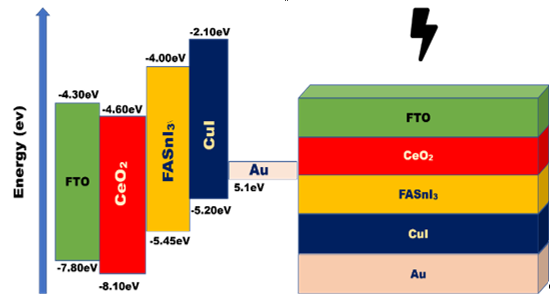
This work presents a design and simulation framework for the multi-parameter optimization of a lead-free Perovskite Solar Cell (PSC) with an FTO/CeO2/FASnI3/CuI structure. It focuses on the device parameters that influence operational stability. Using the Solar Cell Capacitance Simulator One-Dimension (SCAPS-1D) (version 3.3.12), the study first verified the baseline performance of the device. Six parameters, previously optimized for efficiency, were re-evaluated and categorized into fixed design parameters set during fabrication and those susceptible to drift through known FASnI3 degradation pathways. Normalized sensitivity coefficients were then calculated from the simulation sweeps. The results showed a baseline Power Conversion Efficiency (PCE) of 22.04%, an open-circuit voltage (Voc) of 0.9843V, a short-circuit current density (Jsc) of 26.01 mA/cm², and a fill factor (FF) of 86.12%. Following multi-parameter optimisation of bandgap, absorber thickness, and back-contact work function, the device achieved an optimised PCE of 24.85%, with a Voc of 0.9307 V, a Jsc of 30.65 mA/cm², and an FF of 87.10%. Sensitivity analysis revealed that electron affinity is the most influential factor on PCE, with roughly 19 percentage points per eV, followed by acceptor density (about 0.57 percentage points per decade) and defect density (around 0.20 percentage points per decade). The study highlights interfacial electron affinity control as a priority for enhancing device stability, since among the parameters examined PCE proved most sensitive to drift in electron affinity; defect density, however, remains the parameter most likely to drift in practice through the known Sn²⁺ oxidation pathway.
References
Abdelaziz, S., Zekry, A., Shaker, A., & Abouelatta, M. (2020). Investigating the performance of formamidinium tin-based perovskite solar cell by SCAPS device simulation. Optical Materials, 101. https://doi.org/10.1016/j.optmat.2020.109738
Abdul Karim, M., Matsuishi, K., Emrul Kayesh, M., He, Y., & Islam, A. (2023). Supporting Information Inhibition of Sn 2+ Oxidation in FASnI3 Perovskite Precursor Solution and Enhanced Stability of Perovskite Solar Cells by Reductive Additive.
Ayyappa, R., Marzouk, R., Dafaalla, H., & AlAqil, M. A. (2026). Numerical simulation of thickness-dependent carrier collection efficiency in SnSe absorber layers. Scientific Reports, 16(1). https://doi.org/10.1038/s41598-026-46035-6
Bhandari, S., Valsalakumar, S., Ali, M. S., Mallick, T. K., Hinshelwood, J., & Sundaram, S. (2025). Influence of Adjustable CeO2 Morphology on the Performance of Ambient Hole Transport Layer-Free Carbon-Based Perovskite Solar Cells. Energy and Fuels, 39(20), 9566–9575. https://doi.org/10.1021/acs.energyfuels.5c00518
Burgelman, M., Nollet, P., & Degrave, S. (2000). Modelling polycrystalline semiconductor solar cells. www.elsevier.com/locate/tsf
Chabri, I., Benhouria, Y., Oubelkacem, A., Kaiba, A., Essaoudi, I., & Ainane, A. (2023). SCAPS device simulation study of formamidinium Tin-Based perovskite solar Cells: Investigating the influence of absorber parameters and transport layers on device performance. Solar Energy, 262. https://doi.org/10.1016/j.solener.2023.111846
Ding, C., Zhang, Y., Liu, F., Kitabatake, Y., Hayase, S., Toyoda, T., Yoshino, K., Minemoto, T., Katayama, K., & Shen, Q. (2018). Effect of the Conduction Band Offset on Interfacial Recombination Behavior of the Planar Perovskite Solar Cells.
Dong, J., Feng, X., Jia, J., Shi, B., Wu, Y., & Cao, B. (2023). Annealing free CeO2 electron transport layer for efficient perovskite solar cells. Journal of Solid State Chemistry, 317. https://doi.org/10.1016/j.jssc.2022.123661
IEA, I. U. W. B. and W. (2025). Tracking SDG 7: The Energy Progress Report 2025.
Jalaludin, N. A., Salehuddin, F., Rahim, F. L., Mustafa, A. N., Kaharudin, K. E., Islam, M. A., Amin, N., & Arith, F. (2025). Efficient hole extraction by doped-polyaniline/graphene oxide in lead-free perovskite solar cell: a computational study. Physica Scripta, 100(2). https://doi.org/10.1088/1402-4896/ada4e8
Kadhem, W. J., AlZoubi, T., AlGharram, M., Makhadmeh, G., Abuelsamen, A., AL-Diabat, A. M., Mandumpal, J., & Zyoud, S. H. (2026). Sustainable optoelectronic architecture of polymer-based HTLs for high-performance CsSnI2Br perovskite solar cells. ChemPhysMater. https://doi.org/10.1016/j.chphma.2026.03.003
Khawaja, K. A., Xiang, W., Wall, J., Gu, X., Li, L., & Yan, F. (2025). Hole transport layer selection for stable and efficient carbon electrode-based perovskite solar cells. RSC Advances, 15(17), 13681–13690. https://doi.org/10.1039/d5ra01694k
Li, S., Yang, F., Chen, M., Yang, J., Jiang, L., Sun, Y., Nirmala Graced, A., Jain, S. M., & Liu, H. (2022). Additive engineering for improving the stability of tin-based perovskite (FASnI3) solar cells. In Solar Energy (Vol. 243, pp. 134–141). Elsevier Ltd. https://doi.org/10.1016/j.solener.2022.07.009
Manga, P. J., Amusat, R. O., Mohammed, M., Samaila, H., Likta, E. W., Ibrahim, G., Daniel, S., & Gin, N. S. (2024). FUDMA Journal of Renewable and Atomic Energy (FJoRAE) Device Simulation Of Free Hole Transport Layer (FHTL) Based On FASnI3 Perovskite Solar Cell With C60 Electron Transport Layer (ETL). 1(1), 1–16. https://doi.org/10.33003/fjorae.2024.0101.01
Mehrabian, M., Taleb-Abbasi, M., & Akhavan, O. (2024). Using Cu2O/ZnO as Two-Dimensional Hole/Electron Transport Nanolayers in Unleaded FASnI3 Perovskite Solar Cells. Materials, 17(5). https://doi.org/10.3390/ma17051064
Mohamad Noh, M. F., Arzaee, N. A., Sadikin, S. N., Idris, M. I., Chau, C. F., Yap, B. K., Huang, J., Ishikawa, R., & Mahmood Zuhdi, A. W. (2026). Semitransparent Perovskite Solar Cells: Strategies, Prospects, and Challenges. In Nano-Micro Letters (Vol. 18, Number 1). Springer Science and Business Media B.V. https://doi.org/10.1007/s40820-026-02147-2
Nordin, N. A., Ansari, M. N. M., Nomanbhay, S. M., Hamid, N. A., Tan, N. M. L., Yahya, Z., & Abdullah, I. (2021). Integrating photovoltaic (Pv) solar cells and supercapacitors for sustainable energy devices: A review. In Energies (Vol. 14, Number 21). MDPI. https://doi.org/10.3390/en14217211
Pesci, M., Romagnoli, L., Brunetti, B., Vecchio Ciprioti, S., Ciccioli, A., & Latini, A. (2025). Stability of Tin-Containing Hybrid Perovskites: The Thermal Decomposition of Formamidinium Tin Triiodide (FASnI3) Investigated by Thermogravimetry and Effusion Techniques. Journal of Physical Chemistry C, 129(20), 9291–9301. https://doi.org/10.1021/acs.jpcc.5c01854
Rehman, A. ul, Afzal, S., Naeem, I., Bibi, D., Sarwar, S. G., Nabeel, F., & Obodo, R. M. (2024). Performance optimization of FASnI3 based perovskite solar cell through SCAPS-1D simulation. Hybrid Advances, 7. https://doi.org/10.1016/j.hybadv.2024.100301
Roy, P., Kumar Sinha, N., Tiwari, S., & Khare, A. (2020). A review on perovskite solar cells: Evolution of architecture, fabrication techniques, commercialization issues and status. In Solar Energy (Vol. 198, pp. 665–688). Elsevier Ltd. https://doi.org/10.1016/j.solener.2020.01.080
Shah, N., Shah, A. A., Leung, P. K., Khan, S., Sun, K., Zhu, X., & Liao, Q. (2023). A Review of Third Generation Solar Cells. In Processes (Vol. 11, Number 6). Multidisciplinary Digital Publishing Institute (MDPI). https://doi.org/10.3390/pr11061852
Shah, S. A. A., Sayyad, M. H., Khan, K., Guo, K., Shen, F., Sun, J., Tareen, A. K., Gong, Y., & Guo, Z. (2020). Progress towards high-efficiency and stable tin-based perovskite solar cells. In Energies (Vol. 13, Number 19). MDPI AG. https://doi.org/10.3390/en13195092
Shukla, R., Kumar, R. R., & Pandey, S. K. (2021). Theoretical Study of Charge Carrier Lifetime and Recombination on the Performance of Eco-Friendly Perovskite Solar Cell. IEEE Transactions on Electron Devices, 68(7), 3446–3452. https://doi.org/10.1109/TED.2021.3078063
Downloads
Published
Issue
Section
Categories
License
Copyright (c) 2026 Mannir Ahmad, Zakiyyu Ibrahim Takai, Tasiu Zangina

This work is licensed under a Creative Commons Attribution 4.0 International License.