
Acute Oral Toxicity of an Alkaloid-Rich Fraction of Nauclea diderrichii Stem Bark in Wistar Rats: Biochemical and Histopathological Evaluation
DOI:
https://doi.org/10.33003/fjs-2026-1017-6053Keywords:
Nauclea diderrichii, Alkaloid-Rich Fraction, Acute Oral Toxicity, Biomarker, Histopathology, HepatorenalAbstract
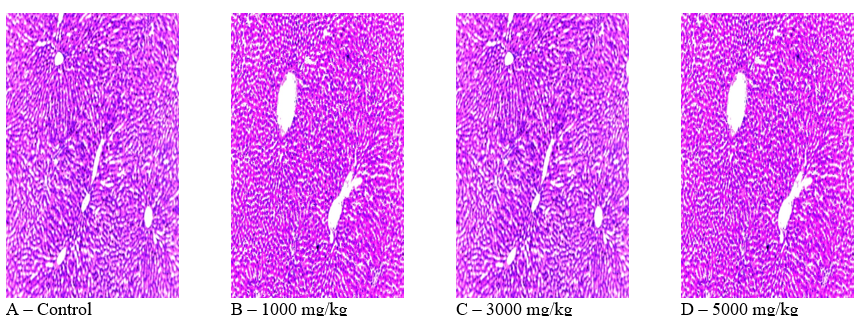
The study evaluated the acute oral toxicity of an alkaloid-rich fraction derived from the stem bark of Nauclea diderrichii, a plant traditionally used in Sub-Saharan Africa for various ailments including malaria and gastrointestinal disorders. Acute oral toxicity was assessed in Wistar rats using Lorke’s method (Phase I: n = 3 per group; Phase II: n = 1 per dose). A separate cohort of male Wistar rats (n = 3 per group: vehicle control, 1000, 3000 and 5000 mg/kg) was used to evaluate body weight, relative organ weight, serum biochemical biomarkers and histopathology. No mortality was recorded at any dose up to 5000 mg/kg, indicating an oral LD₅₀ greater than 5000 mg/kg. Minor, transient behavioural changes such as lethargy and reduced feeding were observed at higher doses and resolved within 24 h. Body-weight gain was modestly reduced, and relative liver and kidney weights were significantly elevated at 3000 and 5000 mg/kg. Serum ALT, AST, ALP, bilirubin, urea, creatinine and cystatin C increased in a dose-dependent manner at these doses, while histopathological evaluation revealed no structural lesions in liver or kidney at any dose. The absence of mortality up to 5000 mg/kg suggests low acute lethality; however, the dose-dependent biochemical and organ-weight changes observed at higher doses indicate biological effects that warrant further investigation. The findings of this study served as the foundation of safety guide of traditional preparations of N. diderrichii and further sub-acute/chronic studies incorporating sensitive structural biomarkers are needed before therapeutic or ethnomedicinal safety conclusions can be drawn.
References
Abdulrahman, M., & Adamu, M. (2019). In vitro phytochemistry and antiplasmodial activity of leaf extract and fractions of Nauclea diderrichii. Earthline Journal of Chemical Sciences, 2(2), 333–342.
Akhila, J. S., Shyamjith, D., & Alwar, M. C. (2007). Acute toxicity studies and determination of median lethal dose. Current Science, 917–920.
Akunne, T. C., Obi, B. C., Ofokansi, M. N., Nwonu, P. C., & Okoli, C. O. (2017). Antidiabetic activity and toxicological evaluation of the methanol–dichloromethane root bark extract of Nauclea diderrichii (De Wild) Merr. International Journal of Pharmacy and Pharmaceutical Sciences, 9(9), 279–283.
Bancroft, J. D., & Gamble, M. (2008). Theory and Practice of Histological Techniques. Elsevier Health Sciences.
Bekoe, E. O., Lartey, M., Gordon, A., & Asante, B. (2024). Medicinal uses, pharmacological activities, and bioactive compounds of Nauclea latifolia and implications in the treatment of tropical diseases. Health Sciences Investigations Journal, 5(1), 670–685. https://doi.org/10.46829/hsijournal.2024.6.5.1.670-685
Dey, P., Kundu, A., Kumar, A., Gupta, M., Lee, B. M., Bhakta, T., Dash, S., & Kim, H. S. (2020). Analysis of alkaloids (indole alkaloids, isoquinoline alkaloids, tropane alkaloids). In Recent Advances in Natural Products Analysis (pp. 505–567). Elsevier.
Douho Djimeli, R. C., Nchouwet, M. L., Poualeu Kamani, S. L., Tchoumba Tchoumi, L. M., Kamanyi, A., & Wansi Ngnokam, S. L. (2022). Antisecretory and spasmolytic activities of aqueous and ethanolic stem bark extracts of Nauclea diderrichii in Wistar rats. BioMed Research International, 2022(1), 7569848.
Evans, W. C. (2009). Trease and Evans’ Pharmacognosy. Elsevier Health Sciences.
Gu, X., & Manautou, J. E. (2012). Molecular mechanisms underlying chemical liver injury. Expert Reviews in Molecular Medicine, 14, e4. https://doi.org/10.1017/S1462399411002110
Hall, A. P., Elcombe, C. R., Foster, J. R., Harada, T., Kaufmann, W., Knippel, A., Küttler, K., Malarkey, D. E., Maronpot, R. R., & Nishikawa, A. (2012). Liver hypertrophy: a review of adaptive (adverse and non-adverse) changes—conclusions from the 3rd International ESTP Expert Workshop. Toxicologic Pathology, 40(7), 971–994.
Hamad, N. S., Ghafoor, D. D., & Rasul, H. O. (2026). Dose-dependent hepato-renal histopathology and inflammatory signaling changes after subacute oral resveratrol exposure in healthy female rats. Journal of Applied Toxicology. https://doi.org/10.1002/jat.70240
Harborne, A. J. (1998). Phytochemical Methods: A Guide to Modern Techniques of Plant Analysis. Springer Science & Business Media.
Jimoh, A. A., Mohammed, H., Oloyede, R. B., Yakubu, M. I., Mallam, D., Bashir, A. I-J., Timothy, M., & Sambo, S. S. (2026). Acute and sub-acute oral toxicity evaluation of methanol leaf extract of Vitellaria paradoxa Gaertn F. in Wistar rats. FUDMA Journal of Sciences, 10(3), 297–305.
Kilty, C. G., Keenan, J., & Shaw, M. (2007). Histologically defined biomarkers in toxicology. Expert Opinion on Drug Safety, 6(2), 207–215. https://doi.org/10.1517/14740338.6.2.207
Kuete, V., & Seukep, A. J. (2023). Phytochemistry and antibacterial potential of the genus Nauclea. In Advances in Botanical Research (Vol. 107, pp. 239–273). Elsevier.
Lamidi, M., Ollivier, E., Mahiou, V., Faure, R., Debrauwer, L., Nze Ekekang, L., & Balansard, G. (2005). Gluco-indole alkaloids from the bark of Nauclea diderrichii. 1H and 13C NMR assignments of 3α-5α-tetrahydrodeoxycordifoline lactam and cadambine acid. Magnetic Resonance in Chemistry, 43(5), 427–429.
Latif, R., & Nawaz, T. (2026). Medicinal plants and human health: a comprehensive review of bioactive compounds, therapeutic effects, and applications. Phytochemistry Reviews, 25(3), 2299–2342. https://doi.org/10.1007/s11101-025-10194-7
Liu, W., Di Giorgio, C., Lamidi, M., Elias, R., Ollivier, E., & De Méo, M. P. (2011). Genotoxic and clastogenic activity of saponins extracted from Nauclea bark as assessed by the micronucleus and the comet assays in Chinese hamster ovary cells. Journal of Ethnopharmacology, 137(1), 176–183.
Lorke, D. (1983). A new approach to practical acute toxicity testing. Archives of Toxicology, 54(4), 275–287.
Mamede, L., Ledoux, A., Jansen, O., & Frédérich, M. (2020). Natural phenolic compounds and derivatives as potential antimalarial agents. Planta Medica, 86(09), 585–618.
Martins, R. X., Carvalho, M., Maia, M. E., Flor, B., Souza, T., Rocha, T. L., Félix, L. M., & Farias, D. (2024). 2,4-D herbicide-induced hepatotoxicity: unveiling disrupted liver functions and associated biomarkers. Toxics, 12(1), 35.
Mbiantcha, M., Djami, M. B., Ateufack, G., Atsamo, D. A., Tsafack, G. E., Yousseu, W. N., Djuichou, F. S. N., Matah, V. M. M., Kenmogne, L. K., Adjouzem, F. C., Ndjoya, L. F. Z., & Tiokeng, G. L. (2020). Anti-inflammatory and anti-arthritic properties of aqueous extract of Nauclea diderrichii (Rubiaceae) stem bark in rats. Advances in Traditional Medicine, 20(2), 199–212. https://doi.org/10.1007/s13596-020-00446-6
Messina, A., & Duclos-Vallée, J.-C. (2023). Molecular mechanisms of hepatotoxicity. International Journal of Molecular Sciences, 24(4), 3791.
Moyo, M., Aremu, A. O., & Van Staden, J. (2015). Medicinal plants: an invaluable, dwindling resource in sub-Saharan Africa. Journal of Ethnopharmacology, 174, 595–606.
National Research Council. (2011). Guide for the Care and Use of Laboratory Animals (8th ed.). National Academies Press.
Omar, F., Tareq, A. M., Alqahtani, A. M., Dhama, K., Sayeed, M. A., Emran, T. Bin, & Simal-Gandara, J. (2021). Plant-based indole alkaloids: a comprehensive overview from a pharmacological perspective. Molecules, 26(8), 2297.
Organisation for Economic Co-operation and Development (OECD). (2001). Acute Oral Toxicity – Acute Toxic Class Method (OECD Guidelines for the Testing of Chemicals, Section 4, No. 423). OECD Publishing.
Pearson, A., Gafner, S., Rider, C. V., Embry, M. R., Ferguson, S. S., & Mitchell, C. A. (2022). Plant vs. kidney: evaluating nephrotoxicity of botanicals with the latest toxicological tools. Current Opinion in Toxicology, 32, 100371.
Pottel, H., Delanaye, P., & Cavalier, E. (2024). Exploring renal function assessment: creatinine, cystatin C, and estimated glomerular filtration rate focused on the European Kidney Function Consortium equation. Annals of Laboratory Medicine, 44(2), 135–143. https://doi.org/10.3343/alm.2023.0237
Qadri, S. S., Javaid, D., Reyaz, A., Ganie, S. Y., & Reshi, M. S. (2025). Liver disorders and phytotherapy. Toxicology Reports, 14, 102047.
Shaikh, J. R., & Patil, M. (2020). Qualitative tests for preliminary phytochemical screening: an overview. International Journal of Chemical Studies, 8(2), 603–608.
Shan, S., Du, P., Zheng, S., Liu, C., & Chen, G. (2026). Comprehensive characterization and hepatotoxicity prediction of pyrrolizidine alkaloids from Emilia sonchifolia (L.) DC. via building block molecular networking and network toxicology. Processes, 14(5), 786.
Thakur, S., Kumar, V., Das, R., Sharma, V., & Mehta, D. K. (2024). Biomarkers of hepatic toxicity: an overview. Current Therapeutic Research, 100, 100737.
Tietz, N. W. (1995). Clinical Guide to Laboratory Tests (3rd ed.). W.B. Saunders.
Yang, N., Guo, J., Zhang, J., Gao, S., Xiang, Q., Wen, J., Huang, Y., Rao, C., & Chen, Y. (2024). A toxicological review of alkaloids. Drug and Chemical Toxicology, 47(6), 1267–1281.
Yousef Almulhim, M. (2025). The efficacy of novel biomarkers for the early detection and management of acute kidney injury: a systematic review. PLoS One, 20(1), e0311755.
Downloads
Published
Issue
Section
Categories
License
Copyright (c) 2026 Ibrahim Hamisu Abdul, Alhassan Muhammad Wudil, Abubakar Yusuf

This work is licensed under a Creative Commons Attribution 4.0 International License.


