
Green Synthesis of Iron Nanoparticle Catalyst Using Manihot esculenta (Cassava) Peels Waste Extract and Their Application for the Degradation of Pharmaceutical Wastewater
DOI:
https://doi.org/10.33003/fjs-2026-1017-6042Keywords:
Green Synthesis, Iron Nanoparticles, Manihot esculenta, Pharmaceutical Wastewater, Photocatalytic DegradationAbstract
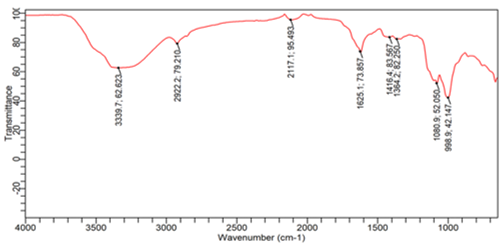
The synthesized iron nanoparticles (FeNPs) were characterized using Scanning Electron Microscopy coupled with Energy Dispersive X-ray spectroscopy (SEM-EDX), Ultraviolet-Visible Spectroscopy (UV-Vis), X-Ray Diffraction (XRD), Thermogravimetric Analysis (TGA), Fourier Transformed Infrared Spectroscopy (FTIR) and Brunauer-Emmett-Teller (BET) analysis. In addition, environmental impact assessment was conducted through reusability tests and toxicity assessments using Clarias gariepinus and Chlorella vulgaris which revealed the low risk of the FeNPs in the environment. The BET analysis revealed that the FeNPs have a high surface area of 407.111 m²/g, pore volume of 0.190 cm³/g, and an average pore size of 2.398 nm indicating microporosity. The XRD analysis confirmed a stable face-centred cubic crystal structure with the UV-Vis result confirming successful formation of iron oxide nanoparticles stabilized by cassava peel phytochemicals. The SEM-EDX revealed an irregular, agglomerated and porous morphologies with iron as the dominant element, characteristic of green-synthesized iron nanoparticles. FTIR analysis showed the presence of bioactive compounds which confirms that cassava peel extract served dual functions as both a reducing and stabilizing agent while TGA confirms thermal stability up to 4000C. The synthesized FeNPs showed remarkable catalytic activity achieving an 88% degradation of paracetamol and 83% of ampicillin under optimized conditions of pH 5 and temperature 800C. These findings have added value to the existing research in the field of green nanotechnology and contributes to developing safer alternatives in pharmaceutical wastewater treatment, providing environmentally friendly agricultural practices while protecting human health and ecosystems.
References
Darma, M. S., Hamza, A., & Imrana, I. (2025). Kinetics of photocatalytic degradation of methyl orange using CuO-α-Fe₂O₃ nanocomposite under visible light irradiation. FUDMA Journal of Sciences, 9, 216–223. DOI: https://doi.org/10.33003/fjs-2025-09(AHBSI)-3435
Dutta, V., Sharma, S., & Raizada, P. (2020). Photocatalytic degradation of pharmaceutical pollutants using metal oxide nanomaterials: A review. Journal of Environmental Chemical Engineering, 8(5), 104316.
Eche, P. I., Shaibu, S. E., Uwah, E. I., & Moses, E. A. (2025). One-pot biosynthesis and structural elucidation of iron-biochar nanocomposites from waste coconut shells. FUDMA Journal of Sciences, 9(2), 13–22. DOI: https://doi.org/10.33003/fjs-2025-0902-3037
Iravani, S. (2011). Green synthesis of metal nanoparticles using plants. Green Chemistry, 13(10), 2638–2650.
Jain, R., Mendiratta, S., Kumar, L., & Srivastava, A. (2021). Green synthesis of iron nanoparticles using Artocarpus heterophyllus peel extract and their application as a heterogeneous Fenton-like catalyst for the degradation of Fuchsin Basic dye. Current Research in Green and Sustainable Chemistry, 4, 100086.
Kayode-Afolayan, S. D., Ahuekwe, E. F., & Nwinyi, O. C. (2022). Impacts of pharmaceutical effluents on aquatic ecosystems. Scientific African, 17, e01288.
Khan, I., Saeed, K., & Khan, I. (2022). Green synthesis of iron oxide nanoparticles and their environmental applications. Environmental Research, 204, 111967.
Kolawole, A. S., & Iyiola, A. O. (2023). Environmental pollution: threats, impact on biodiversity, and protection strategies. In Sustainable utilization and conservation of Africa’s biological resources and environment (pp. 377-409). Singapore: Springer Nature Singapore.
Kumar, H., Bhardwaj, K., Sharma, R., Nepovimova, E., & Kuca, K. (2023). Green synthesis of metallic nanoparticles using fruit and vegetable waste: A step towards sustainable waste management. Journal of Environmental Management, 344, 118499.
Makarov, V. V., Love, A. J., Sinitsyna, O. V., Makarova, S. S., Yaminsky, I. V., Taliansky, M. E., & Kalinina, N. O. (2014). Green synthesis of metal nanoparticles using plants: A review. Acta Naturae, 6(1), 35–44.
Organisation for Economic Co operation and Development (2011). Test No. 201: Freshwater alga and cyanobacteria, growth inhibition test. OECD Guidelines for the Testing of Chemicals, Section 2. OECD Publishing, Paris.
Organisation for Economic Co-operation and Development (2019). Test No. 203: Fish acute toxicity test. OECD Guidelines for the Testing of Chemicals, Section 2. OECD Publishing, Paris. https://doi.org/10.1787/9789264069947-en
Rahman, M. S., Hossain, M. M., & Islam, M. A. (2023). Surface area and pore structure effects on catalytic activity of green-synthesized iron oxide nanoparticles. Journal of Environmental Chemical Engineering, 11(2), 109876.
Rathod, S. V., Saras, P., & Gondaliya, S. M. (2024). Environmental pollution: Threats and challenges for management. In Eco-restoration of polluted environment (pp. 1-34). CRC Press.
Sharma, G., Kumar, D., Pandey, P., & Singh, A. (2022). Biological synthesis of nanoparticles and their applications in environmental remediation: A sustainable approach. Environmental Nanotechnology, Monitoring & Management, 17, 100656.
Singh, J., Dutta, T., Kim, K.-H., Rawat, M., Samddar, P., & Kumar, P. (2018). Plant-mediated synthesis of metal nanoparticles and their environmental applications. Journal of Nanobiotechnology, 16, 84.
Singh, R., Kumar, P., & Sharma, V. (2022). Structural properties of green synthesized iron oxide nanoparticles. Journal of Environmental Chemical Engineering, 10, 107875.
Zaidi, N., Mir, M. A., Chang, S. K., Abdelli, N., & Andrews, K. (2025). Integrating computational analysis with IR, Raman, and visible spectroscopy for ampicillin characterization. Tropical Journal of Pharmaceutical Research, 24(11).
Zhang, Y., Li, X., & Chen, H. (2021). Influence of pore structure on catalytic performance of iron oxide nanoparticles. Applied Surface Science, 563, 150321.
Downloads
Published
Issue
Section
Categories
License
Copyright (c) 2026 Jibrin Noah Akoji, Merit Amarachukwu Eze, Lami Karimatu Abdullahi

This work is licensed under a Creative Commons Attribution 4.0 International License.