
DC-Focus: A Hyperbolic Focus+Context Formalism for Scalable Feature-Model Visualization
DOI:
https://doi.org/10.33003/fjs-2026-1019-6003Keywords:
Software Product Line Engineering, Variability management, Feature model visualization, Focus+context, Hyperbolic geometry, Poincare disk, Mobius transformationAbstract
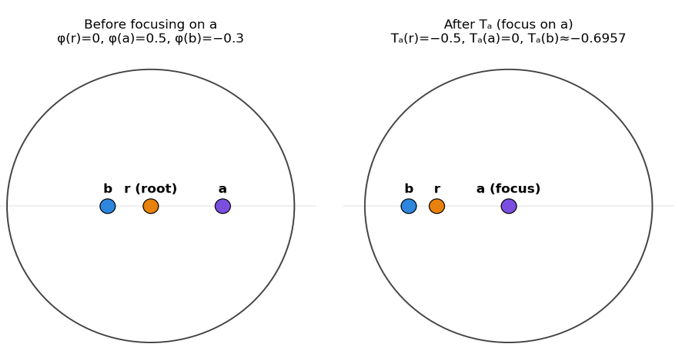
Feature models in industrial-scale Software Product Lines (SPL) routinely exceed a thousand features, yet the dominant visual metaphor for exploring them remains the Euclidean tree, whose readability degrades sharply as the number of nodes grows. Existing hyperbolic tree browsers address the general rendering problem but do not natively capture feature-model semantics — typed nodes (root/branch/child), a dependency relation separate from the tree structure, and cross-tree constraints — which is the specific gap this paper addresses. This paper presents a formal focus+context visualization model that embeds a feature model as a labelled graph in the Poincare disk and defines a Mobius-transformation-based re-centring operator to bring any selected feature into visual focus while preserving the surrounding structural context. We define the model as a seven-tuple over feature nodes, directed relationships, a type function, a root, a dependency relation, visualization attributes, and cross-tree constraints, and we specify five supporting algorithms for node insertion, focus navigation, node update, node deletion, and ancestry tracing. We show that the focus transformation is an isometry of the disk and therefore preserves the topological structure of the underlying feature model under re-centring. The model underlies a working browser-based prototype; this paper's contribution is the formal model, the isometry proof, and the algorithmic specification, and we do not report quantitative scalability results here. A worked numerical example illustrates the transformation on a small feature tree, and we discuss the architectural realization of the model as a four-layer, browser-based system.
References
Diaz, O., Montalvillo, L., Medeiros, R., Azanza, M., & Fogdal, T. (2022). Visualizing the customization endeavor in product-based-evolving software product lines. Empirical Software Engineering, 27(3), Article 59. doi.org.
Furnas, G. W. (1986). Generalized fisheye views. In Proceedings of the SIGCHI Conference on Human Factors in Computing Systems (pp. 16–23). Association for Computing Machinery. doi.org
Hess, T., Ostheimer, L., Betz, T., Karrer, S., Schmidt, T. J., Coquet, P., Semmler, S., & Thüm, T. (2025). variability.dev: Towards an online toolbox for feature modeling. In Proceedings of the 6th International Workshop on Variability Modeling of Software-Intensive Systems (MODEVAR 2024). arXiv preprint arXiv:2506.09845.
Lamping, J., Rao, R., & Pirolli, P. (1995). A focus+context technique based on hyperbolic geometry for visualizing large hierarchies. In Proceedings of the SIGCHI Conference on Human Factors in Computing Systems (pp. 401–408). Association for Computing Machinery. doi.org
Lindohf, R., Krüger, J., Herzog, E., & Berger, T. (2021). Software product-line evaluation in the large. Empirical Software Engineering, 26(2), Article 23. doi.org
Pohl, K., & Metzger, A. (2018). Software product lines. In The essence of software engineering (pp. 185–201). Springer. doi.org
Quinton, C., Vierhauser, M., Rabiser, R., Baresi, L., & Grünbacher, P. (2020). Evolution in dynamic software product lines (HAL preprint hal-02867825). HAL Open Science.
Rabiser, R., Krüger, J., Linsbauer, L., Grünbacher, P., Lopez-Herrejon, R. E., Schwägerl, F., Westfechtel, B., & Heider, W. (2018). Multi-purpose, multi-level feature modeling of large-scale industrial software systems. Software and Systems Modeling, 17(4), 1313–1339. doi.org
Downloads
Published
Issue
Section
Categories
License
Copyright (c) 2026 Muhammad Nura Malami, Muhammad Garba, Abubakar Ahmad Aliero, Afar Aminu, Abdulrashid Allami, Musa Muhammad Lawal, Saratu Ibrahim Mungadi, Bashar Bin Usman

This work is licensed under a Creative Commons Attribution 4.0 International License.


