
GC-MS Based Phytochemical Profiling and Complementary Antioxidant Activities of Ethanol Extract of Garcinia kola Seeds Collected from Kogi State, Nigeria
DOI:
https://doi.org/10.33003/fjs-2026-1017-6002Keywords:
Garcinia kola, Antioxidant Activity, DPPH, FRAP, Total Antioxidant Capacity, GC-MS, PhytochemicalsAbstract
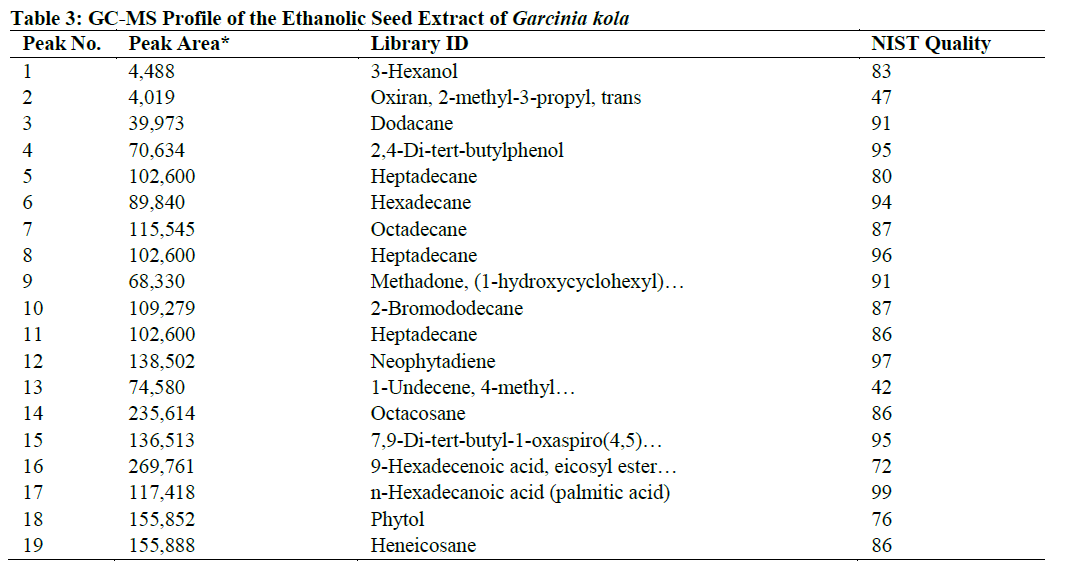
Garcinia kola Heckel (bitter kola) is widely used in West African traditional medicine and is valued for its diverse phytochemical constituents. This study evaluated the antioxidant activity and chemical composition of an ethanolic seed extract of G. kola using complementary in vitro antioxidant assays and gas chromatography-mass spectrometry (GC-MS). Qualitative phytochemical screening indicated the presence of flavonoids, phenols, tannins, alkaloids, saponins, and phytates. Antioxidant activity was assessed by 2,2-diphenyl-1-picrylhydrazyl (DPPH) radical-scavenging, total antioxidant capacity (TAC), and ferric reducing antioxidant power (FRAP) assays. The extract showed concentration-dependent DPPH scavenging, ranging from 43.24% at 100 µg/mL to 69.38% at 500 µg/mL, with an IC₅₀ of 284.09 µg/mL. The TAC and FRAP values were 96.61 µg ascorbic acid equivalents (AAE)/g and 84.89 µg AAE/g at 500 µg/mL, respectively. GC-MS tentatively identified 26 constituents, with n-hexadecanoic acid (27.84%), 2,4-di-tert-butylphenol (10.97%), and 9,12-octadecadienoic acid (approximately 4- 5%) among the more abundant components. These findings indicate measurable antioxidant capacity and chemical diversity, but GC-MS library matching alone does not establish definitive compound identity, biological activity, or causal contribution to the antioxidant response. Further isolation, structural confirmation, quantitative analysis, and mechanistic studies are warranted.
References
Abubakar, A., Olorunkemi, M., Busari, M., Hamzah, R., & Abdulrasheed-Adeleke, T. (2020). Comparative in vitro antioxidant activities of aqueous extracts of Garcinia kola and Buchholzia coriacea seeds. Tanzania Journal of Science, 46(2).
Adaramoye, O. A. (2009). Comparative effects of vitamin E and kolaviron (a biflavonoid from Garcinia kola) on carbon tetrachloride-induced renal oxidative damage in mice. Pakistan Journal of Biological Sciences, 12(16), 1146-1151. https://doi.org/10.3923/pjbs.2009.1146.1151
Apiamu, A., Orhonigbe, I., Evuen, U. F., Kadiri, H. E., Okoro, I. O., & Kpomah, E. D. (2023). In-vitro nutritional, phytochemical, antioxidant and anti-inflammatory analyses indicated disparity in Cola nitida L. and Garcinia kola Heckel used in Nigeria. FUDMA Journal of Sciences, 7(3), 102–111. https://doi.org/10.33003/fjs-2023-0703-1827.
Akinmoladun, A. C., Akinrinola, B. L., Olaleye, M. T., &Farombi, E. O. (2015). Kolaviron, a Garcinia kola biflavonoid complex, protects against ischemia/reperfusion injury: Pertinent mechanistic insights from biochemical and physical evaluations in rat brain. Neurochemical Research, 40(4), 777-787. https://doi.org/10.1007/s11064-015-1527-z
Benzie, I. F. F., &Strain, J. J. (1996). The ferric reducing ability of plasma (FRAP) as a measure of antioxidant power: The FRAP assay. Analytical Biochemistry, 239(1), 70-76. https://doi.org/10.1006/abio.1996.0292
Brand-Williams, W., Cuvelier, M. E., &Berset, C. (1995). Use of a free radical method to evaluate antioxidant activity. LWT - Food Science and Technology, 28(1), 25-30. https://doi.org/10.1016/S0023-6438(95)80008-5
Dogara, A. M., et al. (2022). Biological evaluation of Garcinia kola Heckel. Advances in Pharmacological and Pharmaceutical Sciences, 2022, 3837965.
Farombi, E. O. (2003). African indigenous plants with chemotherapeutic potentials and biotechnological approach to the production of bioactive prophylactic agents. African Journal of Biotechnology, 2(12), 662-671. https://doi.org/10.5897/AJB2003.000-1122
Farombi, E. O., &Owoeye, O. (2011). Antioxidative and chemopreventive properties of Vernonia amygdalina and Garcinia biflavonoid. International Journal of Environmental Research and Public Health, 8(6), 2533-2555. https://doi.org/10.3390/ijerph8062533
Gülçin, İ. (2020). Antioxidants and antioxidant methods: An updated overview. Archives of Toxicology, 94(3), 651-715. https://doi.org/10.1007/s00204-020-02689-3
Iwu, M. M. (2014). Handbook of African medicinal plants (2nd ed.). CRC Press.
Joshua, P. E., Ukegbu, C. Y., Eze, C. S., Umeh, B. O., Oparandu, L. U., Okafor, J. O., Nkwocha, C., & Ogara, A. (2017). Comparative studies on the possible antioxidant properties of ethanolic seed extracts of Cola nitida (kola nut) and Garcinia kola (bitter kola) on hydrogen peroxide induced oxidative stress in rats. Journal of Medicinal Plants Research, 11/12(22), 367–372. https://doi.org/10.5897/JMPR2017.6346.
Okoko, T. (2009). In vitro antioxidant and free radical scavenging activities of Garcinia kola seeds. Food and Chemical Toxicology, 47 (10), 2620–2623.
Prieto, P., Pineda, M., &Aguilar, M. (1999). Spectrophotometric quantitation of antioxidant capacity through the formation of a phosphomolybdenum complex: Specific application to the determination of vitamin E. Analytical Biochemistry, 269(2), 337-341. https://doi.org/10.1006/abio.1999.4019
Shahidi, F., &Ambigaipalan, P. (2015). Phenolics and polyphenolics in foods, beverages and spices: Antioxidant activity and health effects - A review. Journal of Functional Foods, 18, 820-897. https://doi.org/10.1016/j.jff.2015.06.018
Sies, H. (2020). Oxidative stress: Concept and some practical aspects. Antioxidants, 9(9), 852. https://doi.org/10.3390/antiox9090852
Sofowora, A. (2008). Medicinal plants and traditional medicine in Africa (3rd ed.). Spectrum Books.
Tauchen, J., Franková, A., Maňourová, A., Valterová, I., Lojka, B., &Leuner, O. (2023). Garcinia kola: A critical review on chemistry and pharmacology of an important West African medicinal plant. Phytochemistry Reviews, 22(5), 1305-1351. https://doi.org/10.1007/s11101-023-09869-w
Downloads
Published
Issue
Section
Categories
License
Copyright (c) 2026 Kingsley Adebayo, Shehu Fatimah Ohunene, Emmanuel Ayobami Taiwo, Ibiejemite Blessing Abiola, Ahmed Jumai Ramat

This work is licensed under a Creative Commons Attribution 4.0 International License.


