
Knowledge of Malaria Transmission, Treatment Adherence, and Antimalarial Drug Resistance Awareness among Adults in Osun State, Nigeria: A Cross-Sectional Study
DOI:
https://doi.org/10.33003/fjs-2026-1018-5987Keywords:
Malaria, Knowledge, Drug Resistance, Preventive Behavior, Health Belief ModelAbstract
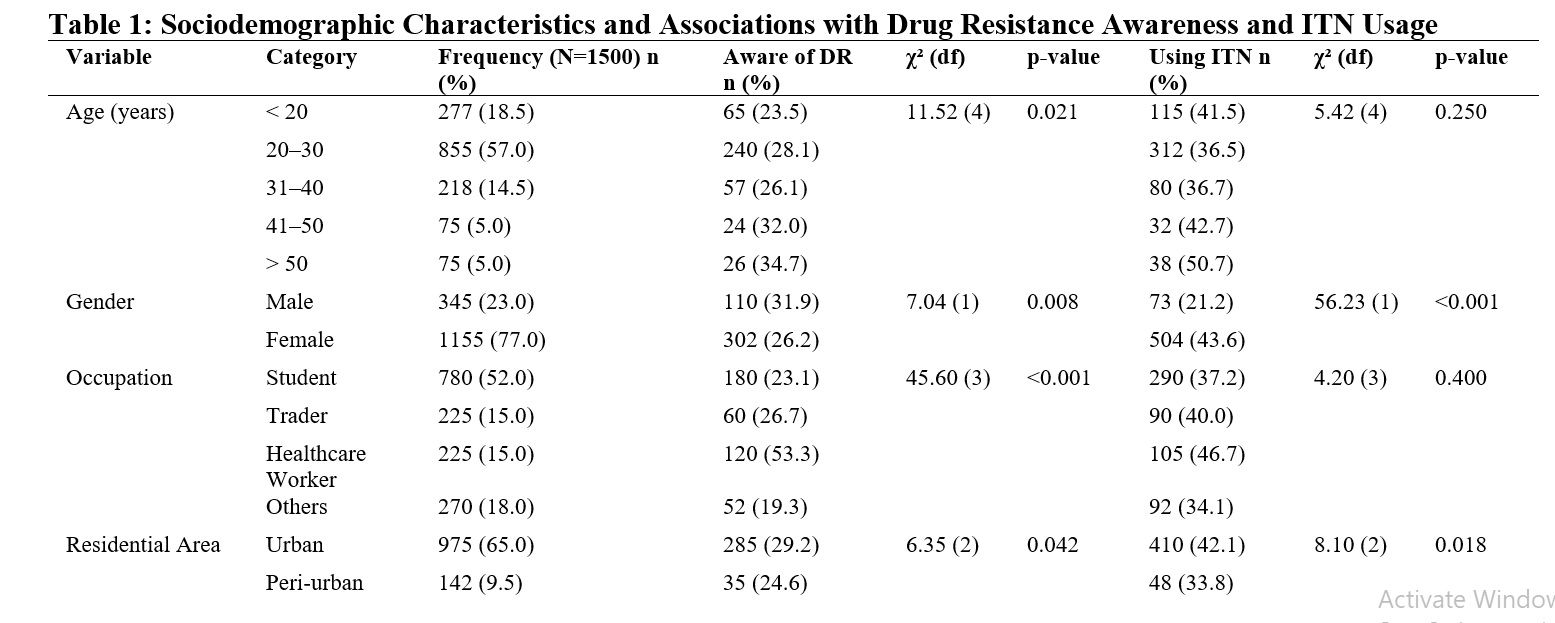
Malaria remains a major public health burden in Nigeria, driven by biological and modifiable human factors. This study assessed knowledge, attitudes, and perceptions of malaria transmission, treatment, and drug resistance among adults in Osun State, Nigeria, and examined associations between cognitive gaps and preventive/treatment-seeking behaviors using the Health Belief Model. A cross-sectional study was conducted among 1,500 adults (≥18 years) in Osun State between June and August 2023 using a pre-tested questionnaire. Descriptive statistics, chi-square tests, and multivariable logistic regression were used. Key gaps: 49.5% were unaware of the primary transmission route, and only 27.5% recognized antimalarial drug resistance. Among 712 participants who used antimalarial drugs in the past two weeks, 70.5% completed treatment. Awareness of drug resistance was independently associated with treatment completion (aOR=1.68; 95% CI:1.25–2.25; p<0.001), formal healthcare use (aOR=1.45; 95% CI:1.12–1.88; p=0.005), and lower herbal medicine use (aOR=0.65; 95% CI:0.50–0.85; p=0.002). Female gender predicted insecticide-treated net use (aOR=2.15; 95% CI:1.65–2.80; p<0.001) but was inversely associated with drug resistance awareness (aOR=0.62; 95% CI:0.46–0.83; p=0.001). Knowledge deficits, especially regarding drug resistance, are linked to less favourable preventive and treatment-seeking behaviours. Targeted behavioral change communication, vendor education, and healthcare worker engagement are imperative to improve treatment adherence and curb drug resistance.
References
Abiodun, O. E., & Akinola, D. J. (2019). Mapping the impact of land use and land cover change on urban land and vegetation in Osun State, Nigeria. Nigerian Journal of Environmental Sciences and Technology, 3(2), 317–330.
Adedotun, A. A., Morenikeji, O. A., & Odaibo, A. B. (2010). Knowledge, attitudes and practices about malaria in an urban community in south-western Nigeria. Journal of Vector Borne Diseases, 47(3), 155–159.
Aderele, M. O., Bola, T. S., & Oke, D. O. (2020). Land use/land cover changes of Ago-Owu Forest Reserve, Osun State, Nigeria using remote sensing techniques. Open Journal of Forestry, 10(4), 401–411. https://doi.org/10.4236/ojf.2020.104025
Ajibaye, O., Rahman, S. A., Aina, O. O., Ujuju, C., Agomo, C. O., Akindele, S., ... & Olukosi, A. Y. (2025). Prevalence and factors associated with childhood malaria and anaemia in Osun state, Nigeria: A baseline household malariometric study. Malaria Journal, 24(1), 11. https://doi.org/10.1186/s12936-024-05238-w
Alyafei, A., & Easton-Carr, R. (2024). The health belief model of behavior change. In StatPearls. StatPearls Publishing.
Bello, I. S., Olajubu, T. O., Osundiya, O. O., Salami, O. T., Ibrahim, A. O., & Ahmed, A. A. (2023). Malaria among the elderly in five communities of Osun East district, Southwest Nigeria: Prevalence and association with non-communicable diseases. SAGE Open Medicine, 11, 20503121231164259. https://doi.org/10.1177/20503121231164259
Bhatt, S., Weiss, D. J., Cameron, E., Bisanzio, D., Mappin, B., Dalrymple, U., & Gething, P. W. (2015). The effect of malaria control on Plasmodium falciparum in Africa between 2000 and 2015. Nature, 526(7572), 207–211. https://doi.org/10.1038/nature15535
Cui, L., Mharakurwa, S., Ndiaye, D., Rathod, P. K., & Rosenthal, P. J. (2015). Antimalarial drug resistance: literature review and activities and findings of the ICEMR network. The American journal of tropical medicine and hygiene, 93(3 Suppl), 57.
Dawaki, S., Al-Mekhlafi, H. M., Ithoi, I., Ibrahim, J., Atroosh, W. M., Abdulsalam, A. M., & Lau, Y. L. (2016). Is Nigeria winning the battle against malaria? Prevalence, risk factors and KAP assessment among Hausa communities in Kano State. Malaria Journal, 15(1), 351. https://doi.org/10.1186/s12936-016-1394-3
Degarege, A., Fennie, K., Degarege, D., Chennupati, S., & Madhivanan, P. (2019). Improving socioeconomic status may reduce the burden of malaria in sub-Saharan Africa: A systematic review and meta-analysis. PLOS One, 14(1), e0211205. https://doi.org/10.1371/journal.pone.0211205
Odediji, S. A., Olabanji, S. A., Olawuyi, A. O., Amoo, K. O., Amoo-Adeboye, B. O., & Adeleke, M. A. (2025). Prevalence and risk factors of congenital malaria in Osogbo, Southwestern Nigeria. GMS German Medical Science, 23, Doc07. https://doi.org/10.3205/000000338
Ogidan, O. C., Nzoputam, C. I., Barrow, A., & Ekholuenetale, M. (2025). Prevalence and determinants of insecticide-treated net ownership among women of reproductive age in Nigeria: A mixed-effect insight from the 2021 malaria indicator survey. Malaria Journal, 24(1), 75. https://doi.org/10.1186/s12936-025-05314-9
Olowe, R. A., Olawumi, O., & Adekunle, O. O. (2025). Current trends in antimalarial drug resistance in Nigeria: A mini review. Bima Journal of Science and Technology, 8(3A), 171–188.
Rouamba, T., Sondo, P., Yerbanga, I. W., Compaore, A., Traore-Coulibaly, M., Hien, F. S., Diande, N. A., Valia, D., Valea, I., Akweongo, P., Baiden, R., Binka, F., Kirakoya-Samadoulougou, F., & Tinto, H. (2019). High adherence level to artemisinin-based combination therapies in rural settlement 11 years after their introduction in the health system, Nanoro, Burkina Faso. Patient preference and adherence, 13, 371–380. https://doi.org/10.2147/PPA.S190927
Tairou, F., Nawaz, S., Tahita, M. C., Herrera, S., Faye, B., & Tine, R. C. (2022). Malaria prevention knowledge, attitudes, and practices (KAP) among adolescents living in an area of persistent transmission in Senegal: Results from a cross-sectional study. PLOS One, 17(12), e0274656. https://doi.org/10.1371/journal.pone.0274656
Tizifa, T. A., Kabaghe, A. N., McCann, R. S., van den Berg, H., Van Vugt, M., & Phiri, K. S. (2018). Prevention efforts for malaria. Current Tropical Medicine Reports, 5(1), 41–50. https://doi.org/10.1007/s40475-018-0139-3
World Health Organization. (2011). Standards and operational guidance for ethics review of health-related research with human participants. World Health Organization.
World Health Organization. (2023). World malaria report 2023. World Health Organization.
Downloads
Published
Issue
Section
Categories
License
Copyright (c) 2026 Saheed Adeyinka Odediji, Kazeem Olarewaju Amoo, Abdullah Olaleye Olawuyi, Basirat Opemipo Amoo-Adeboye, Olabanji Ahmed Surakat, Monsuru Adebayo Adeleke

This work is licensed under a Creative Commons Attribution 4.0 International License.


