
The Magnitude of Insecticide-Treated Net Utilization Gaps and Malaria Infection Determinants among Febrile Patients in Osun State, Nigeria
DOI:
https://doi.org/10.33003/fjs-2026-1017-5949Keywords:
Insecticide-Treated Nets, Utilization Gap, Malaria, Social Determinants, Febrile PatientsAbstract
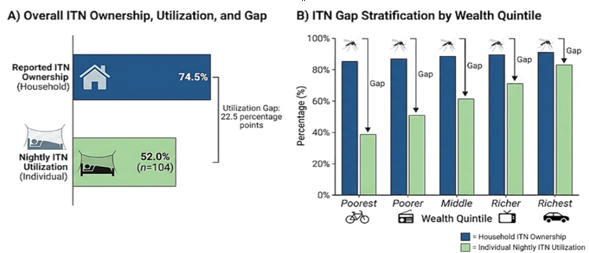
The persistent disparity between insecticide-treated (ITN) net ownership and actual nightly utilization limits the effectiveness of malaria prevention strategies in Nigeria. This study assessed ITN coverage, the social determinants of its use, and its direct association with confirmed malaria infection among febrile patients in Osun State. A facility-based cross-sectional study enrolled 200 febrile patients across six Local Government Areas, serving as a focused sentinel investigation. Data regarding sociodemographics and net utilization were collected via a structured questionnaire. Malaria infection was confirmed using a nested polymerase chain reaction (PCR) reference standard. Data were analyzed using descriptive statistics and multivariate logistic regression, with multicollinearity assessed via Variance Inflation Factors (VIF). ITN ownership was 74.5%, while actual utilization was 52.0%, yielding a 22.5 percentage-point gap. Higher education (aOR=2.51), richest wealth quintile (aOR=3.02), and mass media exposure (aOR=1.89) independently predicted net use. PCR-confirmed malaria positivity was 23.5%. Net non-use (aOR=4.12) and open eaves (aOR=1.92) strongly predicted infection. Socioeconomic factors drive a significant utilization gap, resulting directly in higher malaria prevalence among non-users. Intervention strategies must pair distribution with targeted behavioral communication and structural improvements.
References
Adeleke, M. A., Mafiana, C. F., Idowu, A. B., Adekunle, M. F., & Sam-Wobo, S. O. (2008). Mosquito larval habitats and public health implications in Abeokuta, Ogun State, Nigeria. Tanzania Journal of Health Research, 10(2), 103–107. https://doi.org/10.4314/thrb.v10i2.14353
Ankomah, A., Adebayo, S. B., Arogundade, E. D., Anyanti, J., Nwokolo, E., Inyang, U., Ipadeola, O. B., & Meremiku, M. (2014). The effect of mass media campaign on the use of insecticide-treated bed nets among pregnant women in Nigeria. Malaria Research and Treatment, 2014, 694863. https://doi.org/10.1155/2014/694863
Ankomah, A., Adebayo, S. B., Arogundade, E. D., Anyanti, J., Nwokolo, E., Ladipo, O., & Meremikwu, M. M. (2012). Determinants of insecticide-treated net ownership and utilization among pregnant women in Nigeria. BMC Public Health, 12(1), 105. https://doi.org/10.1186/1471-2458-12-105
Awolola, T. S., Okwa, O., Hunt, R. H., Ogunrinade, A. F., & Coetzee, M. (2002). Dynamics of the malaria-vector populations in coastal Lagos, south-western Nigeria. Annals of Tropical Medicine & Parasitology, 96(1), 75–82. https://doi.org/10.1179/000349802125000484
Awosolu, O. B., Yahaya, Z. S., Farah Haziqah, M. T., & Olusi, T. A. (2022). Performance evaluation of nested polymerase chain reaction (Nested PCR), light microscopy, and Plasmodium falciparum histidine-rich protein 2 rapid diagnostic test (PfHRP2 RDT) in the detection of falciparum malaria in a high-transmission setting in Southwestern Nigeria. Pathogens, 11(11), 1312. https://doi.org/10.3390/pathogens11111312
Barrow, A., Ogidan, O. C., Nzoputam, C. I., & Ekholuenetale, M. (2025). Coverage and contextual factors associated with insecticide-treated net use among women of reproductive age in Nigeria: Evidence from the 2021 malaria indicator survey data. PLOS Global Public Health, 5(2), e0004207. https://doi.org/10.1371/journal.pgph.0004207
Baume, C. A., & Marin, M. C. (2007). Intra-household mosquito net use in Ethiopia, Ghana, Mali, Nigeria, Senegal, and Zambia: Are nets being used? Who in the household uses them? The American Journal of Tropical Medicine and Hygiene, 77(5), 963–971. https://doi.org/10.4269/ajtmh.2007.77.963
Bhatt, S., Weiss, D. J., Cameron, E., Bisanzio, D., Mappin, B., Dalrymple, U., Battle, K. E., Moyes, C. L., Henry, A., Eckhoff, P. A., Wenger, E. A., Briët, O., Penny, M. A., Smith, T. A., Bennett, A., Yukich, J., Eisele, T. P., Griffin, J. T., Fergus, C. A., ... Hay, S. I. (2015). The effect of malaria control on Plasmodium falciparum in Africa between 2000 and 2015. Nature, 526(7572), 207–211. https://doi.org/10.1038/nature15535
Busari, L. O., Raheem, H. O., Iwalewa, Z. O., Fasasi, K. A., & Adeleke, M. A. (2023). Investigating insecticide susceptibility status of adult mosquitoes against some class of insecticides in Osogbo metropolis, Osun State, Nigeria. PLoS ONE, 18(5), e0285605. https://doi.org/10.1371/journal.pone.0285605
Cochran, W. G. (1977). Sampling techniques (3rd ed.). John Wiley & Sons.
Dawaki, S., Al-Mekhlafi, H. M., Ithoi, I., Ibrahim, J., Atroosh, W. M., Abdulsalam, A. M., Sady, H., Elyana, F. N., Adamu, A. U., Yelwa, S. I., Ahmed, A., Al-Areeqi, M. A., & Lau, Y. L. (2016). Is Nigeria winning the battle against malaria? Prevalence, risk factors and KAP assessment among Hausa communities in Kano State. Malaria Journal, 15, 351. https://doi.org/10.1186/s12936-016-1394-3
Eisele, T. P., Larsen, D. A., Anglewicz, P. A., Keating, J., Yukich, J., Bennett, A., Hutchinson, P., & Steketee, R. W. (2012). Malaria prevention in pregnancy, birthweight, and neonatal mortality: A meta-analysis of 32 national cross-sectional datasets in Africa. The Lancet Infectious Diseases, 12(12), 942–949. https://doi.org/10.1016/S1473-3099(12)70222-0
Haileselassie, W., Adam, R., Habtemichael, M., David, R. E., Solomon, N., Workineh, S., Haider, J., Belachew, A., Deressa, W., Yan, G., & Kassaw, N. A. (2023). Socio-demographic and economic inequity in the use of insecticide-treated bed nets during pregnancy: A survey-based case study of four sub-Saharan African countries with a high burden of malaria. Archives of Public Health, 81(1), 64. https://doi.org/10.1186/s13690-023-01080-9
Ismail, M., Mukhtar, A., Odetokun, I. A., Ibrahim, M. A., Salman, A. A., Bawa-Sani, H. G., Nass, S. S., Goni, B. W., Nuhu, A., Zhang, X., Usman, A., & Isah, M. B. (2025). Performance of rapid diagnostic tests for malaria diagnosis in Nigeria: A systematic review and meta-analysis. Malaria Journal, 25(1), 17. https://doi.org/10.1186/s12936-025-05680-4
Koenker, H., & Kilian, A. (2014). Recalculating the net use gap: A multi-country comparison of ITN use versus ITN access. PLoS ONE, 9(5), e97496. https://doi.org/10.1371/journal.pone.0097496
Krezanoski, P. J., Tsai, A. C., Hamer, D. H., Comfort, A. B., & Bangsberg, D. R. (2014). Household malaria knowledge and its association with bednet ownership in settings without large-scale distribution programs: Evidence from rural Madagascar. Journal of Global Health, 4(1), 010401. https://doi.org/10.7189/jogh.04.010401
Ladi-Akinyemi, B. O., Ogunyemi, A. O., & Oluwole, F. A. (2019). A rural-urban comparison of ownership and utilization of Long-Lasting Insecticide Treated Nets among pregnant women in Ogun State Nigeria. Annals of Health Research, 5(1), 36–50.
Lengeler, C. (2004). Insecticide-treated bed nets and curtains for preventing malaria. Cochrane Database of Systematic Reviews, (2), CD000363. https://doi.org/10.1002/14651858.CD000363.pub2
National Population Commission. (2019). Nigeria demographic and health survey 2018. NPC and ICF.
Ndjinga, J. K., & Minakawa, N. (2010). The importance of education to increase the use of bed nets in villages outside of Kinshasa, Democratic Republic of the Congo. Malaria Journal, 9, 279. https://doi.org/10.1186/1475-2875-9-279
Nzelu, C. E., Nzelu, U. M., Ugwunze, A. R., & Azodoh, N. (2026). Determinants of malaria insecticide-treated nets use among women of reproductive age in Nigeria. Nigerian Medical Journal, 66(5), 1823–1834.
Oguonu, T., Okafor, H. U., & Obu, H. A. (2005). Caregivers' knowledge, attitude and practice on childhood malaria and treatment in urban and rural communities in Enugu, south-east Nigeria. Public Health, 119(5), 409–414. https://doi.org/10.1016/j.puhe.2004.05.013
Oladepo, O., Tona, G. O., Oshiname, F. O., & Titiloye, M. A. (2010). Malaria knowledge and agricultural practices that promote mosquito breeding in two rural farming communities in Oyo State, Nigeria. Malaria Journal, 9, 91. https://doi.org/10.1186/1475-2875-9-91
Oladimeji, K. E., Tsoka-Gwegweni, J. M., Ojewole, E., & Yunga, S. T. (2019). Knowledge of malaria prevention among pregnant women and non-pregnant mothers of children aged under 5 years in Ibadan, South West Nigeria. Malaria Journal, 18, 92. https://doi.org/10.1186/s12936-019-2962-x
Omojuyigbe, J. O., Owolade, A. J., Sokunbi, T. O., Bakenne, H. A., Ogungbe, B. A., Oladipo, H. J., & Agughalam, P. I. (2023). Malaria eradication in Nigeria: State of the nation and priorities for action. Journal of Medicine, Surgery, and Public Health, 1, 100024. https://doi.org/10.1016/j.glmedi.2023.100024
Omole, E. B., & Ndukwe, O. S. (2023). Assessment of socio-demographic factors associated with the utilization of Insecticide-Treated Nets (ITNs) among children under-5 years old and pregnant women in Nigeria: A secondary analysis of NMIS data. medRxiv. https://doi.org/10.1101/2023.11.30.23299225
Onwujekwe, O., Hanson, K., & Fox-Rushby, J. (2004). Inequalities in purchase of mosquito nets and willingness to pay for insecticide-treated nets in Nigeria: Challenges for malaria control interventions. Malaria Journal, 3, 6. https://doi.org/10.1186/1475-2875-3-6
Oresanya, O. B., Hoshen, M., & Sofola, O. T. (2008). Utilization of insecticide-treated nets by under-five children in Nigeria: Assessing progress towards the Abuja targets. Malaria Journal, 7, 145. https://doi.org/10.1186/1475-2875-7-145
Osun, O. G., Ahmed, A. S., Suliman, S. A., Olorunfemi, A. B., Thomas, B. N., & Ojurongbe, O. (2024). Comparative evaluation of microscopy, rapid diagnostic tests, and polymerase chain reaction (PCR) for malaria diagnosis in Nigerian children. Cureus, 16(11), e73739. https://doi.org/10.7759/cureus.73739
Pulford, J., Hetzel, M. W., Bryant, M., Siba, P. M., & Mueller, I. (2011). Reported reasons for not using a mosquito net when one is available: A review of the published literature. Malaria Journal, 10, 83. https://doi.org/10.1186/1475-2875-10-83
Rohkmad, M. F., Sandy, S., Widiyanti, M., Adiningsih, S., Kesuma, A. P., Maladan, Y., Anggraeni, Y. M., Ramadhani, T., Ipa, M., Hidajat, M. C., & Kawulur, H. (2025). Performance comparison of rapid diagnostic test, microscopy, and polymerase chain reaction for malaria detection in high-transmission area, Keerom Regency, Papua Province, Indonesia. Acta Tropica, 107935. https://doi.org/10.1016/j.actatropica.2025.107935
Sabo, M., Abdulrasheed, D., Muhammad, A. Q., Olanrewaju, O. D., Aujara, I. L., & Adeola, A. M. (2025). Distribution, ownership and utilization of insecticide treated mosquito net in relation to malaria prevention among pregnant women in Irepodun Local Government Area, Osun State, Nigeria. Sahel Journal of Life Sciences FUDMA, 3(3), 272–276.
Salami, T. A., Animasaun, T. T., & Daramola, C. F. (2026). Insecticides treated nets (ITNs) usage intensity and self-reported malaria prevalence among rural households in Osun State, Nigeria. FUDMA Journal of Agriculture and Agricultural Technology, 12(2), 57–70.
Udonwa, N. E., Gyuse, A. N., & Etokidem, A. J. (2010). Malaria: Knowledge and prevention practices among school adolescents in a coastal community in Calabar, Nigeria. African Journal of Primary Health Care & Family Medicine, 2(1), 103. https://doi.org/10.4102/phcfm.v2i1.103
World Health Organization. (2023). World malaria report 2023. World Health Organization.
World Health Organization. (2024). World malaria report 2024. World Health Organization.
World Medical Association. (2013). World Medical Association Declaration of Helsinki: Ethical principles for medical research involving human subjects. JAMA, 310(20), 2191–2194. https://doi.org/10.1001/jama.2013.281053
Downloads
Published
Issue
Section
Categories
License
Copyright (c) 2026 Saheed Adeyinka Odediji, Abdullah Olaleye Olawuyi, Lateef Oluwatoyin Busari, Kazeem Olarewaju Amoo, Basirat Opemipo Amoo-Adeboye, Yusirat Olarinre Yusuff, Zarat Oyindamola Iwalewa, Olabanji Ahmed Surakat, Monsuru Adebayo Adeleke

This work is licensed under a Creative Commons Attribution 4.0 International License.


