
Keratinase Production from Cattle Horn Waste by Abattoir-Derived Bacterial Isolates in Kwara State, Nigeria
DOI:
https://doi.org/10.33003/fjs-2026-1018-5982Keywords:
Abattoir Soil, Cattle Horn Waste, Keratinase, Proteolytic Screening, Bacillus cereus, Lysinibacillus fusiformisAbstract
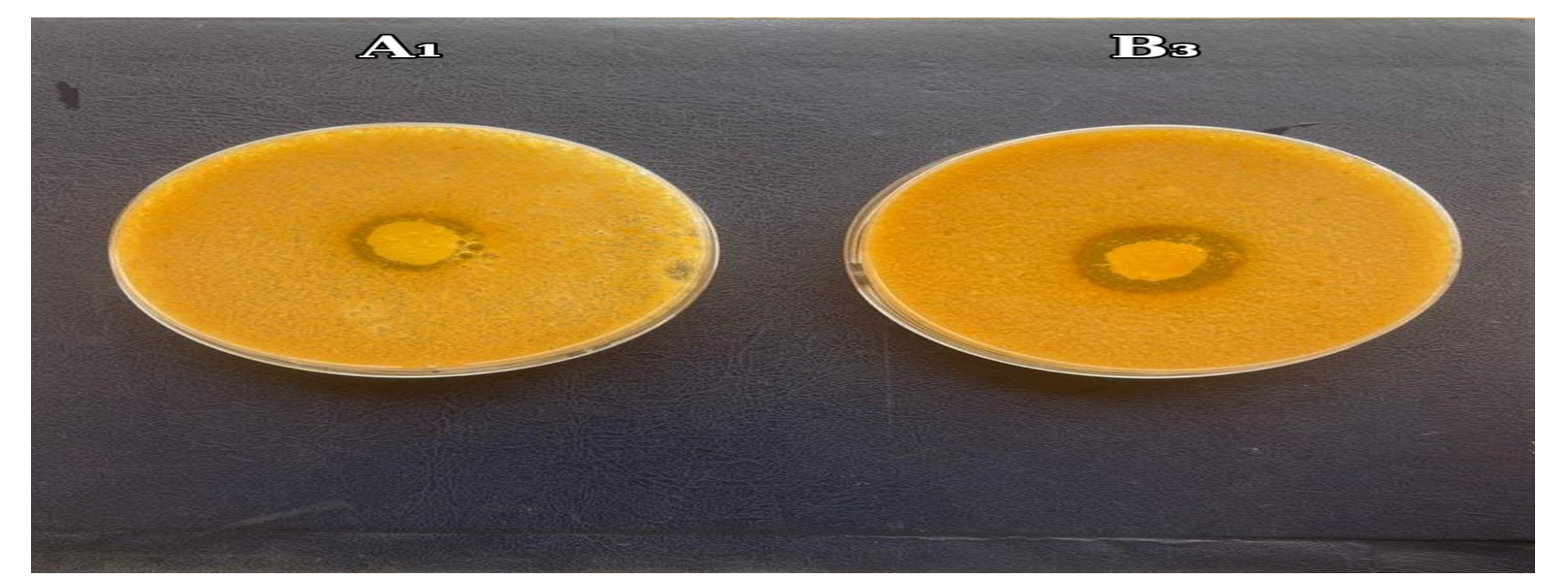
Cattle horn is a keratin-rich animal by-product whose compact protein structure makes it resistant to ordinary proteolytic degradation. Microbial keratinases provide a biological approach for converting keratinous waste into soluble products. This study aimed to isolate bacteria from abattoir soil, screen the isolates for extracellular proteolytic activity, identify the selected isolates, and evaluate keratinase activity during submerged fermentation with cattle horn powder. Five soil samples were collected from five spots across two locations at Akerebiata Abattoir, Ilorin, Kwara State, Nigeria, at a depth of 5 cm below the top soil. Six bacterial isolates were recovered on horn meal agar and screened on skim milk agar for extracellular proteolytic activity. The selected isolates were identified by 16S rRNA gene sequencing and BLAST analysis. Keratinase production was evaluated by submerged fermentation in 250 mL vessels containing 100 mL production medium, using 5 mL inoculum at 37 °C and 120 rpm for 14 days. Fermentation was conducted in three biological replicates, and enzyme assays were performed in duplicates. Six bacterial isolates were recovered. A₁ and B₃ produced hydrolysis halos of 18.00 ± 0.04 mm and 22.00 ± 0.025 mm, respectively. BLAST analysis identified isolate K1 as Bacillus cereus and isolate K2 as Lysinibacillus fusiformis. K1 had a sequence length of 1518 bp, 99.34% identity, 100% query coverage and an E-value of 0.0 against accession GQ406846.1. K2 had a sequence length of 1516 bp, 99.93% identity, 100% query coverage and an E-value of 0.0 against accession OQ568519.1.
References
Aktayeva, S., Baltin, K., Kiribayeva, A., Akishev, Z., Silayev, D., Ramankulov, Y. and Khassenov, B. (2022). Isolation of Bacillus sp. A5.3 strain with keratinolytic activity. Biology, 11(2), 244. https://doi.org/10.3390/biology11020244
Banasaz, S. and Ferraro, V. (2024). Keratin from animal by-products: Structure, characterization, extraction and application—A review. Polymers, 16(14), 1999. https://doi.org/10.3390/polym16141999
Bokveld, A., Nnolim, N. E. and Nwodo, U. U. (2021). Chryseobacterium aquifrigidense FANN1 produced detergent-stable metallokeratinase and amino acids through the abasement of chicken feathers. Frontiers in Bioengineering and Biotechnology, 9, 720176. https://doi.org/10.3389/fbioe.2021.720176
Das, S., Das, A., Das, N., Nath, T., Langthasa, M., Pandey, P., Kumar, V., Choure, K., Kumar, S. and Pandey, P. (2024). Harnessing the potential of microbial keratinases for bioconversion of keratin waste. Environmental Science and Pollution Research, 31(46), 57478–57507. https://doi.org/10.1007/s11356-024-34233-6
de Menezes, C. L. A., Santos, R. D. C., Santos, M. V., Boscolo, M., da Silva, R., Gomes, E. and da Silva, R. R. (2021). Industrial sustainability of microbial keratinases: Production and potential applications. World Journal of Microbiology and Biotechnology, 37(5), 86. https://doi.org/10.1007/s11274-021-03052-z
de Oliveira Martinez, J. P., Cai, G., Nachtschatt, M., Navone, L., Zhang, Z., Robins, K. and Speight, R. (2020). Challenges and opportunities in identifying and characterising keratinases for value-added peptide production. Catalysts, 10(2), 184. https://doi.org/10.3390/catal10020184
Deba, F., Nelofer, R. and Irfan, M. (2023). Isolation, identification, and screening of keratinase producing bacteria from soil and production optimization using feather waste as substrate. Punjab University Journal of Zoology, 38(1), 109–118. https://doi.org/10.17582/journal.pujz/2023.38.1.109.118
Derhab, N., Mabrouk, M. E. M., El-Metwally, M. M. and Mohammed, Y. M. M. (2024). Thermostable keratinase from Bacillus cereus L10: Optimization and some potential biotechnological applications. Biomass Conversion and Biorefinery, 14, 29757–29773. https://doi.org/10.1007/s13399-023-04887-2
Gerlicz, W. A., Sypka, M., Jodłowska, I. and Białkowska, A. M. (2024). Isolation, selection, and identification of keratinolytic bacteria for green management of keratin waste. Molecules, 29(14), 3380. https://doi.org/10.3390/molecules29143380
Janda, J. M. and Abbott, S. L. (2007). 16S rRNA gene sequencing for bacterial identification in the diagnostic laboratory: Pluses, perils, and pitfalls. Journal of Clinical Microbiology, 45(9), 2761–2764. https://doi.org/10.1128/JCM.01228-07
Lai, Y., Wu, X., Zheng, X., Li, W. and Wang, L. (2023). Insights into the keratin efficient degradation mechanism mediated by Bacillus sp. CN2 based on integrating functional degradomics. Biotechnology for Biofuels and Bioproducts, 16, 59. https://doi.org/10.1186/s13068-023-02308-0
Liu, Y., Lai, Q., Göker, M., Meier-Kolthoff, J. P., Wang, M., Sun, Y., Wang, L. and Shao, Z. (2015). Genomic insights into the taxonomic status of the Bacillus cereus group. Scientific Reports, 5, 14082. https://doi.org/10.1038/srep14082
Martínez, M. G. T., Luís, J. and Bolaños, N. (2023). Lysinibacillus fusiformis: A novel fibrolytic native strain from the rumen microbiome that increases in vitro digestibility of central agricultural residues. Journal of Applied Animal Research, 51(1), 658–668. https://doi.org/10.1080/09712119.2023.2269227
Mpaka, L., Nnolim, N. E. and Nwodo, U. U. (2025). Microbial keratinolysis: Eco-friendly valorisation of keratinous waste into functional peptides. Microorganisms, 13(10), 2270. https://doi.org/10.3390/microorganisms13102270
Nnolim, N. E. and Nwodo, U. U. (2020). Bacillus sp. CSK2 produced thermostable alkaline keratinase using agro-wastes: Keratinolytic enzyme characterization. BMC Biotechnology, 20(1), 65. https://doi.org/10.1186/s12896-020-00659-2
Rahimnahal, S., Meimandipour, A., Fayazi, J., Karkhane, A. A., Shamsara, M., Beigi Nassiri, M., Mirzaei, H., Hamblin, M. R., Tarrahimofrad, H., Bakherad, H., Zamani, J. and Mohammadi, Y. (2023). Biochemical and molecular characterization of novel keratinolytic protease from Bacillus licheniformis (KRLr1). Frontiers in Microbiology, 14, 1132760. https://doi.org/10.3389/fmicb.2023.1132760
Reinmuth-Selzle, K., Tchipilov, T., Backes, A. T., Tscheuschner, G., Tang, K., Ziegler, K., Lucas, K., Pöschl, U., Fröhlich-Nowoisky, J. and Weller, M. G. (2022). Determination of the protein content of complex samples by aromatic amino acid analysis, liquid chromatography-UV absorbance, and colorimetry. Analytical and Bioanalytical Chemistry, 414(15), 4457–4470. https://doi.org/10.1007/s00216-022-03910-1
Sypka, M., Jodłowska, I. and Białkowska, A. M. (2021). Keratinases as versatile enzymatic tools for sustainable development. Biomolecules, 11(12), 1900. https://doi.org/10.3390/biom11121900
Vema, R. and Kumar, V. (2023). Isolation and characterization of keratinolytic bacteria from poultry waste soils of Himachal Pradesh. Journal of Applied Biology and Biotechnology, 11(3), 172–179. https://doi.org/10.7324/JABB.2023.112620
Downloads
Published
Issue
Section
Categories
License
Copyright (c) 2026 Majekodunmi Racheal Adedayo, Kate Rachael Imeje, Elizabeth Ajiboye Adeyinka, Frank Olakunle Otuyelu

This work is licensed under a Creative Commons Attribution 4.0 International License.


