
An Empirical Analysis of Loan Repayment Flexibility on Delinquency Rates of Cocoa Farmers in Cross River State
DOI:
https://doi.org/10.33003/fjs-2026-1015-5962Keywords:
Loan repayment flexibility, Delinquency rate, Cocoa farmers, Cross River State, NigeriaAbstract
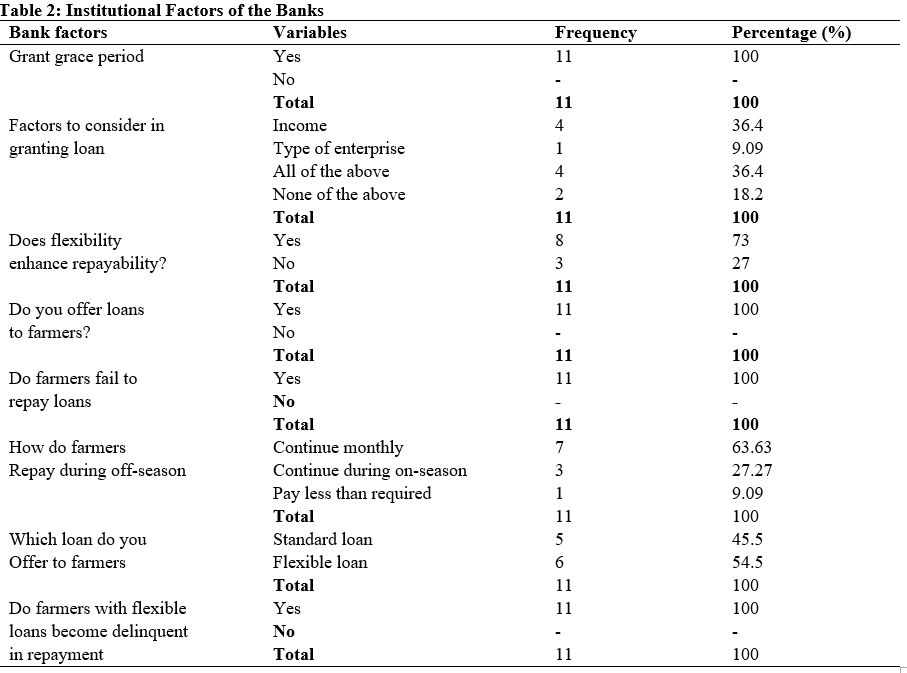
This study examined the impact of loan repayment flexibility on cocoa farmers' delinquency rates in Cross River State, Nigeria, using a cross-sectional dataset. This was exigent given that delayed payment impacted banks’ portfolios and their capacity to extend more loans, not just to cocoa farmers but to farmers generally. Based on the study’s specific objectives of examining the repayment flexibility of the lending banks in the study area and analyzing its effect on delinquency, a questionnaire was administered to 92 cocoa farmers. Data obtained were analyzed using descriptive statistics and a probit regression model. The results revealed that all the banks offered flex loans to the farmers, and at least 41.3% of the farmers had a one-year moratorium after disbursement to start repayment, with repayment due when the crop was sold. In terms of the probit results, age (-.0102684, P<0.05), household size (.0331566, P<0.10), cocoa business experience (-.011093, P<0.10), loan amount received (4.96e-07, P<0.001), and the lending bank (.01768, P<0.10) had the greatest impact on delinquency rate, with household size having the highest – 3.31%. The implication is that larger cocoa farmers’ households have a greater chance of being delinquent or failing to repay their loans by 90%. Therefore, the paper suggests a redesign of the flex loan terms by the lending banks targeted at co-creating a sustainable future with the farmers by working on these impacting variables.
References
Afolabi, J.A. (2008). Analysis of Loan Repayment Among Small Scale Farmers in South Western Nigeria: A Discriminant Approach. Journal of Social Science, 17(1): 83-88
Ajah, E.A., Asuquo, I.A., Agbachom, E.E., Ettah, O.I. & Eyo, E.O. (2025). Microfinance Banks' Utilization of Information Cues in the Prediction of Loan Default and Credit Risk in Nigeria: The Lens Modelling Approach. International Journal of Economics and Financial Issues, 15(2): 220-225. DOI: https://doi.org/10.32479/ijefi.17171.
Alexis, O.T. (2024). The Former Kings of Nigeria’s Economy: Cocoa and the Groundnut Pyramids. Available online at https://www.oriire.com
Asuquo, I., Ajah, E. & Eyo, E. (2023). Loan Repayment Capacity of Smallholder Cassava Farmers in Nigeria. Scope Journal, 13(2): 383-393.
Asuquo, I., Ajah, E., & Eyo, E. (2023). Smallholder Crop Farmers’ Attributes for Formal Financial Services in Nigeria: An Analysis. Journal of Global Innovations in Agricultural Sciences, 11(3):347-354. https://doi.org/10.22194/JGIAS/23.1109
Bolarinwa, K.K. & Fakoya, E.O. (2011). Impact of Farm Credit on Farmers' Socio-economic Status in Ogun State, Nigeria. Journal of Social Sciences, 26(1):67-71.
Dadson, A. (2012). Determinant of Loan Repayment among Farmers in Ghana. Journal of Development and Agricultural Economics, 4(13): 339-345
Erhieguren, E.A. & Gbigbi, T.M. (2025). Loan Delinquency Among Small-Scale Food Crop Farmers and its impact on Agricultural Productivity. GSC Advanced Research and Reviews, 22(3): 81https://doi.org/10.30574/gscarr.2025.22.3.0370
Eyo, E.O. & Asuquo, I.A. (2011). Farmers Credit Reserve and the Success of Microfinance Institutions in Cross River State, Nigeria. Agricultural Journal, 6(3): 74-81.
Ezihe, J.A.C., Akpa, J.A. & Ayoola, J.B. (2016). Accessibility and Repayment of Agricultural Loan among Farmers in Benue State, Nigeria. IOSR Journal of Agriculture and Veterinary Science, 9(8): 39-46
Food and Agriculture Organization Statistics- FAOSTAT (2015). Available online at: https://openknowledge.fao.org
Harnessing Nigeria’s Agricultural Potential with Cocoa at the forefront. Available online at https://sunbeth.net
Harun, M.E. & Legesse, B. (2023). Farmers’ Risk Rating and Crop Portfolio Choice in Kewot Woreda, North Ethiopia. Journal of Global Innovations in Agricultural Sciences, 11(1): 49-54. DOI: https://doi.org/10.22194/JGIAS/11.1039
Jaiyesimi, F. (2024). Nigeria makes N358 billion from Cocoa export in 2023, says Kyari. Business Day. Available online at https://businessday.ng
Kongor, J.E., Owusu, M., & Oduro-Yeboah, C. (2024). Cocoa Production in the 2020s: Challenges and Solutions. CABI Agriculture and Bioscience, 5(102)
National Bureau of Statistics (NBS) (2022). Demographic Statistical Bulletin. NBS, Abuja, Nigeria. Available online at https://www.nigeriastat.gov.ng.
Nigeria’s New Inflation Reality + A Cocoa Production Boost (2025). Available online at https://dataphyte.substack.com
Nkang, N.M., Ajah, E.A., Abang, S.O. & Edet, E.O.(2009). Investment in Cocoa Production in Nigeria: A Cost and Return Analysis of three Cocoa Production Systems in Cross River State Cocoa Belt. Journal of Central European Agriculture, 8(1): 81-90
Nwaru, J.C. (2004). Rural Credit Markets and Resource Use in Arable Crop Production in Imo State of Nigeria. PhD Dissertation, Michael Okpara University of Agriculture, Umudike, Nigeria.
Olukunle, O.T (2020). Competitiveness of Nigerian Cocoa Exports in the Global Market. Journal of Sustainable Development in Africa. 22(3): 2-17
Oke, O.O., Banmeke, T.O.A., Adeoye, A.S., Iselebhor, F., Adebayi, O.R. (2026). Assessing the Agroforestry systems among farmers and their access to incentives in Southwest Nigeria. FUDMA journal of sciences, 10(14),53-57. https://doi.org/10.33003/fjs-2026-1014-5584
Reviving the Cocoa industry in Nigeria (2017). Available online at https://proshare.co
Udo, A. (2023). Reviving Nigeria’s Cocoa industry: Challenges, Opportunities, Way Forward. Available online at https://agronigeria.ng
Weber, R. & Mushoff, O. (2017). Can Flexible Agricultural Microfinance Loans limit the Repayment Risk of Low Diversified Farmers? Agricultural Economics, 48(5): 537-548. DOI: https://doi.org/101111/agec.12355
Weber, R., Mushoff, O., & Petrick, M. (2014). How Flexible Repayment Schedules affect Credit Risk in Agricultural Microfinance. Discussion paper, No 1404. Department for Agricultural Economics and Rural Development, University of Goettingen. Available at https://hdl.handle.net/10419/96512.
World Bank (2003). Reaching the Rural Poor – a renewed strategy for rural development. Working Paper No 30411. Washington D.C, World Bank. Available online at https://documents.worldbank.org/curated/en/186311468762029547
Downloads
Published
Issue
Section
Categories
License
Copyright (c) 2026 Innocent Asuquo, Innocent Eyong

This work is licensed under a Creative Commons Attribution 4.0 International License.