
Cardiovascular Responses and Oxidative-Stress Biomarkers among Bakery Workers Exposed to Indoor Heat in Kano, Nigeria
DOI:
https://doi.org/10.33003/fjs-2026-1020-5953Keywords:
Cardiovascular Responses, Oxidative Stress, Bakery Workers, Indoor-Heat ExposureAbstract
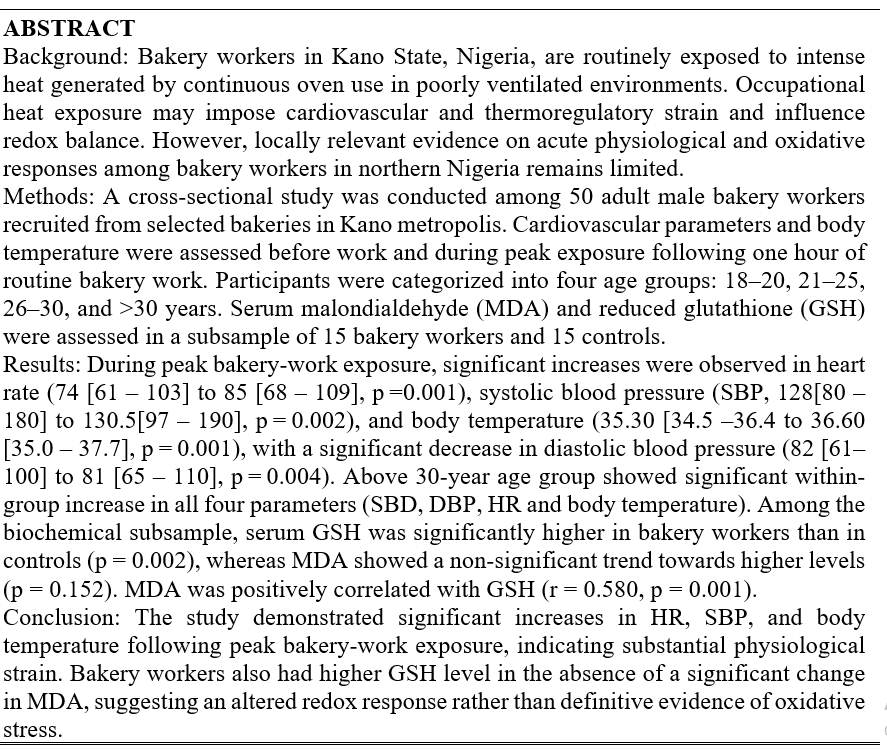
Background: Bakery workers in Kano State, Nigeria, are routinely exposed to intense heat generated by continuous oven use in poorly ventilated environments. Occupational heat exposure may impose cardiovascular and thermoregulatory strain and influence redox balance. However, locally relevant evidence on acute physiological and oxidative responses among bakery workers in northern Nigeria remains limited.
Methods: A cross-sectional study was conducted among 50 adult male bakery workers recruited from selected bakeries in Kano metropolis. Cardiovascular parameters and body temperature were assessed before work and during peak exposure following one hour of routine bakery work. Participants were categorized into four age groups: 18–20, 21–25, 26–30, and >30 years. Serum malondialdehyde (MDA) and reduced glutathione (GSH) were assessed in a subsample of 15 bakery workers and 15 controls.
Results: During peak bakery-work exposure, significant increases were observed in heart rate (74 [61 – 103] to 85 [68 – 109], p =0.001), systolic blood pressure (SBP, 128[80 – 180] to 130.5[97 – 190], p = 0.002), and body temperature (35.30 [34.5 –36.4 to 36.60 [35.0 – 37.7], p = 0.001), with a significant decrease in diastolic blood pressure (82 [61–100] to 81 [65 – 110], p = 0.004). Above 30-year age group showed significant within-group increase in all four parameters (SBD, DBP, HR and body temperature). Among the biochemical subsample, serum GSH was significantly higher in bakery workers than in controls (p = 0.002), whereas MDA showed a non-significant trend towards higher levels (p = 0.152).
References
Ademu, L. A., Yohanna, R., & Samuel, S. A. (2026). Physiological and immuno-metabolic responses of heat stressed broilers to dietary l-glutamic acid supplementation. FUDMA Journal of Animal Production and Environmental Science, 2(1), 193-199. https://doi.org/10.33003/japes.2026.v2i1.193-199
Agada, L. E., & Yakubu, M. S. (2022). Heat wave and its impact in Northeastern Nigeria: A case study of Yobe State, Nigeria. FUDMA journal of sciences, 6(1), 232-239. https://doi.org/10.33003/fjs-2022-0601-893
Al-Otaibi, S. T. (2022). Physiological and biochemical parameters among a population of bakers exposed to environmental heat. International Journal of Occupational Medicine and Environmental Health, 35(3), 265. https://doi.org/10.13075/ijomeh.1896.01813
Amoadu, M., Ansah, E. W., Sarfo, J. O., & Hormenu, T. (2023). Impact of climate change and heat stress on workers’ health and productivity: a scoping review. The Journal of Climate Change and Health, 12, 100249. https://doi.org/10.1016/j.joclim.2023.100249
Ballatori, N., Krance, S. M., Notenboom, S., Shi, S., Tieu, K., & Hammond, C. L. (2009). Glutathione dysregulation and the etiology and progression of human diseases. Biological chemistry, 390(3), 191 – 214. https://doi.org/10.1515/BC.2009.033
Belhadj Slimen, I., Najar, T., Ghram, A., Dabbebi, H., Ben Mrad, M., & Abdrabbah, M. (2014). Reactive oxygen species, heat stress and oxidative-induced mitochondrial damage. A review. International journal of hyperthermia, 30(7), 513-523. https://doi.org/10.3109/02656736.2014.971446
Crandall, C. G., & Gonzalez‐Alonso, J. (2010). Cardiovascular function in the heat‐stressed human. Acta physiologica, 199(4), 407-423. https://doi.org/10.1111/j.1748-1716.2010.02119.x
De Sario, M., de'Donato, F. K., Bonafede, M., Marinaccio, A., Levi, M., Ariani, F., & Michelozzi, P. (2023). Occupational heat stress, heat-related effects and the related social and economic loss: a scoping literature review. Frontiers in public health, 11, 1173553. https://doi.org/10.3389/fpubh.2023.1173553
Ding, X., & Gao, B. (2025). Heat stress‐mediated multi‐organ injury: pathophysiology and treatment strategies. Comprehensive Physiology, 15(3), e70012. https://doi.org/10.1002/cph4.70012
D’Oria, R., Schipani, R., Leonardini, A., Natalicchio, A., Perrini, S., Cignarelli, A., & Giorgino, F. (2020). The role of oxidative stress in cardiac disease: from physiological response to injury factor. Oxidative medicine and cellular longevity, 2020(1), 5732956. https://doi.org/10.1155/2020/5732956
Ellman, G. L. (1959). Tissue sulfhydryl groups. Archives of Biochemistry and Biophysics, 82(1), 70–77. https://doi.org/10.1016/0003-9861(59)90090-6
Forman, H. J., Zhang, H., & Rinna, A. (2009). Glutathione: Overview of its protective roles, measurement, and biosynthesis. Molecular Aspects of Medicine, 30(1–2), 1–12. https://doi.org/10.1016/j.mam.2008.08.006
Foster, J., Smallcombe, J. W., Hodder, S., Jay, O., Flouris, A. D., Nybo, L., & Havenith, G. (2021). An advanced empirical model for quantifying the impact of heat and climate change on human physical work capacity. International journal of biometeorology, 65(7), 1215-1229. https://doi.org/10.1007/s00484-021-02105-0
Gharibi, V., Khanjani, N., Heidari, H., Ebrahimi, M. H., & Hosseinabadi, M. B. (2020). The effect of heat stress on hematological parameters and oxidative stress among bakery workers. Toxicology and industrial health, 36(1), 1-10. https://doi.org/10.1177/0748233719899824
Gutteridge, J. M., & Wilkins, S. (1983). Copper salt-dependent hydroxyl radical formation: damage to proteins acting as antioxidants. Biochimica et Biophysica Acta (BBA)-General Subjects, 759(1-2), 38-41. https://doi.org/10.1016/0304-4165(83)90186-1
Kenney, W. L., Craighead, D. H., & Alexander, L. M. (2014). Heat waves, aging, and human cardiovascular health. Medicine & Science in Sports & Exercise, 46(10), 1891–1899. https://doi.org/10.1249/MSS.0000000000000325
Kenney, W. L., & Munce, T. A. (2003). Invited review: Aging and human temperature regulation. Journal of Applied Physiology, 95(6), 2598–2603. https://doi.org/10.1152/japplphysiol.00202.2003
Khazaei, P., Sahlabadi, A. S., Ramezanifar, S., Mehrifar, Y., Khadiv, E., Rastegari, P., & Gharari, N. (2023). The effects of heat stress on bakery workers: a systematic review. Iranian journal of public health, 52(12), 2528. https://doi.org/10.18502/ijph.v52i12.14314
Kjellstrom, T., Briggs, D., Freyberg, C., Lemke, B., Otto, M., & Hyatt, O. (2016). Heat, human performance, and occupational health: A key issue for the assessment of global climate change impacts. Annual Review of Public Health, 37(1), 97–112. https://doi.org/10.1146/annurev-publhealth-032315-021740
Larose, J., Boulay, P., Sigal, R. J., Wright, H. E., & Kenny, G. P. (2013). Age-related decrements in heat dissipation during physical activity occur as early as the age of 40. PLOS One, 8(12), e83148. https://doi.org/10.1371/journal.pone.0083148
Liu, J., Varghese, B. M., Hansen, A., Zhang, Y., Driscoll, T., Morgan, G., Dear, K., Gourley, M., Capon, A., & Bi, P. (2022). Heat exposure and cardiovascular health outcomes: A systematic review and meta-analysis. The Lancet Planetary Health, 6(6), e484–e495. https://doi.org/10.1016/S2542-5196(22)00117-6
Melaku, C., Abere, G., Zele, Y. T., Mamaye, Y., Abebaw, T., Bezie, A. E., & Worede, E. A. (2024). Occupational heat exposure-related symptoms prevalence and associated factors among hospitality industry kitchen workers in Ethiopia: Wet bulb globe temperature. Safety and Health at Work, 15(4), 472-480. https://doi.org/10.1016/j.shaw.2024.08.002
Mirsanei, Z., Asemani, Y., Derakhshanjazari, M., Gharibi, V., Norouzi, P., Mahdavi, S., & Cousins, R. (2024). The influence of occupational heat stress on serum inflammatory cytokines among traditional bakery workers in Iran. Plos one, 19(5), e0302847. https://doi.org/10.1371/journal.pone.0302847
Scott, N., Graczyk, H., & Papandrea, D. (2024). Ensuring safety and health at work in a changing climate: Global report. International Labour Organization, 2024. https://www.ilo.org/publications/ensuring-safety-and-health-work-changing-climate
Powers, S. K., & Jackson, M. J. (2008). Exercise-induced oxidative stress: cellular mechanisms and impact on muscle force production. Physiological reviews, 88(4), 1243-1276. https://doi.org/10.1152/physrev.00031.2007
Redza-Dutordoir, M., & Averill-Bates, D. A. (2016). Activation of apoptosis signalling pathways by reactive oxygen species. Biochimica et Biophysica Acta (BBA)-Molecular Cell Research, 1863(12), 2977-2992. https://doi.org/10.1016/j.bbamcr.2016.09.012
Sies, H. (2015). Oxidative stress: A concept in redox biology and medicine. Redox Biology, 4, 180–183. https://doi.org/10.1016/j.redox.2015.01.002
Tsikas, D. (2017). Assessment of lipid peroxidation by measuring malondialdehyde (MDA) and relatives in biological samples: Analytical and biological challenges. Analytical Biochemistry, 524, 13–30. https://doi.org/10.1016/j.ab.2016.10.021
Downloads
Published
Issue
Section
Categories
License
Copyright (c) 2026 Muhammad-mahi Musa Achimugu, Esther Ejiro Onodairo, Abdullahi Sani Zango, Basheer Isah Waziri

This work is licensed under a Creative Commons Attribution 4.0 International License.


