
An Insight on the Therapeutic Potential of Breathing Exercises for Hypertension & Cardiovascular Health: Review of Current Evidence and Future Directions
DOI:
https://doi.org/10.33003/fjs-2026-1009-5060Keywords:
Breathing exercise, Blood pressure, HypertensionAbstract
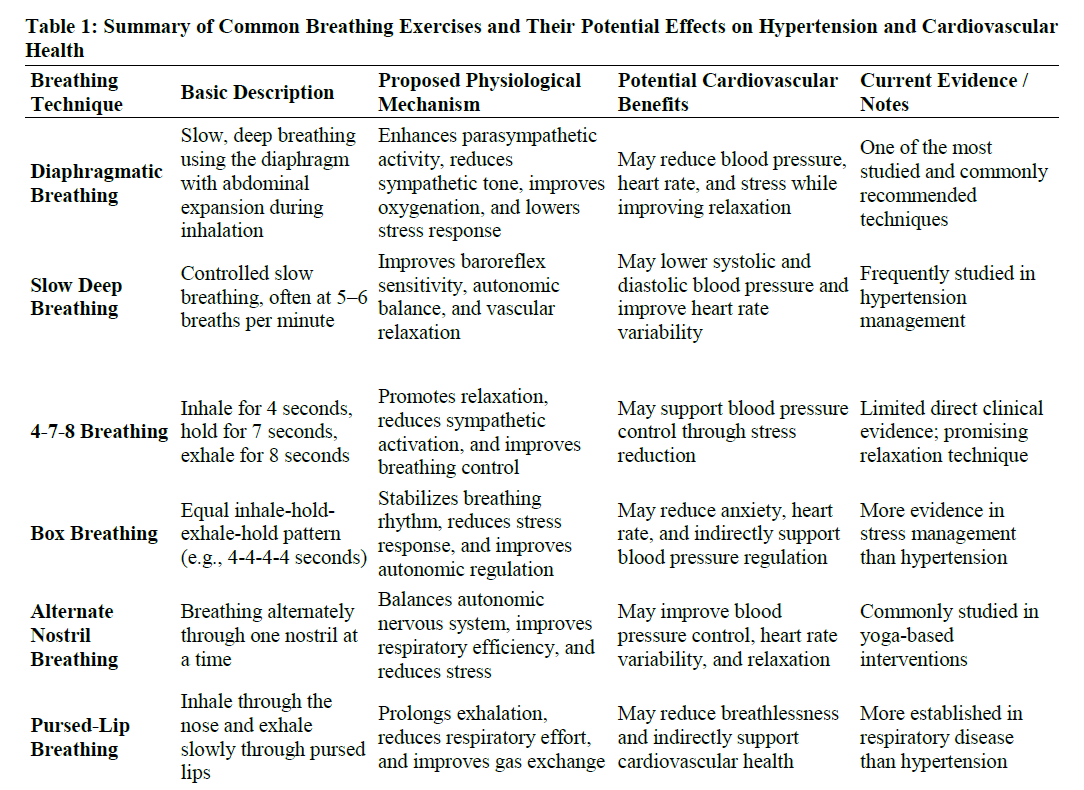
Hypertension, a key contributing factor for cardiovascular disease (CVD), continues to drive global morbidity and mortality, affecting 1.3 billion people worldwide. While pharmacological treatments are the standard of care, they are often associated with side effects and do not always achieve optimum blood pressure control. in recent years, non-pharmacological interventions, particularly breathing exercises, have gained recognition for their potential to complement conventional therapies. This review explores the the therapeutic impacts of various techniques including diaphragmatic deep breathing, 4-7-8 breathing, box breathing, alternate nostril breathing, and pursed-lip breathing on blood pressure regulation, cardiovascular health and autonomic function. Additionally, we examined device guided intervention as an emerging technique. Despite robust evidence supporting the individual benefits of these techniques on blood pressure control and cardiovascular health, there is a notable gap in the literature regarding the combine and synergistic effect of multiple breathing techniques. To address this gap, this review underscores the importance of future research to explore potential synergistic benefits of combining different breathing exercise patterns in the management of hypertension and enhancing cardiovascular health.
References
Akbari, P., and Khorasani-Zadeh, A. (2023). Thiazide diuretics. In StatPearls. StatPearls Publishing.
Amandeep, K., Preksha, M., and Divya, S. (2015). Effectiveness of abdominal breathing exercise on blood pressure among hypertensive patients. International Journal of Therapy Applications, 24: 39-49.
Chen, Y. F., Huang, X. Y., Chien, C. H., and Cheng, J. F. (2017). The effectiveness of diaphragmatic breathing relaxation training for reducing anxiety. Perspectives in Psychiatric Care, 53(4):329-336.
Chinagudi, S., Badami, S., Herur, A., Patil, S., Shashikala, G. V., and Ankad, R. (2014). Immediate effect of short duration of slow deep breathing on heart rate variability in healthy adults. National Journal of Physiology, Pharmacy and Pharmacology, 4(1).
de Barros, S., da Silva, G. V., de Gusmão, J. L., de Araújo, T. G., de Souza, D. R., Cardoso, C. G., and Mion, D. (2017). Effects of long-term device-guided slow breathing on sympathetic nervous activity in hypertensive patients: A randomized open-label clinical trial. Blood Pressure, 26(6):359-365.
de Freitas Gonçalves, K. S., Daniel, A. C. Q. G., Lamas, J. L. T., Oliveira, H. C., Silveira, R. C., Cloutier, L., & Veiga, E. V. (2022). Device-and nondevice-guided slow breathing to reduce blood pressure in patients with hypertension: protocol for a systematic review and meta-analysis. JMIR Research Protocols, 11(3), e33579.
Farzam, K., and Jan, A. (2023). Beta blockers. In StatPearls [Internet]. StatPearls Publishing.
Forouzanfar, M. H., Afshin, A., Alexander, L. T., Biryukov, S. and Brauer, M., Cercy, K. (2016). Global, regional, and national comparative risk assessment of 79 behavioural, environmental and occupational, and metabolic risks or clusters of risks, 1990–2015: A systematic analysis for the global burden of disease study 2015. Lancet, 388(10053):1659-1724.
Garg, P., Mendiratta, A., Banga, A., Bucharles, A., Victoria, P., Kamaraj, B., Qasba, R. K., Bansal, V., Thimmapuram, J., Pargament, R., and Kashyap, R. (2023). Effect of breathing exercises on blood pressure and heart rate: A systematic review and meta-analysis. International Journal of Cardiology Cardiovascular Risk Prevention, 27:200232.
Herawati, I., Mat Ludin, A. F., Ishak, M. M. and Farah, N. M. F. (2023). Breathing exercise for hypertensive patients: A scoping review. Frontiers in Physiology, 14:1048338.
Joseph, C. N., Porta, C., Casucci, G., Casiraghi, N., Maffeis, M., Rossi, M. and Bernardi, L. (2005). Slow breathing improves arterial baroreflex sensitivity and decreases blood pressure in essential hypertension. Hypertension, 46(4):714-718.
Kalaivani, S., Kumari, M. J. and Pal, G. K. (2019). Effect of alternate nostril breathing exercise on blood pressure, heart rate, and rate pressure product among patients with hypertension in JIPMER, Puducherry. Journal of Education and Health Promotion, 8(1):145.
Mackay, I. and Mensah, G. (2004). Atlas of heart disease and stroke. Geneva: World Health Organization.
Mahmood, S., Shah, K. U., Khan, T. M., Nawaz, S., Rashid, H., Baqar, S. W. A. B. and Kamran, S. (2018). Non-pharmacological management of hypertension: In the light of current research. Irish Journal of Medical Science, 188(2): 437-452.
Neves, A. L., Coelho, J., Couto, L., Leite-Moreira, A., and Ronco-Albuquerque, R. Jr. (2013). Metabolic endotoxemia: A molecular link between obesity and cardiovascular risk. Journal of Molecular Endocrinology, 51(2):51-64.
Ojo, A. E., Ojji, D. B., Grobbee, D. E., Huffman, M. D. and Peters, S. A. E. (2024). The burden of cardiovascular disease attributable to hypertension in Nigeria: A modelling study using summary-level data. Global Heart, 19(1):50.
Oneda, B., Ortega, K. C., Gusmão, J. L., Araújo, T. G. and Mion, D. (2010). Sympathetic nerve activity is decreased during device-guided slow breathing. Hypertension Research, 33(7):708-712.
Russo, M. A., Santarelli, D. M. and O'Rourke, D. (2017). The physiological effects of slow breathing in the healthy human. Breathe (Sheffield), 13(4): 298-309.
Sharaf, A. Y., Ghaleb, M. A., and Ahmed, R. F. (2020). Effect of pursed lip breathing exercise on physiological parameters among patients with chronic obstructive pulmonary disease. International Journal of Novel Research in Healthcare and Nursing, 7(1):687-701.
Unger, T., Borghi, C., Charchar, F., Nadia, A. K., Poulter, N. R., Prabhakaran, D. and Ramirez, A. (2020). 2020 International society of hypertension global hypertension practice guidelines. American Heart Association, 75(6).
Verbraecken, J. (2016). Telemedicine applications in sleep disordered breathing: Thinking out of the box. Sleep Medicine Clinics, 11(4):445-459.
Vieira, D. S., Mendes, L. P., Elmiro, N. S., Velloso, M., Britto, R. R., & Parreira, V. F. (2014). Breathing exercises: influence on breathing patterns and thoracoabdominal motion in healthy subjects. Brazilian journal of physical therapy, 18(6), 544-552.
Wang, S. Z., Li, S., Xu, X. Y., Lin, G. P., Shao, L., Zhao, Y. and Wang, T. H. (2010). Effect of slow abdominal breathing combined with biofeedback on blood pressure and heart rate variability in prehypertension. Journal of Alternative and Complementary Medicine, 16(10):1039-1045.
World Health Organization. (2023). Hypertension. Accessed 20th October, 2025
World Heart Federation. (2023). World Heart Report 2023: Confronting the world’s number one killer. Geneva, Switzerland.
Downloads
Published
Issue
Section
Categories
License
Copyright (c) 2026 Basheer Isah Waziri, Zahra'u Sani Ibrahim

This work is licensed under a Creative Commons Attribution 4.0 International License.


