
Effect of Sawdust Ash on the Properties of Concrete Produced with Portland Limestone Cement Grades 32.5N and 42.5R
DOI:
https://doi.org/10.33003/fjs-2026-1018-5942Keywords:
Sawdust Ash, Concrete, Portland Limestone Cement, Compressive Strength, Split Tensile Strength, Sustainable ConstructionAbstract
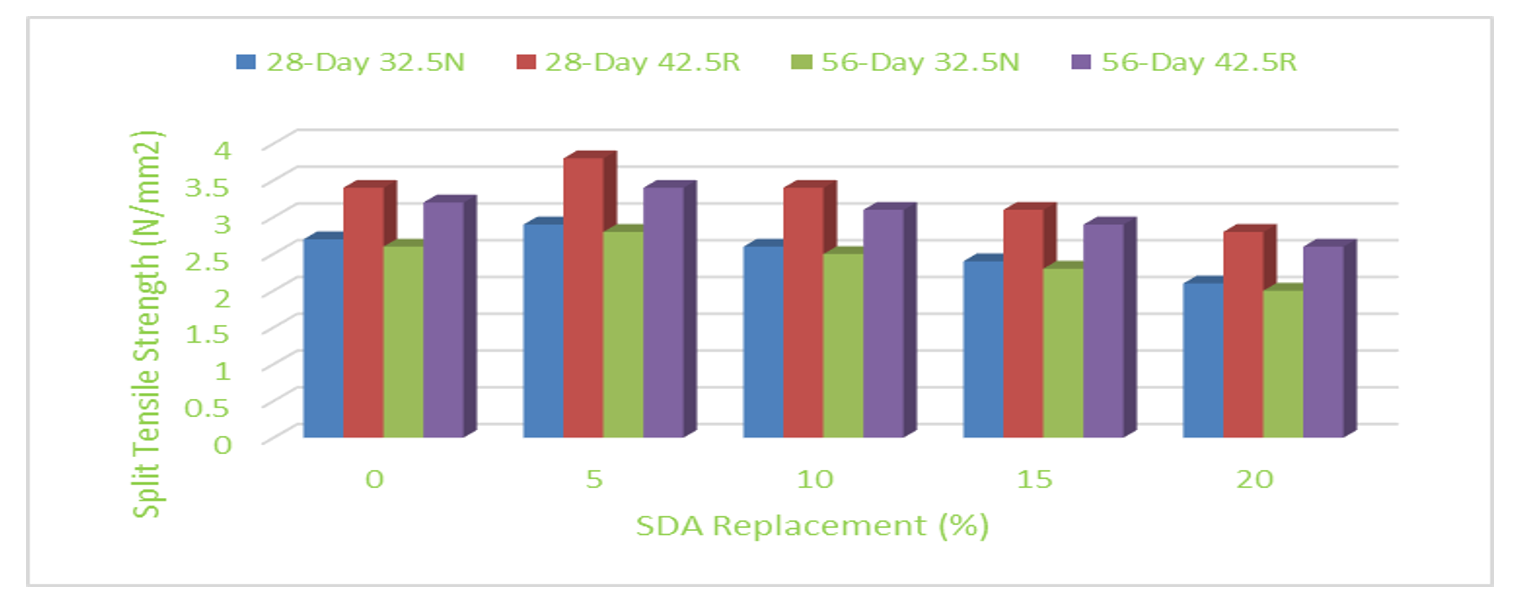
The search for sustainable and resource-efficient construction materials has increased interest in waste-derived materials as partial cement substitutes. This study investigated the effects of sawdust ash (SDA) on concrete produced with Portland limestone cement grades 32.5N and 42.5R. SDA replaced cement at 0%, 5%, 10%, 15%, and 20% by mass using a 1:2:4 mix ratio and water-to-cementitious-material ratio of 0.58. For each cement type, 50 cubes and 50 cylindrical specimens were produced and cured for 28 and 56 days. A two-way ANOVA assessed the effects of SDA level and cement type on 56-day compressive strength using 10 treatment combinations with five independent replicates each. The specific gravities of river sand, crushed granite, and SDA were 2.53, 2.54, and 2.05, respectively. Slump decreased from 53 to 20 mm for 32.5N concrete and from 48 to 22 mm for 42.5R concrete as SDA increased from 0% to 20%. Density similarly decreased, while water absorption increased. At 56 days, compressive strength of 32.5N concrete increased from 25.60 N/mm² at 0% SDA to 26.80 N/mm² at 5%, while 42.5R concrete increased from 26.90 to 31.90 N/mm². Further SDA addition reduced strength. The highest 56-day split tensile strengths were 2.90 N/mm² for 32.5N and 3.80 N/mm² for 42.5R at 5% SDA. Two-way ANOVA showed that SDA content, cement type, and their interaction significantly affected compressive strength (p < 0.001). The study concluded that, within the investigated replacement levels, 5% SDA replacement provided optimum strength performance, particularly with 42.5R cement,
References
Adagba, T. (2026). The potential of cassava peel ash (CPA) as a cement replacement material for sustainable concrete production: A review. Recent Progress in Materials, 8(3), 006. https://doi.org/10.21926/rpm.2603006
Ahmed, A. (2024). Assessing the effects of supplementary cementitious materials on concrete properties: A review. Discover Civil Engineering, 1(1), 145. https://doi.org/10.1007/s44290-024-00154-z
Akerele, D. D., Aguayo, F., & Wu, L. (2025). Portland limestone cement in concrete pavement and bridge decks: Performance evaluation and future directions. Buildings, 15(5), 660. https://doi.org/10.3390/buildings15050660
Alabduljabbar, H., Huseien, G. F., Sam, A. R. M., Alyouef, R., Algaifi, H. A., & Alaskar, A. (2020). Engineering properties of waste sawdust-based lightweight alkali-activated concrete: Experimental assessment and numerical prediction. Materials, 13(23), 5490. https://doi.org/10.3390/ma13235490
Alexander, M., Bentur, A., & Mindess, S. (2017). Durability of concrete: Design and construction. CRC Press.
Ayuba, S., Uche, O. A., & Bassah, E. J. (2022). Properties of self-compacting concrete (SCC) admixing sawdust ash (SDA) cement as replacement. UNIZIK Journal of Engineering and Applied Sciences, 21(1), 789–798.
Ayuba, S., Uche, O. U. A., Haruna, S., & Mohammed, A. (2022). Durability properties of cement–saw dust ash (SDA) blended self-compacting concrete (SCC). Nigerian Journal of Technology, 41(2), 212–221. https://doi.org/10.4314/njt.v41i2.2
Babafemi, A. J., Akinola, O. T., Kolawole, J. T., Paul, S. C., & Miah, M. J. (2021). Effect of sawdust ash and laterite on the electrical resistivity of concrete. Magazine of Civil Engineering, 105(5), 10502. https://doi.org/10.34910/MCE.105.2
British Standards Institution. (1990). BS 812-103:1990: Testing aggregates—Methods for determination of particle size distribution. British Standards Institution.
British Standards Institution. (1997). BS EN 8110:1997: Structural use of concrete. British Standards Institution.
British Standards Institution. (1997). BS EN 933-1:1997: Tests for geometrical properties of aggregates—Determination of particle size distribution—Sieving method. British Standards Institution.
British Standards Institution. (1997). Structural use of concrete: Part 1. Code of practice for design and construction (BS 8110-1:1997).
British Standards Institution. (1997). Tests for geometrical properties of aggregates — Part 1: Determination of particle size distribution — sieving method (BS EN 933-1:1997). https://doi.org/10.3403/0286959
British Standards Institution. (2016). Methods of testing cement — Part 3: Determination of setting times and soundness (BS EN 196-3:2016).
British Standards Institution. (2019). BS EN 12350-2:2019: Testing fresh concrete—Part 2: Slump test. British Standards Institution.
British Standards Institution. (2019). BS EN 12350-6:2019: Testing fresh concrete—Part 6: Density. British Standards Institution.
British Standards Institution. (2019). BS EN 12390-3:2019: Testing hardened concrete—Part 3: Compressive strength of test specimens. British Standards Institution.
British Standards Institution. (2019). Testing hardened concrete — Part 2: Making and curing specimens for strength tests (BS EN 12390-2:2019).
British Standards Institution. (2022). BS EN 1097-6:2022: Tests for mechanical and physical properties of aggregates—Part 6: Determination of particle density and water absorption. British Standards Institution.
British Standards Institution. (2023). BS EN 12390-6:2023: Testing hardened concrete—Part 6: Tensile splitting strength of test specimens. British Standards Institution.
Chowdhury, S., Mishra, M., & Suganya, O. (2015). The incorporation of wood waste ash as a partial cement replacement material for making structural grade concrete: An overview. Ain Shams Engineering Journal, 6(2), 429–437. https://doi.org/10.1016/j.asej.2014.11.005
Council for the Regulation of Engineering in Nigeria. (2017). Concrete mix design manual (Ref. CS0012). COREN.
Danchuwa, I. M., Abatcha, M. Z., Aliyu, Y., Yawale, M. B., Abubakar, W. H., & Abubakar, A. U. (2022). Characterization of some Portland limestone cements in Nigeria using Fourier-transform infrared spectroscopy (FTIR). Journal of Structural Monitoring and Built Environment, 2(1), 49–58. https://penerbit.uthm.edu.my/ojs/index.php/jsmbe/article/view/11619
Elinwa, A. U., & Iro, A. M. (2014). Sawdust ash as powder material for self-compacting concrete containing naphthalene sulfonate. Advances in Civil Engineering, 2014, 129276. https://doi.org/10.1155/2014/129276
Elinwa, A. U., & Mahmood, Y. A. (2002). Ash from timber waste as cement replacement material. Cement and Concrete Composites, 24(2), 219–222. https://doi.org/10.1016/S0958-9465(01)00039-7
Elinwa, A. U., Sarikinshanu, M., Martins, G. E., & Umar, A. H. (2018). Mechanical strength of admixed Conplast SP430 - Sawdust ash cement paste and concrete. SSRN Electronic Journal. https://doi.org/10.2139/ssrn.3193915
Fahad, F., Bhuiyan, K. I., Montasir, F., Dey, P., Akash, M. A. A., & Kumer, A. (2025). Evaluating the use of eggshell powder and sawdust ash as cement replacements in sustainable concrete development. Journal of Sustainable Construction Materials and Technologies, 10(1), 1–21. https://doi.org/10.47481/jscmt.1667601
Fapohunda, C. A., Famodimu, B. I., Adigo, B. C., & Jeje, A. S. (2020). Effect of changing cement grade on the properties of structural concrete. Nigerian Journal of Technological Development, 17(3), 197–204. https://doi.org/10.4314/njtd.v17i3.6
Fapohunda, C., Akinbile, B., & Oyelade, A. (2018). A review of the properties, structural characteristics and application potentials of concrete containing wood waste as partial replacement of one of its constituent material. YBL Journal of Built Environment, 6(1), 63–85. https://doi.org/10.2478/jbe-2018-0005
Gana, A. J., & Owolabi, I. D. (2018). Use of sawdust ash to replace cement in concrete production. International Journal of Civil Engineering and Technology, 9(11), 2883–2900.
Gana, A. J., & Yusuf, T. D. (2018). Solignum treated sawdust as fine aggregate in concrete production. International Journal of Civil Engineering and Technology (IJCIET), 9(12), 252–260.
Gupta, S., Mohapatra, B. N., & Bansal, M. (2020). A review on development of Portland limestone cement: A step towards low carbon economy for Indian cement industry. Current Research in Green and Sustainable Chemistry, 3, 100019. https://doi.org/10.1016/j.crgsc.2020.100019
Gwarah, L. S., Akatah, B. M., Onungwe, I., & Akpan, P. P. (2019). Partial replacement of ordinary Portland cement with sawdust ash in concrete. Current Journal of Applied Science and Technology, 32(6), 1–7. https://doi.org/10.9734/cjast/2019/v32i630036
Harriet, N., Joel, M., George, I., & Jonas, B. (2021). Effect of molasses on the strength and workability of concrete with cement partially replaced by saw dust ash (SDA). European Journal of Engineering Science and Technology, 4, 43–56. https://doi.org/10.33422/ejest.v4i4.691
Ibeabuchi, V. T. (2025). An experimental approach toward sustainable and eco-friendly sandcrete block using sawdust as a partial replacement for cement. In A. H. Khan, M. N. Akhtar, & K. A. Bani-Hani (Eds.), recent developments and innovations in the sustainable production of concrete (pp. 501–509). Woodhead Publishing. https://doi.org/10.1016/B978-0-443-23895-6.00018-2
Iro, U. I., Alaneme, G. U., Milad, A., Olaiya, B. C., Otu, O. N., Isu, E. U., & Amuzie, M. N. (2022). Optimization and simulation of saw dust ash concrete using extreme vertex design method. Advances in Materials Science & Engineering, 2022, 5082139. https://doi.org/10.1155/2022/5082139
Joel, M., & Mbapuun, I. D. (2016). Comparative analysis of the properties of concrete produced with Portland limestone cement (PLC) grade 32.5N and 42.5R for use in rigid pavement work. Global Journal of Engineering Research, 15(1), 17–25. https://doi.org/10.4314/gjer.v15i1.3
Joshua, O., Kolapo, O., Fagbenle, O., Ogunde, A., & Nduka, D. (2019). Assessment of concrete durability in buildings: The effects of the quality of cements available in Lagos, Nigeria. International Review of Civil Engineering, 10(2), 73–79. https://doi.org/10.15866/irece.v10i2.15575
Kebede, S. (2020). The effect of aggregate gradation in cement consumption for concrete production: A laboratory investigation and field survey in Bahir Dar [Doctoral dissertation].
Kola-Aderoju, A. O., & Ibrahim, O. K. (2026). Comparative evaluation of cement, sawdust ash and maize husk ash in stabilization of dumpsite soil in Oyo, Southwestern Nigeria. UNIABUJA Journal of Engineering and Technology, 1(1), 29–44. https://ujet.uniabuja.edu.ng/index.php/ ujet/article/view/175
Mbaraga, F. (2021). The effect of sawdust ash and cement stabilization in the asphalt mixture composed of reclaimed asphalt pavement [Master's thesis, University of Rwanda].
Meko, B., & Ighalo, J. O. (2021). Utilization of Cordia africana wood sawdust ash as partial cement replacement in C 25 concrete. Cleaner Materials, 1, 100012. https://doi.org/10.1016/j. clema.2021.100012
Mohamad, N., Muthusamy, K., Embong, R., Kusbiantoro, A., & Hashim, M. H. (2022). Environmental impact of cement production and solutions: A review. Materials Today: Proceedings, 48, 741–746. https://doi.org/10.1016/j.matpr.2021.02.212
Naik, T. R. (2002). Greener concrete using recycled materials. Concrete International, 24(7), 45–49.
Naik, T. R. (2020). Sustainability of the cement and concrete industries. In Sustainable construction materials and technologies (pp. 19–25).
Naqi, A., & Jang, J. G. (2019). Recent progress in green cement technology utilizing low-carbon emission fuels and raw materials: A review. Sustainability, 11(2), 537. https://doi.org/10.3390/su11020537
Neville, A. M. (2011). Properties of concrete (5th Ed.). Pearson.
Nnaji, C. C., & Udokpoh, U. U. (2022, April). Sawdust waste management in Enugu timber market. In Proceedings of the 4th African International Conference on Industrial Engineering and Operations Management (pp. 5–7). https://doi.org/10.46254/af03.20220087
Ogunbiyi, M., Ogunbiyi, M., Olawale, S., Alabi, O., & Thanni, M. (2017). Assessment of the qualities of Dangote and Elephant (Portland) cement brands commonly used in the Nigerian construction industry. International Journal of Innovative Research in Science, Engineering and Technology, 6, 3888–3895.
Oguntoke, O., Emoruwa, F. O., & Taiwo, M. A. (2019). Assessment of air pollution and health hazard associated with sawmill and municipal waste burning in Abeokuta Metropolis, Nigeria. Environmental Science and Pollution Research, 26(32), 32708–32722. https://doi.org/10.1007/s11356-019-04310-2
Onyango, O. V., Wambu, E. W., Kiplagat, A., Lutta, S., & Munyao, O. M. (2026a). Development of a low-carbon pozzolana–lime cement using sawdust ash and calcined clay. . https://doi.org/10.21203/rs.3.rs-8782472/v1
Onyango, O. V., Wambu, E. W., Okoth, M. O., & Kipkemboi, P. K. (2026b). Pozzolanic reactivity and mortar performance of sugarcane bagasse and sawdust ashes in lime-based binders. Discover Concrete and Cement, 2(1), 49. https://doi.org/10.1007/s44416-026-00093-1
Onyechere, C. I. (2022). Properties of sawdust concrete. Journal of Building Material Science, 4(2), 1–9. https://doi.org/10.30564/jbms.v4i2.4818
Raheem, A. A., & Ige, O. O. (2019). Chemical composition and physicomechanical characteristics of sawdust ash blended cement. Journal of Building Engineering, 21, 404–408. https://doi.org/10.1016/j.jobe.2018.10.014
Raheem, A. A., Olasunkanmi, B. S., & Folorunso, C. (2012). Saw dust ash as partial replacement for cement in concrete. Organization, Technology and Management in Construction: An International Journal, 4(2), 474–480. https://doi.org/10.5592/otmcj.2012.2.3
Soomro, M., Tam, V. W. Y., & Evangelista, A. C. J. (2022). Production of cement and its environmental impact. In Recycled concrete: Technologies and performance (pp. 11–46). Woodhead Publishing. https://doi.org/10.1016/B978-0-323-85210-4.00010-2
Surahyo, A., Surahyo, L., & Luby. (2019). Concrete construction (pp. 239–255). Springer International Publishing. https://doi.org/10.1007/978-3-030-10510-5
Thomas, B. S., Yang, J., Mo, K. H., Abdalla, J. A., Hawileh, R. A., & Ariyachandra, E. (2021). Biomass ashes from agricultural wastes as supplementary cementitious materials or aggregate replacement in cement/geopolymer concrete: A comprehensive review. Journal of Building Engineering, 40, 102332. https://doi.org/10.1016/j.jobe.2021.102332
Tunio, Z. A., Memon, B. A., Memon, N. A., Lakho, N. A., Oad, M., & Buller, A. H. (2019). Effect of coarse aggregate gradation and water-cement ratio on unit weight and compressive strength of no-fines concrete. Engineering, Technology & Applied Science Research, 9(1), 3786–3789. https://doi.org/10.48084/etasr.2472
Udoeyo, F. F., & Dashibil, P. U. (2002). Sawdust ash as concrete material. Journal of Materials in Civil Engineering, 14(2), 173–176.
Udoeyo, F. F., Inyang, H., Young, D. T., & Oparadu, E. E. (2006). Potential of wood waste ash as an additive in concrete. Journal of Materials in Civil Engineering, 18(4), 605–611. https://doi.org/10.1061/(ASCE)0899-1561(2006)18:4(605)
Udokpoh, U., & Nnaji, C. (2023). Reuse of sawdust in developing countries in the light of sustainable development goals. Recent Progress in Materials, 5(1), 1–33. https://doi.org/10.21926/rpm.2301006
Vishwakarma, V., & Ramachandran, D. (2018). Green concrete mix using solid waste and nanoparticles as alternatives—A review. Construction and Building Materials, 162, 96–103. https://doi.org/10.1016/j.conbuildmat.2017.11.174
Wasiu, S. P., Fapohunda, C. A., Madueke, C. I., Oluwatoyin, E. O., & Adekunle, O. A. (2026). Multiscale structural and microstructural investigation of ternary blends of sawdust ash and sponge gourd ash in concrete. FUDMA Journal of Sciences, 10(8), 400–410 DOI: https://doi.org/10.33003/fjs-2026-1008-5341
Downloads
Published
Issue
Section
Categories
License
Copyright (c) 2026 Aondona Shadrak Jagba, Herbert Uvirsue Ijoh, Peter Luper Dzwa

This work is licensed under a Creative Commons Attribution 4.0 International License.


