
Effect of Used Engine Oil as a Chemical Admixture on the Properties of Normal and Pozzolanic Concrete
DOI:
https://doi.org/10.33003/fjs-2026-1016-5921Keywords:
Used Engine Oil, Rice Husk Ash, Pozzolanic Concrete, Sustainable Concrete, Workability, Compressive Strength, Splitting Tensile Strength, Waste UtilizationAbstract
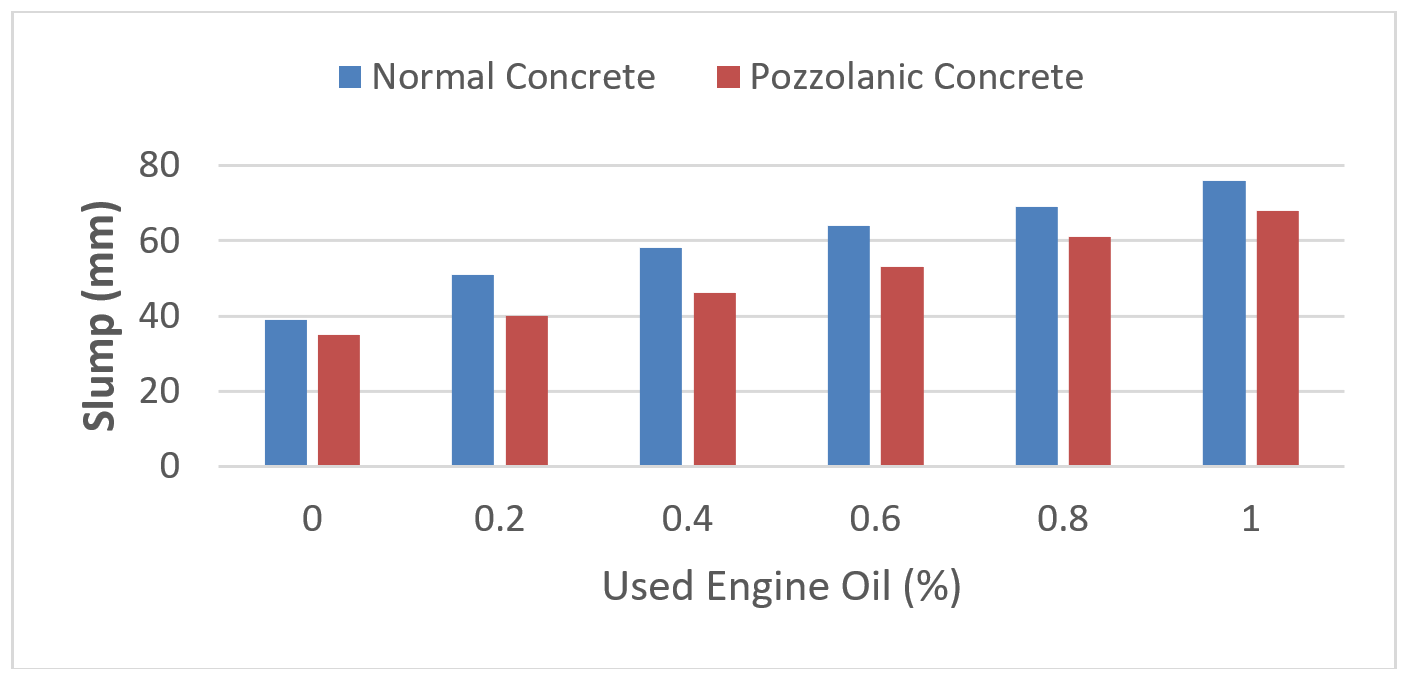
The increasing environmental burden associated with the disposal of used engine oil (UEO) and the carbon emissions from Portland cement production has created a need for sustainable concrete materials and waste-management strategies. This study investigated the effect of UEO as a chemical admixture on the properties of normal and pozzolanic concrete containing rice husk ash (RHA). UEO was incorporated at 0, 0.2, 0.4, 0.6, 0.8, and 1.0% by weight of cement using a 1:2:4 mix ratio and a water-cement ratio of 0.58. The concrete specimens were evaluated for workability, density, water absorption, compressive strength, and splitting tensile strength. The result revealed that, the increasing UEO content improved workability from 39 to 76 mm for normal concrete and from 35 to 68 mm for pozzolanic concrete respectively. Conversely, density decreased from 2681.48 to 2385.19 kg/m³ and from 2533.33 to 2237.04 kg/m³, respectively. At 28 days, compressive strength decreased from 26.88 to 15.57 N/mm² for normal concrete and from 21.55 to 10.85 N/mm² for pozzolanic concrete as UEO increased from 0 to 1.0%, representing reductions of 42.1% and 49.7%, respectively. Splitting tensile strength also decreased with increasing UEO content. At the recommended 0.2% UEO dosage, normal concrete experienced a relatively modest 3.1% reduction in 28-day compressive strength, from 26.88 to 26.05 N/mm². Overall, UEO improved workability but reduced density and mechanical strength at higher dosages. Therefore, 0.2% UEO is recommended as the optimum dosage, although it’s relatively high chloride and sulphate contents warrant caution in reinforced concrete applications and further durability investigation.
References
Abdelaziz, G. E. (2009). Utilization of used-engine oil in concrete as a chemical admixture. HBRC Journal, 5(3), 9-19.
Adedeji, J. A., Suleiman, M. K., Adegboyega, I. A., Bashingi, N., & Yaro, N. S. A. (2026). Experimental investigation of bricks produced with rice husk ash and quarry dust as cement and sand replacements. Materials Proceedings, 33(1), 1. https://doi.org/10.3390/materpro c2026033001
Adefisoye, S. A., Olaomotito, P. A., Fasasi Aleshinloye, A. O., & Alli, P. A. (2025). Effect of rice husk ash as partial cement replacement on the mechanical properties of concrete. Journal of Energy Research and Reviews, 17(12), 69–82. https://doi.org/10.9734/jenrr/2025/v17i12479
Akinpelu, M. A., Odeyemi, S. O., Olafusi, O. S., & Muhammed, F. Z. (2019). Evaluation of splitting tensile and compressive strength relationship of self-compacting concrete. Journal of King Saud University - Engineering Sciences, 31(1), 19–25. https://doi.org/10.1016/j.jksues.2017.01.002
Akinpelu, M. A., Odeyemi, S. O., Olafusi, O. S., & Muhammed, F. Z. (2019). Evaluation of splitting tensile and compressive strength relationship of self-compacting concrete. Journal of King Saud University-Engineering Sciences, 31(1), 19-25. https://doi.org/10.1016/j.jksues. 2017.01.002
Alhassan, A., Aboshio, A., & Uche, O. A. (2023). Rice husk and snail shell ash as partial replacement of ordinary Portland cement in concrete: A review. Nigerian Journal of Technology, 42(4), 425–436. https://doi.org/10.4314/njt.v42i4.2
Ali, B., Qureshi, L. A., & Khan, S. U. (2020). Flexural behavior of glass fiber-reinforced recycled aggregate concrete and its impact on the cost and carbon footprint of concrete pavement. Construction and Building Materials, 262, Article 120820. https://doi.org/10.1016/j. conbuildmat.2020.120820
Alsadey, S. (2018). Effects of used engine oil as chemical admixture in concrete. International Journal of Energy and Sustainable Development, 3(2), 38–43. http://www.aiscience.org/journal/ijesd
Armioni, D. M., Raţiu, S. A., Benea, M. L., & Puţan, V. (2024). Overview on the environmental impact of used engine oil. Journal of Physics: Conference Series, 2927(1), 012007. https://doi.org/10.1088/1742-6596/2927/1/012007
Assaad, J. J. (2013). Disposing used engine oils in concrete – Optimum dosage and compatibility with water reducers. Construction and Building Materials, 44, 734–742. https://doi.org/10.1016/j .conbuildmat.2013.03.078
Awoyemi, T. J., Ibedu, K. E., Kaura, J. M., & Lawan, A. (2023). Strength-Durability properties and microstructural analysis of concrete containing cow bone Ash and bentonite. FUDMA Journal of Sciences, 7(5), 39-49. DOI: https://doi.org/10.33003/fjs-2023-0705-1900
Barbhuiya, S., Das, B. B., & Adak, D. (2025). Effects of chemical admixtures on the properties of concrete. In Binding materials for sustainable construction (pp. 329–362). Woodhead Publishing. https://doi.org/10.1016/B978-0-443-26566-2.00009-X
Barua, D., Rahman, M. M., Chowdhury, M. W. R., Arif, M. M., & Hasan, M. A. (2018). Effectiveness of rice husk ash (RHA) as a partial replacement of cement in concrete. In Proceedings of the 4th International Conference on Civil Engineering for Sustainable Development (ICCESD 2018). KUET.
Beddu, S., Shafiq, N., Nuruddin, M. F., Kamal, N. L. M., & Sadon, S. N. (2016). Effects of used engine oil as an admixture in concrete durability. Current Journal of Applied Science and Technology, 15(6), 1–10. https://doi.org/10.9734/BJAST/2016/20738.
British Standards Institution. (1983). BS 1881-125:1983: Testing concrete—Method for mixing and sampling fresh concrete in the laboratory. British Standards Institution.
British Standards Institution. (1990). BS 812-103:1990: Testing aggregates—Methods for determination of particle size distribution. British Standards Institution.
British Standards Institution. (1997a). BS 8110:1997: Structural use of concrete. British Standards Institution.
British Standards Institution. (1997b). BS EN 933-1:1997: Tests for geometrical properties of aggregates—Determination of particle size distribution—Sieving method. British Standards Institution.
British Standards Institution. (2000a). BS EN 12350-2:2000: Testing fresh concrete—Part 2: Slump test. British Standards Institution.
British Standards Institution. (2000b). BS EN 12350-6:2000: Testing fresh concrete—Part 6: Density. British Standards Institution.
British Standards Institution. (2009a). BS EN 12390-3:2009: Testing hardened concrete—Part 3: Compressive strength of test specimens. British Standards Institution.
British Standards Institution. (2009b). BS EN 12390-6:2009: Testing hardened concrete—Part 6: Tensile splitting strength of test specimens. British Standards Institution.
British Standards Institution. (2013). BS EN 1097-6:2013: Tests for mechanical and physical properties of aggregates—Part 6: Determination of particle density and water absorption. British Standards Institution.
Chen, H., Chow, C. L., & Lau, D. (2023). Recycling used engine oil in concrete: Fire performance evaluation. Journal of Building Engineering, 64, 105637. https://doi.org/10.1016/j.jobe.2022.105637
Chen, H., Zhao, X., Astudillo, J. C., Leung, K. M., Chow, C. L., & Lau, D. (2025). Upcycling used engine oil into concrete: Ecological and mechanical performances in coastal applications. Construction and Building Materials, 483, 141605. https://doi.org/10.1016/j.conbuildmat. 2025.141605
Choudhary, G., & Wanjari, S. (2025). Waste to worth: Fruit peel-derived retarder as a sustainable admixture in hazardous waste-based concrete systems. Case Studies in Construction Materials, e05101. https://doi.org/10.1016/j.cscm.2025.e05101
Falade, F., Ikponmwosa, E. E., & Arogundade, A. (2011). Investigation of some structural properties of foamed aerated concrete. Journal of Engineering Research, 16(1), 67–81
Faqe, H., Dabaghh, H., & Mohammed, A. (2020). Natural admixture as an alternative for chemical admixture in concrete technology: A review. Journal of University of Duhok, 23(2), 301–308. https://doi.org/10.26682/csjuod.2020.23.2.24
Hamad, Bilal S., Rteil, Ahmad A. and El-Fadel, Mutassem (2003) Effect of used engine oil on properties of fresh and hardened concrete. Construction and Building Materials, 17 (5), 311-318. (doi:10.1016/S0950-0618(03)00002-3).
Hasan, S. S., & Fattah, M. Y. (2023). Strength properties of polymer reactive powder concrete with waste materials. Civil Engineering Journal, 9(8), 1936–1956. https://doi.org/10.28991/CEJ-2023-09-08-09
Jongpradist, P., Homtragoon, W., Sukkarak, R., Kongkitkul, W., & Jamsawang, P. (2018). Efficiency of rice husk ash as cementitious material in high-strength cement-admixed clay. Advances in Civil Engineering, 2018, Article 8346319. https://doi.org/10.1155/2018/8346319
Li, J., Chen, P., Cai, H., Xu, Y., & Li, C. (2021). Preliminary study on the utilization of RHA as a performance enhancer for rubber mortar. Materials, 14(12), 3216. https://doi.org/10.3390/ma14123216
Li, Y., Abdelmagid, A. A. A., Qiu, Y., Yang, E., & Chen, Y. (2022). Study on the Aging Mechanism and Microstructure Analysis of Rice-Husk-Ash- and Crumb-Rubber-Powder-Modified Asphalt. Polymers, 14(10), 1969. https://doi.org/10.3390/polym14101969
Nadir, H. M., & Ahmed, A. (2021). Comparative evaluation of potential impacts of agricultural and industrial waste pozzolanic binders on strengths of concrete. Journal of Material Sciences & Manufacturing Research, 2(2), 1–8. https://doi.org/10.47363/JMSMR/2021(2)119
Neville, A. M. (2012). Properties of concrete (5th ed.). Pearson.
Obam, S. O., Ijoh, H. U., & Adeke, T. P. (2025). Effect of heat on some properties of normal and pozzolanic concrete. Engineering Research Journal, 4(10), 44–58. https://doi.org/10.5281/zenodo.14628016
Obam, S. O., Jagba, A. S., & Adeke, P. T. (2024). Regression models for prediction of compressive and tensile concrete strength. CEDTECH International Journal of Engineering & Applied Science, 5(2). 7-25.
Olaiya, B. C., Lawan, M. M., Olonade, K. A., & Segun, O. O. (2025). An overview of the use and process for enhancing the pozzolanic performance of industrial and agricultural wastes in concrete. Discover Applied Sciences, 7(3), 164. https://doi.org/10.1007/s42452-025-06586-1
Olaleye, B. C., Lawan, M. M., Olonade, K. A., & Segun, O. O. (2025). An overview of the use and process for enhancing the pozzolanic performance of industrial and agricultural wastes in concrete. Discover Applied Sciences, 7(3), 164. https://doi.org/10.1007/s42452-025-06586-1
Olaleye, D., & Akintunde, O. P. (2026). Effects of used engine oil on production of high-strength concrete. Journal of Materials Science Research and Reviews, 9(2), 304–315. https://doi.org/10.9734/jmsrr/2026/v9i2477
Ossai, I. C., Hamid, F. S., Aboudi-Mana, S. C., & Hassan, A. (2024).Ecotoxicological effects, human and animal health risks of pollution and exposure to waste engine oils: A review. Environmental Geochemistry and Health, 46(10), 416. https://doi.org/10.1007/s10653-024-02198-7
Ozmen, H. B., & Tanrıverdi, B. (2025). Concrete paradox: Economic importance, environmental impacts, and the sustainability of concrete material. Research and Design, 2(2), 66–84. https://doi.org/10.17515/rede2025-008en0801rs
Patil, D. (2024). Partial replacement of cement by rice husk. TIJER - International Research Journal, 11(8), a227.
Raghav, M., Park, T., Yang, H. M., Lee, S. Y., Karthick, S., & Lee, H. S. (2021). Review of the effects of supplementary cementitious materials and chemical additives on the physical, mechanical and durability properties of hydraulic concrete. Materials, 14(23), 7270. https://doi.org/10.3390/ma14237270
Razzaq, A. W. R., & Alekhin, V. N. (2025). Impact of used engine oil on the water absorption of concrete. Akademicheskij Vestnik UralNIIproekt RAASN, 67(4), 73–80. https://doi.org/10. 25628/UNIIP.2025.67.4.011
Sangoju, B., Gopal, R., & Bhajantri, H. B. (2021). A review on performance-based specifications toward concrete durability. Structural Concrete, 22(5), 2526–2538. https://doi.org/10.1002/suco. 201900542
Shafiq, N., Choo, C. S., & Isa, M. H. (2018). Effects of used engine oil on slump, compressive strength and oxygen permeability of normal and blended cement concrete. Construction and Building Materials, 187, 178–184. https://doi.org/10.1016/j.conbuildmat.2018.07.195
Shar, I. A., Memon, F. A., Bheel, N., Benjeddou, O., & Alwetaishi, M. (2023). Effect of used engine oil on the mechanical properties and embodied carbon of concrete blended with wheat straw ash as cementitious material. Environmental Science and Pollution Research, 30(30), 75879–75893. https://doi.org/10.1007/s11356-023-27803-7
Shatat, M. R. A. (2016). Hydration behavior and mechanical properties of blended cement containing various amounts of rice husk ash in presence of metakaolin. Arabian Journal of Chemistry, 9(Supplement 1), S138–S143. https://doi.org/10.1016/j.arabjc.2013.12.006
Thomas, B. S. (2018). Green concrete partially comprised of rice husk ash as a supplementary cementitious material—A comprehensive review. Renewable and Sustainable Energy Reviews, 82, 3913–3923. https://doi.org/10.1016/j.rser.2017.10.081
Tian, Y., Liu, Y., Xie, Y.-M., Zhang, G.-Y., Ye, H.-L., Yan, D.-M., Li, Y.-J., Li, B., Xue, H.-J., & Cai, Q. (2025). Coupled effects of chlorides and sulfates on steel reinforcement corrosion in concrete structures: A comprehensive review. Case Studies in Construction Materials, 22, Article e04263. https://doi.org/10.1016/j.cscm.2025.e04263
Torres-Ortega, R., Torres-Sanchez, D., & Lopez-Lara, T. (2025). Mechanical properties of hydraulic concretes with partial replacement of Portland cement by pozzolans obtained from agro-industrial residues: A review. Heliyon, 11(1), 1–23. https://doi.org/10.1016/j.heliyon.2024.e41004
Tulashie, S. K., Ebo, P., Ansah, J. K., & Mensah, D. (2021). Production of Portland pozzolana cement from rice husk ash. Materialia, 16, 101048. https://doi.org/10.1016/j.mtla.2021.101048
Varghese, R. G., & Sakaria, P. E. (2017). Experimental investigation on the properties of fresh and hardened concrete with used engine oil as super plasticizer. International Research Journal of Engineering and Technology, 5(4), 2230–2236.
Wang, X. H., Fang, Z. C., & Zheng, L. (2024). Effect of dose and types of the water reducing admixtures and superplasticizers on concrete strength and durability behaviour: A review. Journal of Civil Engineering and Management, 30(1), 33–48. https://doi.org/10.3846/jcem.2024.20145
Zhang, C., Li, J., Yu, M., Lu, Y., & Liu, S. (2024). Mechanism and Performance Control Methods of Sulfate Attack on Concrete: A Review. Materials, 17(19), 4836. https://doi.org/10.3390/ma 17194836
Downloads
Published
Issue
Section
Categories
License
Copyright (c) 2026 Shadrack Aondona Jagba, Herbert Uvirsue Ijoh, Sunday Anebu

This work is licensed under a Creative Commons Attribution 4.0 International License.


