
Influence of Toxic Heavy Metals and Their Potential Sources in the Soil from Major Abattoirs in Zamfara State
DOI:
https://doi.org/10.33003/Keywords:
Heavy metals, Abattoirs, Soils, Physicochemical propertiesAbstract
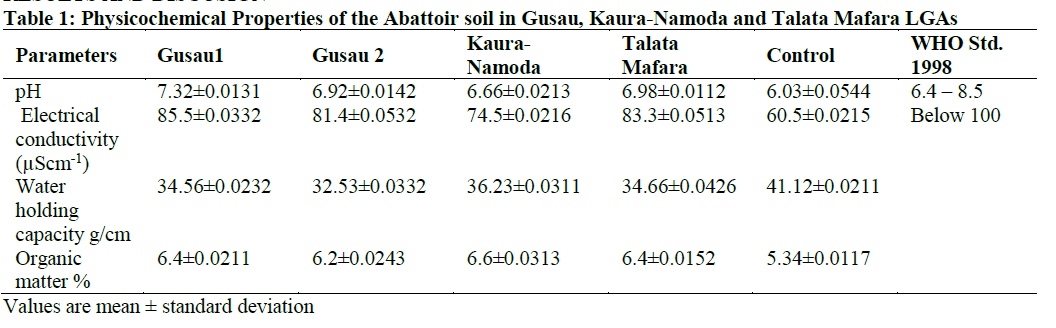
Abattoirs play a vital role in meat production but can significantly impact environmental health due to improper waste management. This study investigated the levels of selected toxic heavy metals Pb, Cu, Cd, Zn, and Cr in soils from abattoir sites in Gusau, Kaura-Namoda and Talata Mafara LGAs of Zamfara State, Nigeria. The aim was to assess the impact of abattoir activities on soil quality and to determine the potential risks posed by heavy metal contamination. Soil samples were collected from four abattoir locations and a control site with no history of abattoir activity. Standard laboratory procedures were used to analyze the physicochemical properties of the soils, as well as the concentrations of the heavy metals. The results indicated that soils from the abattoir sites had slightly elevated pH, electrical conductivity, organic matter, and water holding capacity compared to the control, though all were within permissible limits. Heavy metal analysis showed that Pb,(12.54±0.0215 to 13.61±0.0421) Cu (6.84±0.0251 to7.68±0.0313), and Cd (0.39±0.0439 to 0.41±0.0551), Zn (16.54±0.0417 to 18.62±0.0343) while Cr (6.21±0.0263 to 6.60±0,016) concentrations were higher in abattoir soils than in the control, with Cu and Pb showing high metal pollution index (MPI > 3), while Cd, Zn, and Cr exhibited moderate pollution (1 ≤ MPI < 3). Pollution assessment using Contamination Factor (CF), Degree of Contamination (Cdeg), and Pollution Load Index (PLI) revealed that contamination levels were generally low, though cadmium presented moderate contamination potential in some samples.
References
Abeh G. Akinro, A. O., Ologunagba, I. B. & Yahaya O (2017): Environmental implication of unhygienic operation of a city abattoir in Akure, Western Nigeria. Journal of Engineering and Applied Sciences. 4(9): 61-63. Adeleke N. Godwin E. Adeyemo, K. O. (2021): Unhygienic operation of a city abattoir in South-western Nigeria: environmental implication. African Journal of Environmental Assessment and Management, 4(1): 23-28.Amoah E., Aliyu, J., Ibrahim, A. A. & Abba Aja, H. K. (2019): The effect of livestock slaughter on fetal loss and disease incidence in Maiduguri Abattoir. TechnoScience Africana Journal 2(1):15-22. Ekeke D. and Okonwu F. (2013). Animal Slaughter Characteristics: Implications for the future of Beef production and Peoples’ nutrition. Proc. 5th Ann. Conf. Animal Science Assoc. of Nigeria. Port Harcourt, Nigeria. September, 2000.Iqbal D., Gracey, J., David, S. C. (2014): Construction and operation of medium-sized abattoirs in developing countries. In: 97th Animal Production and Health Paper. Pp 1-104. Iwegbue D., Lawan, M. K., Bello, M, Kwaga, J. K. P. & Raji, M. A. (2009). Evaluation of physical facilities and processing operations of major abattoirs in North-western states of Nigeria. Sokoto Journal of Veterinary Sciences, 11 (1) 56-61. http://dx.doi.org/10.4314/sokjvs.v11i1.9Kebede D. and Desta G. (2018): Concentration of hardness, alkalinity and nitrate in water used for cleaning milk equipment in Brazilian dairy farms, Proceedings of 10th International Society for Animal Hygiene 2-6 July 2000. Maastricht Netherlands. Pp 100-103. Mazurek D., Gracey, J., David, S. C. & Robert, H. (2017). Textbook of Meat Hygiene 10th edition. Bailliere Tindall, England. Pp 102-260.Mohan D., Dandago, M. A., Farouk, S. U. and Igwe, E. C. (2013). Evaluation of slaughter practices in Kano Abattoir. Techno Science Africana Journal, 3(1) 28-31.Nyika E. Bello, M., Lawan, M. K., Dzikwi, A. A., Maikai, B. V., Imam, J. & Sanusi, M. (2015): Abattoir conditions in Nigeria and public health significance under sustainable food security. Book of Abstracts: International Conference of Science and Technology, Held 28th- 30th October, 2008 at University of Abuja Conference Hall, Nigeria. Pp 88. Codex Alimentarius, (1993). Code of Hygiene practice for meat (CAC/RCP 58- 2005) http://www.codexalimentarius.net/download/sta ndard/10196/cxp_058e Retrieved 2010-02-11. Odu M., Muhammad, I. R., Rabi, A. & Abdullahi, A. Y. (2007). Implications of slaughter of pregnant Ewes and Does to future livestock in semi-arid urban abattoir. Journal of Animal and Vet. Advances 6(6):819-822Osibanjo D. and Adie W. (2007): Beef HACCP: Intervention and nonintervention system. International Journal of Food Microbiology, 66 (1-2) 119-129. Ovasogie D. and Ofomaja E. (2007). Prevalence of giardiasis in cattle slaughtered in Sokoto metropolitan abattoir, Sokoto, Nigeria. Scientific Journal of Veterinary Advances (2013) 2(6) 76- 82. ISSN 2322-1879Tukura D., Kebeke W., Gracey F., and Igwe, E. C. (2007): Adamawa State Meat Industry. In Agriculture in Adamawa State. Edited by Igwe, E. C., S. I. Mshelia, S. I. & Jada, M. Y. Paraclete Pub. Yola. ISSBN: 978-8055-26-5WHO (2001). Environmental and public health issues of animal food products delivery system in Imo state, Nigeria. Online Journal of Health and Allied Science, .5(2)2.
Downloads
Published
Issue
Section
Categories
License
Copyright (c) 2026 Moses Sunday, Shehu Sadia

This work is licensed under a Creative Commons Attribution 4.0 International License.


