
Morphological and Physical Characterization of Semi-Arid Soil of Dutse, Jigawa State, North Western Nigeria
DOI:
https://doi.org/10.33003/fjs-2026-1015-5933Keywords:
Morphological, Soil Properties, Semi-Arid Zone, DutseAbstract
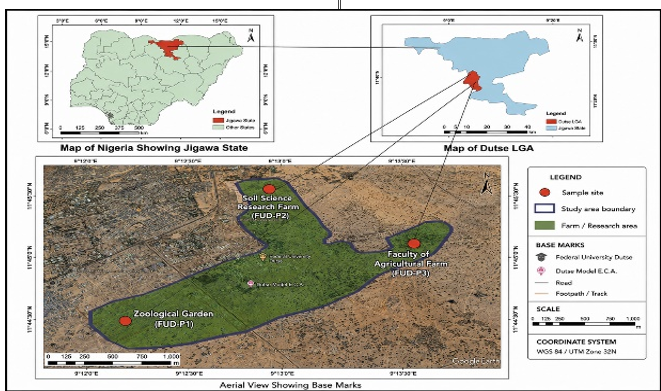
Soil characterization is fundamental for understanding soil genesis, classification, agricultural potential, and sustainable land management. This study characterized the morphological and physical properties of selected soils in the semi-arid environment of Dutse, Jigawa State, Nigeria. A semi-detailed soil survey was conducted at a scale of 1:50,000. Three representative pedons (FUD-P1, FUD-P2, and FUD-P3) was described following the USDA Soil Survey Manual. The coordinates of the pedons were recorded using a Global Positioning System (GPS), while Locus Map version 4.29 (Asamm Software) was used to delineate the study area. The soils colour varied from yellowish brown (10YR7/4) to reddish brown (7.5YR5/3) in both topsoil and subsoil of all the pedons. Soil texture varied from loamy sand to sandy loam, with sand content ranging from 70.0 to 82.0%.with highest value in FUD-PI. Bulk density values ranged from 1.19-1.68 Mg m⁻³. Water-holding capacity ranged from 40 to 60% in both topsoil and subsoil while total porosity varied from 35.20 to 55.26%. Gravimetric moisture content increased with depth, particularly in FUD-P3, indicating its higher clay content and lower bulk density. Significant differences (p ≤ 0.05) were observed in sand content and bulk density among the pedons, whereas differences in porosity and moisture content were not significant (p > 0.05). The silt: clay ratio exceeded 0.15 in all pedons, indicating weak soil profile development and signifying that the soils are at an early stage of Pedogenesis. There is need for appropriate soil management for sustainable use of the land.
References
Adegbite, K., Okafor, M. E., Olasekan, A. A., & Alori, E. (2019). Characterization and classification of soils of a toposequence in a derived savannah agro-ecological zone of Nigeria. The Open Agriculture Journal, 13(1), 44–50.
Anikwe, M. A. N., & Ife, K. (2023). The role of soil ecosystem services in the circular bioeconomy. Frontiers in Soil Science, 3, 1209100.
Babalola, T. S., Fasina, A. S., Kadiri, W. O. J., Mohammed, S. A., Ogunleye, K. S., & Ibitoye-Ayeni, N. K. (2019). Land capability classification of soils in a lithosequence within forest and savannah zone of Nigeria. Elixir Agriculture, 131, 53211–53215.
Babalola, T. S., Ogunleye, K. S., Omoju, O. J., Osakwe, U. C., & Ilori, A. O. A. (2021). Soil characterization and classification in an upland of southern Guinea savannah zone of Nigeria. Indian Journal of Agricultural Research, 55, 709–714.
Badía-Villas, D., & del Moral, F. (2015). Soils of the arid areas. In The soils of Spain (pp. 145–161). Springer International Publishing.
Bamikole, P. A., Abiodun, O. O., Durodoluwa, J. O., & Fatai, O. T. (2020). Selected physical and chemical properties of soil under different agricultural land-use types in Ile-Ife, Nigeria. Heliyon, 6(9), e05090.
Brady, N. C., & Weil, R. R. (2017). The nature and properties of soils (15th ed.). Pearson Education.
Conklin, A. R. (2013). Introduction to soil chemistry: Analysis and instrumentation. John Wiley & Sons.
Delgado, A., & Gómez, J. A. (2024). The soil: Physical, chemical, and biological properties. In Principles of agronomy for sustainable agriculture (pp. 15–30). Springer International Publishing.
Dinssa, B., & Elias, E. (2021). Characterization and classification of soils of Bako Tibe District, West Shewa, Ethiopia. Heliyon, 7(11), e08461.
Gambo, A., Fullen, M. A., & Baldwin, T. C. (2025). Characterization and classification of soils on a toposequence around Dutse, Jigawa State, Nigeria. Discover Soil, 2(1), 97.
Gee, G. W., & Or, D. (2002). Particle-size analysis. In J. H. Dane & G. C. Topp (Eds.), Methods of soil analysis: Part 4. Physical methods (pp. 255–293). Soil Science Society of America.
Girei, A.H., Awalu, A., Nabayi, A., Santuraki, H.A., & Ya'u, S. L. (2026). Characterization and classification of soils along toposequence in teaching and research farm of Federal University Dutse, Jigawa State. FUDMA Journal of Agriculture and Agricultural Technology, 12(2), 76–93.
Gomiero, T. (2016). Soil degradation, land scarcity and food security: Reviewing a complex challenge. Sustainability, 8(3), 281.
Harsh, B., & Kumar, K. A. (2022). Characterization, classification and fertility of Bangalore Blue grape-growing soils of Karnataka. Mysore Journal of Agricultural Sciences, 56(1), 138–146.
Hun, H., Pheak, S., & Sarun, H. (2026). Soil physical properties and their role in plant growth: Texture, structure, porosity, water retention, compaction, aeration, and root responses. Journal of Agriculture and Environment, 5.
Ikpe, E. (2021). Effects of climate change on the yield of selected grain crops and farmers' adaptation strategies in Sokoto State, Nigeria [Unpublished doctoral dissertation]. Ahmadu Bello University.
Knežević, M., Topalović, A., Fuštić, B., & Životić, L. (2025). Soil types—Properties and distribution. In The soils of Montenegro (pp. 117–196). Springer Nature Switzerland.
Ojetade, J. O., Olasoji, H. O., Muda, S. A., & Amusan, A. A. (2022). Characterization, classification and suitability of south-western Nigeria for cacao (Theobroma cacao) production. Tropical Agriculture, 99(1).
Patrick, U. I., Noma, S. S., & Ikpe, E. (2024). Characterization and classification of soil along a toposequence and its implications on crop production in Dundaye District, Sokoto, Nigeria. International Journal of Weather, Climate Change and Conservation Research, 10(1), 21–41.
Raj, A., Jhariya, M. K., Yadav, D. K., Banerjee, A., & Meena, R. S. (2019). Soil for sustainable environment and ecosystems management. In Sustainable agriculture, forest and environmental management (pp. 189–221). Springer.
Santuraki, H. A., Nabayi, A., Adamu, U. K., Mahmud, A. T., & Ashanokari, D. T. (2021). Effects of topography on some properties of soils along a toposequence in Federal University, Dutse, Jigawa State, Nigeria. PAT, 17(1), 30–39.
Sharu, M. B., Noma, S. S., Abubakar, G. A., & Eniolorunda, N. B. (2025). Morphological and physical characterization of Zagga soils in a semi-arid landscape of northwestern Nigeria. FUDMA Journal of Sciences, 9(11), 185–190.
Soil Survey Staff. (2014). Keys to soil taxonomy (12th ed.). United States Department of Agriculture, Natural Resources Conservation Service.
Umeugokwe, C. P., Ajoagu, G. M., & Asadu, C. L. A. (2022). Characterization, classification and suitability evaluation of soils on three geological formations in Nsukka Area of Enugu State for pepper production. Nigerian Journal of Soil Science, 32(2), 95–104.
Vomocil, J. A. (1965). Porosity. In C. A. Black (Ed.), Methods of soil analysis. Part I: Physical and mineralogical properties, including statistics of measurement and sampling (Agronomy Monograph No. 9, pp. 299–314). American Society of Agronomy.
Yeboah, S. O., Amponsah, I. K., Kaba, J. S., & Abunyewa, A. A. (2022). Variability of soil physicochemical properties under different land use types in the Guinea savanna zone of northern Ghana. Cogent Food & Agriculture, 8(1), 2105906.
Yudina, A., & Kuzyakov, Y. (2023). Dual nature of soil structure: The unity of aggregates and pores. Geoderma, 434, 116478.
Downloads
Published
Issue
Section
Categories
License
Copyright (c) 2026 Hassan Aliyu Santuraki, Adamu Ibrahim, Ali Emmanuel

This work is licensed under a Creative Commons Attribution 4.0 International License.


