
Reliability-Validated Explainable Machine Learning for Alum Dosage Prediction in Surface-Water Treatment
DOI:
https://doi.org/10.33003/fjs-2026-1017-5908Keywords:
Alum Dosage Prediction, Surface-Water Treatment, RF-GA, SHAP, Non-Gaussian Data, Treatment OptimizationAbstract
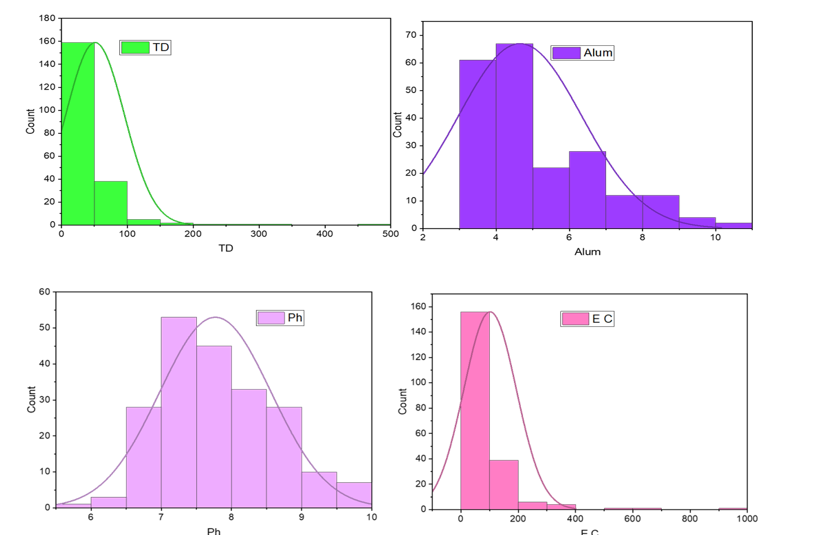
Optimizing alum dosage remains a major operational challenge in surface-water treatment because coagulant demand is governed by nonlinear physicochemical interactions, episodic source-water disturbances, and non-Gaussian variability. This study developed a reliability-validated and explainable machine-learning framework for predicting alum dosage using operational data from the Tamburawa Water Treatment Plant, Kano, Nigeria. The framework integrated distributional analysis, dependency assessment, stationarity diagnostics, principal component analysis (PCA), ensemble modelling, and SHAP interpretation. Strong distributional irregularity was observed, with Ca, TDS, and EC exhibiting pronounced skewness and kurtosis. Turbidity showed the strongest association with alum dosage (r = 0.7919), followed by total hardness (r = 0.5427), while stationarity tests confirmed turbidity as a temporally reliable predictor (ADF p = 0.0051; PP p < 0.001). PCA revealed a compact physicochemical structure, with the first three components explaining 66.6% of total variance. RF-GA achieved the best testing performance (R = 0.7912, R² = 0.6202, MAE = 0.1007, RMSE = 0.1414, NSE = 0.6202), although improvement over RF and RF-PSO was marginal. SHAP confirmed turbidity as the dominant predictor, followed by hardness and pH. In All, the framework supports interpretable, turbidity-prioritized, and more sustainable alum dosing in surface-water treatment.
Downloads
Published
Issue
Section
Categories
License
Copyright (c) 2026 Ismail Aminu Mahmoud, Musa G. Abdullahi, Lurwan Garba

This work is licensed under a Creative Commons Attribution 4.0 International License.


