
Sustainable Room-Temperature Hydrogen Sensing Based on Pristine Biomass-Derived Prosopis Africana Carbon Nanoparticles
DOI:
https://doi.org/10.33003/fjs-2026-1008-5067Keywords:
Hydrogen gas, gas sensor, Nanoparticles, prosopis africanaAbstract
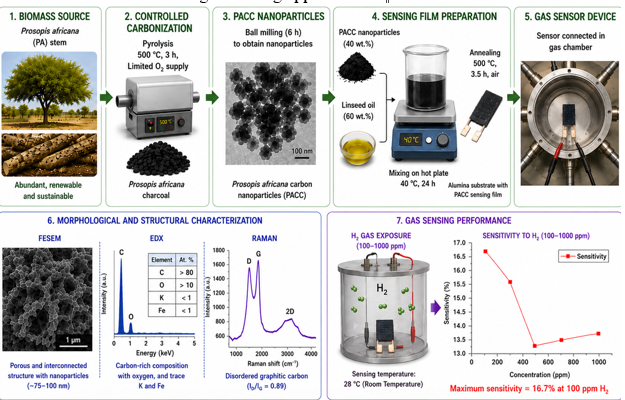
Biomass derived materials have recently attracted significant attention as sustainable and cost-effective candidates for gas sensing applications. In this study, nanoparticles derived from Prosopis africana charcoal (PACC) were developed and investigated for hydrogen (H2) gas detection at room-temperature. The charcoal was produced from Prosopis africana stem via controlled pyrolysis at 500 °C for 3 h under limited oxygen conditions. The PACC sensing film was fabricated by blending the nanoparticles with linseed oil as an organic binder in a 40:60 wt:% ratio, followed by annealing at 500 °C for 3.5 h. The morphological and structural properties of the sensing film were characterized using field emission scanning electron microscopy (FESEM), and energy-dispersive X-ray spectroscopy (EDX). Gas sensing performance was evaluated toward hydrogen concentrations ranging from 100 to 1000 ppm at room temperature. The sensor exhibited measurable response across the tested concentration range, demonstrating the potential of PACC nanoparticles as an effective sensing material. To the best of our knowledge, this study represents the first report on room temperature hydrogen sensing using Prosopis africana charcoal nanoparticles, highlighting their promise as a low-cost and sustainable alternative for gas sensing applications.
References
Al-Diabat, A. M., Algadri, N. A., Ahmed, N. M., Abuelsamen, A., & Bidier, S. A. (2021). A high-sensitivity hydrogen gas sensor based on carbon nanotubes fabricated on SiO2 substrate. Nanocomposites, 7(1), 172–183. https://doi.org/10.1080/20550324.2021.1977063
Babani, S., Hamidon, M. N., Ismail, A., Jaafar, H., Bakar, A. A., & Lawal, I. (2023). Impact of Micrometer and Nanometer-Sized Particles on the Electrical Properties of Prosopis Africana Biochar Thick Films. 2023, 97–100.
Babani, S., Hamidon, M. N., Ismail, A., Jaafar, H., Hassan, I. H., Shafiee, F. N., Yunusa, Z., Lamido, J., Bakar, A. A., Lawal, I., & Shitu, I. G. (2024). Development and characterization of screen-printed Prosopis Africana Char thick film for electronic applications. Journal of the Australian Ceramic Society, 60(2), 643–652. https://doi.org/10.1007/s41779-024-00999-8
Cancelliere, R., Cianciaruso, M., Carbone, K., & Micheli, L. (2022). Biochar: A Sustainable Alternative in the Development of Electrochemical Printed Platforms. Chemosensors, 10(8). https://doi.org/10.3390/chemosensors10080344
Chauhan, P. S., & Bhattacharya, S. (2019). Hydrogen gas sensing methods, materials, and approach to achieve parts per billion level detection: A review. International Journal of Hydrogen Energy, 44(47), 26076–26099. https://doi.org/10.1016/j.ijhydene.2019.08.052
Dhall, S., & Mehta, B. R. (2020a). Room temperature hydrogen gas sensor using candle carbon soot. International Journal of Hydrogen Energy, 45(29), 14997–15002. https://doi.org/10.1016/j.ijhydene.2020.03.142
Dhall, S., & Mehta, B. R. (2020b). Room temperature hydrogen gas sensor using candle carbon soot. International Journal of Hydrogen Energy, 45(29), 14997–15002. https://doi.org/10.1016/j.ijhydene.2020.03.142
Fathy, N. A., Basta, A. H., & Lotfy, V. F. (2020). Novel trends for synthesis of carbon nanostructures from agricultural wastes. In Carbon Nanomaterials for Agri-food and Environmental Applications. Elsevier Inc. https://doi.org/10.1016/B978-0-12-819786-8.00004-9
Hamidon, M. N., Malysia, U. P., Yunusa, Z., Al, H., Al, B., Batin, H. Al, Arabia, S., Magaji, N., Abubakar, A., Malysia, U. P., Shafiee, F. N., Malysia, U. P., Babani, S., & Malysia, U. P. (2023). Morphology and Electrical Properties of Pristine and Composite rice husk ash Nano / Micro particles thick films for Gas Sensing Applications. 4–7.
Hwan, B., Lo, C. F., Nicolosi, J., Chang, C. Y., Chen, V., Strupinski, W., Pearton, S. J., & Ren, F. (2011). Sensors and Actuators B : Chemical Hydrogen detection using platinum coated graphene grown on SiC. 157, 500–503. https://doi.org/10.1016/j.snb.2011.05.007
Ilnicka, A., & Lukaszewicz, J. P. (2020). Graphene-based hydrogen gas sensors: A review. Processes, 8(5). https://doi.org/10.3390/PR8050633
Jafri, N., Wong, W. Y., Doshi, V., Yoon, L. W., & Cheah, K. H. (2018). A review on production and characterization of biochars for application in direct carbon fuel cells. Process Safety and Environmental Protection, 118, 152–166. https://doi.org/10.1016/j.psep.2018.06.036
Jagdale, P., Ziegler, D., Rovere, M., Tulliani, J. M., & Tagliaferro, A. (2019). Waste coffee ground biochar: A material for humidity sensors. Sensors (Switzerland), 19(4), 1–16. https://doi.org/10.3390/s19040801
Jha, R. K., & Bhat, N. (2022). Effect of Ethyl Cellulose on Ammonia Sensing Abilities of Gas Sensors Fabricated Using MoS2Functional Ink for Printed Electronics Application. IEEE Sensors Letters, 6(8), 6–9. https://doi.org/10.1109/LSENS.2022.3176756
Kim, D., Pikhitsa, P. V, Yang, H., & Choi, M. (2011). Room temperature CO and H 2 sensing with carbon nanoparticles. 485501. https://doi.org/10.1088/0957-4484/22/48/485501
Koo, W. T., Cho, H. J., Kim, D. H., Kim, Y. H., Shin, H., Penner, R. M., & Kim, I. D. (2020). Chemiresistive hydrogen sensors: Fundamentals, recent advances, and challenges. ACS Nano, 14(11), 14284–14322. https://doi.org/10.1021/acsnano.0c05307
Lepak-Kuc, S., Kiciński, M., Michalski, P. P., Pavlov, K., Giorcelli, M., Bartoli, M., & Jakubowska, M. (2021). Innovative biochar-based composite fibres from recycled material. Materials, 14(18), 1–11. https://doi.org/10.3390/ma14185304
Li, Z., Yao, Z. J., Haidry, A. A., Plecenik, T., Xie, L. J., Sun, L. C., & Fatima, Q. (2018). Resistive-type hydrogen gas sensor based on TiO2: A review. International Journal of Hydrogen Energy, 43(45), 21114–21132. https://doi.org/10.1016/j.ijhydene.2018.09.051
Llobet, E. (2013). Gas sensors using carbon nanomaterials: A review. Sensors and Actuators, B: Chemical, 179, 32–45. https://doi.org/10.1016/j.snb.2012.11.014
Luo, K. H., Yan, M., Hung, Y. H., Kuang, J. Y., Chang, H. C., Lai, Y. J., & Yeh, J. M. (2023). Polyaniline Composites Containing Eco-Friendly Biomass Carbon from Agricultural-Waste Coconut Husk for Enhancing Gas Sensor Performance in Hydrogen Sulfide Detection. Polymers, 15(23). https://doi.org/10.3390/polym15234554
Manuscript, A. (2015). Nanoscale. https://doi.org/10.1039/b000000x
Menon, S. K., Kumar, A., & Mondal, S. (2025). Advancements in hydrogen gas leakage detection sensor technologies and safety measures (Vol. 9, Issue 1).
Mohd Chachuli, S. A., Hamidon, M. N., Mamat, M. S., Ertugrul, M., & Abdullah, N. H. (2018). A Hydrogen Gas Sensor Based on TiO₂ Nanoparticles on Alumina Substrate. Sensors (Basel, Switzerland), 18(8), 1–13. https://doi.org/10.3390/s18082483
Rath, P. C., Patra, J., Huang, H. T., Bresser, D., Wu, T. Y., & Chang, J. K. (2019). Carbonaceous Anodes Derived from Sugarcane Bagasse for Sodium-Ion Batteries. ChemSusChem, 12(10), 2302–2309. https://doi.org/10.1002/cssc.201900319
Ronzon, T., Gurria, P., Carus, M., Cingiz, K., El-Meligi, A., Hark, N., Iost, S., M’barek, R., Philippidis, G., van Leeuwen, M., Wesseler, J., Medina-Lozano, I., Grimplet, J., Díaz, A., Tejedor-Calvo, E., Marco, P., Fischer, M., Creydt, M., Sánchez-Hernández, E., … Miras Ávalos, J. M. (2025). No 主観的健康感を中心とした在宅高齢者における 健康関連指標に関する共分散構造分析Title. Sustainability (Switzerland), 11(1), 1–14. https://pubmed.ncbi.nlm.nih.gov/28459981/%0Ahttps://doi.org/10.1016/j.resenv.2025.100208%0Ahttp://scioteca.caf.com/bitstream/handle/123456789/1091/RED2017-Eng-8ene.pdf?sequence=12&isAllowed=y%0Ahttp://dx.doi.org/10.1016/j.regsciurbeco.2008.06.005%0Ahttps:
Sankar, V., Balasubramaniam, K., & Sundara, R. (2023). Prosopis juliflora: invasive alien plant species derived biomass carbon and its application in hazardous NO2 gas sensing. Journal of Materials Science: Materials in Electronics, 34(9), 802. https://doi.org/10.1007/s10854-023-10183-6
Shafiee, F. N. (2020). Effect of nanometric and micronic particles size on physical and electrical properties of graphite thick film Mohd Nizar Hamidon * Mohd Haniff Wahid Abdul Halim Shaari Mehmet Ertugrul Nor Hapishah Abdullah and Mohd Asnawi Mohd Kusaimi Muhammad Syazwan Mus. 17, 825–839.
Shahi, N., Min, B., Sapkota, B., & Rangari, V. K. (2020). Eco-Friendly Cellulose Nanofiber Extraction from Sugarcane Bagasse and Film Fabrication. 1–15.
Shiraz, H. G. (2017). Efficient room temperature hydrogen gas sensing based on graphene oxide and decorated porous silicon. International Journal of Hydrogen Energy, 42(24), 15966–15972. https://doi.org/10.1016/j.ijhydene.2017.05.045
Tong, X., Shen, W., Chen, X., & Corriou, J. P. (2017). A fast response and recovery H2S gas sensor based on free-standing TiO2 nanotube array films prepared by one-step anodization method. Ceramics International, 43(16), 14200–14209. https://doi.org/10.1016/j.ceramint.2017.07.165
Wang, B., Sun, L., Schneider-Ramelow, M., Lang, K. D., & Ngo, H. D. (2021). Recent Advances and Challenges of Nanomaterials-Based Hydrogen Sensors. In Micromachines (Vol. 12, Issue 11). https://doi.org/10.3390/MI12111429
Wang, P., Xu, S., Shi, X., Zhu, J., Xiong, H., & Wen, H. (2025). Recent Advances in Resistive Gas Sensors : Fundamentals , Material and Device Design , and Intelligent Applications. 1–29.
Wang, Q., Liu, S., Chen, W., Liu, Z., Li, X., Yang, Y., Meng, Z., Wang, H., Liu, F., & Gao, Y. (2026). Interference-Resilient Hydrogen Sensing for Sustainable Hydrogen Energy Systems : A Review of Material- , Algorithm- , and System-Level Strategies. 1–26.
Wong, C. D. S., Yeoh, J. X., Wu, T., Manickam, S., & Pang, C. H. (2022). Biomass to nanoparticles: Recent advances in the process and processing towards sustainability. Chemical Engineering and Processing - Process Intensification, 175(January), 108908. https://doi.org/10.1016/j.cep.2022.108908
Wu, J. X., Chu, C. P., & Liao, Y. C. (2023). Solderable conductive paste for electronic textiles. Journal of the Taiwan Institute of Chemical Engineers, 142. https://doi.org/10.1016/j.jtice.2022.104616
Yasir, M., Zaccagnini, P., Palmara, G., Frascella, F., Paccotti, N., & Savi, P. (2021). Graphene and Biochar Thick Films.
Ziegler, D., Palmero, P., Giorcelli, M., Tagliaferro, A., & Tulliani, J. M. (2017). Biochars as innovative humidity sensing materials. Chemosensors, 5(4), 1–16. https://doi.org/10.3390/chemosensors5040035
Downloads
Published
Issue
Section
Categories
License
Copyright (c) 2026 Lurwan Garba, Jamila Lamido Sumaila, Yusuf Olanrewaju Kayode, Sulaiman Babani, Zainab Yunusa

This work is licensed under a Creative Commons Attribution 4.0 International License.


