
Geographic Variation in Plasmodium Infection Intensity and Species Distribution among Children under Five: Evidence from Four Slums of Gombe State, Nigeria
DOI:
https://doi.org/10.33003/fjs-2026-1014-5829Keywords:
Geographic Variation, Malaria, Plasmodium Falciparum, Plasmodium Malariae, Community Epidemiology, Parasite Density, Children Under Five, Sub-Saharan AfricaAbstract
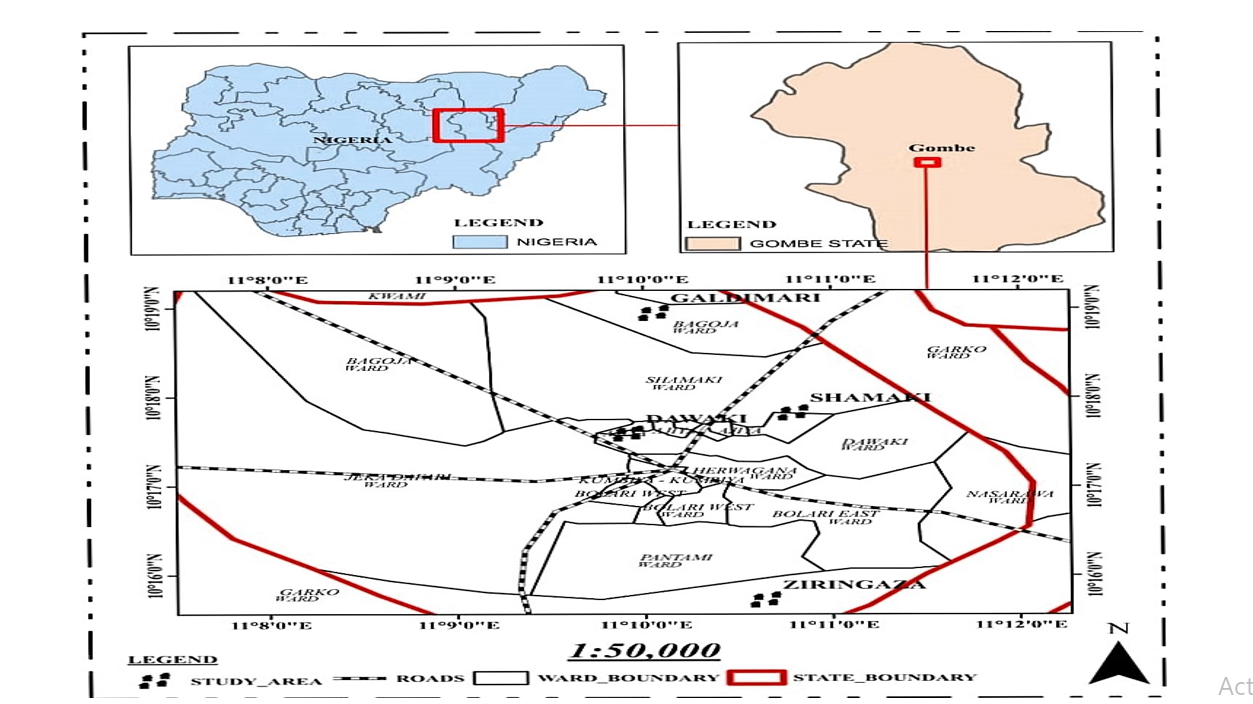
Background: Malaria transmission is geographically heterogeneous, even within small areas sharing similar climatic conditions. Understanding how infection intensity and Plasmodium species composition vary across communities is essential for rational targeting of malaria control resources. Objective: This study examined whether significant differences in malaria parasite seen (MPS) and Plasmodium species distribution exist across four communities among children under five years of age, between November 2024 to February 2026. Methods: A cross-sectional study enrolled 1,162 children under five from Dawaki (n = 272), Tabra Galdimari (n = 296), TudunHatsi (n = 294), and ZirinGaza (n = 300). Blood smear microscopy assessed parasite density (MPS) and identified Plasmodium species. Pearson chi-square tests and Cramer's V evaluated the association between study location and each infection outcome. Results: Highly significant associations were found between location and MPS (χ²(9) = 344.76, p < .001, V = .314) and location and Plasmodium species (χ²(6) = 384.83, p < .001, V = .407). Tudun Hatsi exhibited the highest moderate parasitaemia burden (92.9%) with no high-density infections, while Tabra Galdimari had the highest negativity rate (44.3%) and greatest proportion of high-density infections (6.4%). P. malariae was detected exclusively in Dawaki (25.0% of that site's sample)and absent from all other communities. Conclusion: Substantial and statistically meaningful geographic variation in malaria infection intensity and species composition exists across adjacent communities. These findings support site-specific malaria surveillance and targeted intervention strategies rather than uniform regional approaches.
References
Awosolu. O.B., Yahaya, Z.S., and Farah Hazigah, M.N.(2021).Prevalence, Parasite Density and Determinants of falciparum Malaria Among Febrile Children in some Peri Urban Communities in Southwestern Nigeria: A cross-Sectional Study. Infection and Drug Resistance, 14, 3219-3232. Doi: https:/doi.org/10.2147/IDR.S312519
Barsoum, R. S. (2000). Malarial nephropathies. Nephrology Dialysis Transplantation, 13(6), 1588–1597. https://doi.org/10.1093/ndt/13.6.1588
Bousema, T., Griffin, J. T., Sauerwein, R. W., Smith, D. L., Churcher, T. S., Takken, W. and Drakeley, C. (2012). Hitting hotspots: Spatial targeting of malaria for control and elimination. PLoS Medicine, 9(1), e1001165. https://doi.org/10.1371/journal.pmed.1001165
Cheesebrough,M.(2006). District laboratory Practices in Tropical Countries, part 1, 2nd Edition Cambridge University Press.56-60s
Cohen, J. (1988). Statistical power analysis for the behavioral sciences(2nd ed., pp.14-15). Lawrence Erlbaum Associates .
Crawley, J. (2004). Reducing the burden of anemia in infants and young children in malaria-endemic countries of Africa. American Journal of Tropical Medicine and Hygiene, 71(Suppl 2), 25–34. https://doi.org/10.4269/ajtmh.2004.71.25
Daniel, W. W., Cross, C.L. (2013). Biostatistics: A foundation for Analysis in Health Science, 10th Edition, New York: John Wiley and sons.
Gaudart, J., Poudiougou, B., Dicko, A., Ranque, S., Toure, O., Sagara, I.and Doumbo, O. K. (2006). Space-time clustering of childhood malaria at the household level: A dynamic cohort in a Mali village. BMC Public Health, 6, 286. https://doi.org/10.1186/1471-2458-6-286
Langhorne, J., Ndungu, F. M., Sponaas, A. M., & Marsh, K. (2008). Immunity to malaria: More questions than answers. Nature Immunology, 9(7), 725–732. https://doi.org/10.1038/ni.f.205
Milner, D. A. (2018). Malaria pathogenesis. Cold Spring Harbor Perspectives in Medicine, 8(1), a025569. https://doi.org/10.1101/cshperspect.a025569
Mueller, I., Zimmerman, P. A., & Reeder, J. C. (2009). Plasmodium malariae and Plasmodium ovalethe 'bashful' malaria parasites. Trends in Parasitology, 23(6), 278–283. https://doi.org/10.1016/j.pt.2007.04.009
Nwaneli, E.L., Eguonu, I., Ebenebe, J.C., Osuorah, C.D.I., Ofiaeli, O.C., Nri-Ezedi, C.A.(2020). Malaria Prevalence and its Sociodemographic determinants in Febrile Children, a Hospital –based Study in a Developing community in South-East Nigeria. J. Prev. Med. Hyg 2020 July 4; 61(2):E 173-e180. Doi:10.15167/2421-4248/jpmh2020.61.2.1350.
Oyibo,W., Latham,V.,Oladipo, O.(2023). Malaria Parasite Density and Detailed Qualitative Microscopy Enhances Large Scale Profiling of Infection Endemicity in Nigeria. Sci Rep13, 1599. Doi:https://doi.org/10.1038/s41598-023-27535-1.
Rogerson,S.J., Harid, I., Duffy, P., Leke, R. andTaylor, D.(2007). Malaria in Pregnancy Pathogenesis and Immunity Lancet Infectious Diseases 7(2) 105-117.
Stresman, G. H. (2010). Beyond temperature and precipitation: Ecological risk factors that modify malaria transmission. Acta Tropica, 116(3), 167–172. https://doi.org/10.1016/j.actatropica.2010.08.005
Tusting, L. S., Gething, P. W., Gibson, H. S., Greenwood, B., Knudsen, J., Lindsay, S. W., & Bhatt, S. (2016). Housing improvements and malaria risk in sub-Saharan Africa: A multi-country analysis of survey data. PLoS Medicine, 13(5), e1002012. https://doi.org/10.1371/journal.pmed.1002012
World Health Organization.(2023).World malaria report 2023. WHO. https://www.who.int/teams/global-malaria-programme/reports/world-malaria-report-2023
Downloads
Published
Issue
Section
Categories
License
Copyright (c) 2026 Godnear Ogadimma Ibeh, Godly Chessed, Muhammad Abdul Qadeer, Oluwasanumi Adedimeji Adepoju, Abba Ezra

This work is licensed under a Creative Commons Attribution 4.0 International License.


