
Performance of Concrete Incorporating Naka Lateritic Rock Fines as Partial Replacement of River Sand
DOI:
https://doi.org/10.33003/fjs-2026-1018-5791Keywords:
Naka Lateritic Rock Fines, Fine Aggregate, Concrete, River SandAbstract
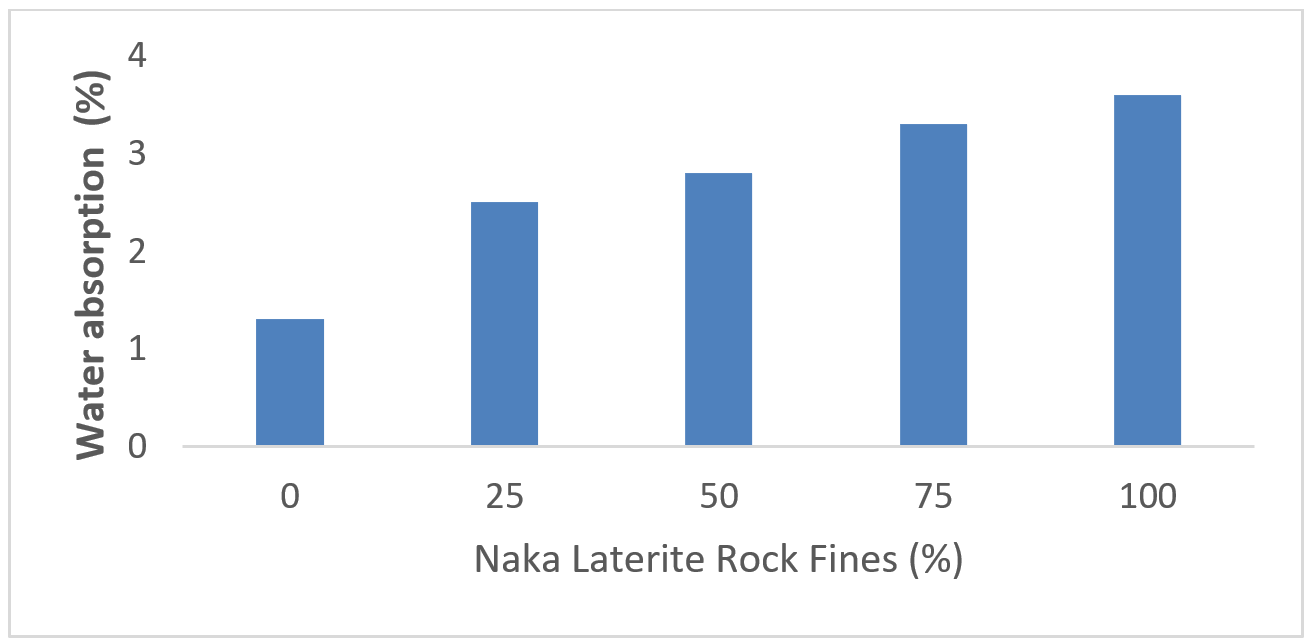
The search for sustainable and locally available materials for concrete production has increased interest in lateritic materials as alternatives to conventional aggregates. This study investigated the performance of concrete incorporating Naka Lateritic Rock Fine (NLRF) as a partial replacement for river sand. Concrete was produced using a mix ratio of 1:2:4 with a water-cement ratio of 0.58. River sand was replaced with NLRF at 0%, 25%, 50%, 75% and 100% by weight. A total of 45 concrete cubes and 45 cylinders were produced and cured for 7, 14 and 28 days. The aggregates were assessed for particle-size distribution and specific gravity, while the concrete was tested for workability, water absorption, density, compressive strength and splitting tensile strength. NLRF recorded a coefficient of uniformity of 3.40, coefficient of curvature of 1.20 and fineness modulus of 3.10, compared with 2.82 for river sand. Materials passing the 75 µm sieve were 3% for NLRF and 2% for river sand. Slump values ranged from 55–90 mm and generally decreased with increasing NLRF content. Specific gravity values were 2.53, 2.37 and 2.62 for river sand, NLRF and granite, respectively. Water absorption increased from 1.3% to 3.6%. Compressive and splitting tensile strengths ranged from 11.83–26.03 N/mm² and 1.92–2.63 N/mm², respectively. The 25% NLRF replacement produced the highest compressive strength of 26.03 N/mm² at 28 days and was identified as the optimum level. Therefore, the study recommends that 25% NLRF is suitable as a partial replacement for river sand in concrete production.
References
Adepegba, D., Balogun, A., & Ogunbode, E. (2016). Alternative fine aggregates for sustainable concrete production. International Journal of Civil Engineering and Technology, 7(4), 102–110.
Adetayo, O. A., Amu, O. O., & Ilori, A. O. (2019). Cement stabilized structural foundation lateritic soil with bone ash powder as additive. Arid Zone Journal of Engineering, Technology and Environment, 15(2), 479–487.
Adeyemi, T. A., & Olowu, O. A. (2017). Evaluation of sandy soil as partial replacement for fine aggregate in concrete production. International Journal of Engineering Research and Technology, 6(8), 412–418.
Afolabi, O. A., & Ajibade, O. E. (2026). Compressive strength and workability of concrete incorporating laterite as partial replacement of fine aggregate. International Journal of Research and Innovation in Applied Science, 11(3), 1306–[page range not provided]. https://doi.org/10.51584/IJRIAS.2026.11030100
Afolabi, O. A., & Edidi, S. I. A. (2025). Effect of partial replacement of cement with rice husk ash on concrete performance characteristics. Journal of Civil Engineering (NAUJCVE), 4(2), 15–23.
Ajagbe, W. O., Afolayan, J. O., & Oyekan, G. L. (2018). Structural behaviour of laterized concrete in structural applications. Nigerian Journal of Technology, 37(2), 376–383.
Akinwumi, A. M., Adewumi, J. R., & Obiora-Okeke, O. A. (2021). Impact of climate change on the stream-flow of Ala River, Akure, Nigeria. Sustainable Water Resources Management, 7, Article 9. https://doi.org/10.1016/j.heliyon.2021.e07941
Aliyu, I., Sulaiman, T. A., Mohammed, A., & Kaura, J. M. (2020). Effect of sulphuric acid on the compressive strength of concrete with quarry dust as partial replacement of fine aggregate. FUDMA Journal of Sciences, 4(1), 553–559.
Ambrose, E. E., Ekpo, D. U., Umoren, I. M., & Ekwere, U. S. (2018). Compressive strength and workability of laterized quarry sand concrete. Nigerian Journal of Technology, 37(3), 605–612. https://doi.org/10.4314/njt.v37i3.3
Anum, I., Williams, F. N., Adole, A. M., & Haruna, A. C. (2014). Properties of different grades of concrete using mix design method. International Journal of Geology, Agriculture and Environmental Sciences, 2(6), 6–10.
Ararsa, W., Quezon, E. T., & Aboneh, A. (2018). Suitability of Ambo sandstone fine aggregate as an alternative river sand replacement in normal concrete production. American Journal of Civil Engineering and Architecture, 6(4), 140–146. https://doi.org/10.12691/ajcea-6-4-2
Belay, M. D. (2021). Evaluation of the effects of coarse aggregate size on concrete properties. Journal of Construction Research.
British Standards Institution. (1983). BS 1881-111:1983: Testing concrete—Method for normal curing of test specimens. British Standards Institution.
British Standards Institution. (1990). BS 812-103:1990: Testing aggregates—Methods for determination of particle size distribution. British Standards Institution.
British Standards Institution. (1997). BS EN 933-1:1997: Tests for geometrical properties of aggregates—Determination of particle size distribution—Sieving method. British Standards Institution.
British Standards Institution. (2000). BS EN 197-1:2000: Cement — Part 1: Composition, specifications and conformity criteria for common cements. BSI.
British Standards Institution. (2019). BS EN 12350-2:2019: Testing fresh concrete—Part 2: Slump test. British Standards Institution.
British Standards Institution. (2019). BS EN 12350-6:2019: Testing fresh concrete—Part 6: Density. British Standards Institution.
British Standards Institution. (2019). BS EN 12390-3:2019: Testing hardened concrete—Part 3: Compressive strength of test specimens. British Standards Institution.
British Standards Institution. (2022). BS EN 1097-6:2022: Tests for mechanical and physical properties of aggregates—Part 6: Determination of particle density and water absorption. British Standards Institution.
British Standards Institution. (2023). BS EN 12390-6:2023: Testing hardened concrete—Part 6: Tensile splitting strength of test specimens. British Standards Institution.
BS EN 12620. (2013). Aggregates for concrete. British Standards Institution.
Christopher, A. F., Blessing, A. A., & Babatunde, I. F. (2020). Splitting tensile strength and compressive strength ratios and relations for concrete made with different grades of Nigerian Portland limestone cement (PLC). FUW Trends in Science & Technology Journal, 5(3), 802–808.
Dessalegn, M. (2021). Evaluation the effects of coarse aggregates size on concrete properties. Journal of Construction Research, 3, 49. https://doi.org/10.30564/jcr.v3i2.4049
Falade, F., Ikponmwosa, E., & Arogundade, A. (2011). Investigation of some structural properties of foamed aerated concrete. Journal of Engineering Research, 16, 67–80.
Federal Highway Administration (FHWA). (2006). Soils and foundations reference manual. U.S. Department of Transportation.
Gambhir, M. L. (2013). Concrete technology: Theory and practice (5th ed.). McGraw Hill Education.
Garba, I., Kaura, J. M., Sulaiman, T. A., Aliyu, I., & Abdullahi, M. (2024). Effects of laterite on strength and durability of reinforced concrete as partial replacement of fine aggregate. FUDMA Journal of Sciences, 8(1), 201–207. https://doi.org/10.33003/fjs-2024-0801-2210
Isah, G., Sulaiman, T. A., Kaura, J. M., & Abdullahi, M. (2024). Optimization and predictive models on strengths and durability of reinforced laterized concrete. Covenant Journal of Engineering Technology, 8(1). https://journals.covenantuniversity.edu.ng/index.php/cjet/article/view/4002
Kachalla, A. M., Waziri, B. S., Mohammad, A. S., & Ibrahim, Y. (2026). Suitability of locally sourced soils as fine aggregates in concrete production: A review. Arid Zone Journal of Engineering, Technology and Environment, 22(2), 526–535.
Kwaghsaa, K. S. (2025). Assessment of ground water quality in Naka Town, Gwer-West Local Government Area of Benue State, Nigeria. International Journal of Research Publication and Reviews, 6(3), 7261–7264. https://doi.org/10.55248/gengpi.6.0325.12128
Mehta, P. K., & Monteiro, P. J. M. (2017). Concrete: Microstructure, properties, and materials (4th ed.). McGraw Hill Education.
Nadir, Y., & Sujatha, A. (2018). Durability properties of coconut shell aggregate concrete. KSCE Journal of Civil Engineering, 22, 1920–1926. https://doi.org/10.1007/s12205-017-0063-6
Neville, A. M. (1997). Properties of concrete (4th ed.). Longman.
Neville, A. M. (2006). Properties of concrete. Pearson Education.
Neville, A. M. (2011). Properties of concrete (5th ed.). Pearson Education.
Neville, A. M. (2012). Properties of concrete (5th ed.). Pearson.
Neville, A. M. (2015). Properties of concrete (5th ed.). Pearson Education.
Neville, A. M., & Brooks, J. J. (1997). Concrete technology (2nd ed.). Longman.
Neville, A. M., & Brooks, J. J. (2010). Concrete technology. Prentice Hall.
Nigeria Geographic Names Database. (2017). Gwer West, Gwer West, Benue State. http://nga.geonamebase.com/node/49150
Nwankwo, C. N., & Okafor, F. O. (2021). Performance evaluation of lateritic soil as partial replacement of fine aggregate in concrete production. Nigerian Journal of Technology, 40(3), 456–464. https://doi.org/10.4314/njt.v40i3.8
Nwogu, C. P. (2022). Effect of coarse aggregate grading on properties of concrete [Unpublished bachelor's project, Nnamdi Azikiwe University].
Obam, S. O., Ijoh, H. U., & Adeke, T. P. (2025). Effect of heat on some properties of normal and pozzolanic concrete. Engineering Research Journal, 4(10), 44–58. https://doi.org/10.5281/zenodo.14628016
Obam, S. O., Jagba, A. S., & Adeke, P. T. (2024). Regression models for prediction of compressive and tensile concrete strength. CEDTECH International Journal of Engineering & Applied Science, 5(2).
Ogunbode, E. B., Makun, C. S., Ango, J. A., Hassan, I. O., Lawal, A. T., & Ibrahim, S. M. (2021). Chloride ingress resistance of rice husk ash-based green concrete composites containing steel fibres. Environmental Technology and Science Journal, 12(1), 71–80.
Ogunleye, E. (2023). Innovations and applications of laterized concrete in sustainable construction. Global Journal of Engineering and Technology Advances, 16(3), 107–120.
Oladimeji, O. T., Ogunbode, E. B., & Adesanya, D. A. (2022). Performance of sandy soil in concrete mixes as alternative fine aggregate. Journal of Building Engineering, 44, 103330.
Olanitori, L. M., & Olotuah, A. O. (2006). Strength characteristics of laterized concrete. Construction and Building Materials, 20(10), 1057–1062. https://doi.org/10.1016/j.conbuildmat.2005.02.027
Olutoge, F. A., Adeniran, K. M., & Oyegbile, O. B. (2013). The ultimate strength behaviour of laterised concrete beam. Science Research, 1(3), 52–58. https://doi.org/10.11648/j.sr.20130103.14
Omoregie, A., & Alutu, O. E. (2016). The influence of fine aggregate combinations on particle size distribution, grading parameters, and compressive strength of sandcrete blocks. International Journal of Engineering Research and Applications.
Ozioko, H. O., Eze, E. E., & Ekunie, A. C. (2025). Suitability assessment of laterite soil as alternative to sharp sand in cement block production: Performance evaluation and predictive analysis. Nigerian Journal of Technology, 44(4), 518–532. https://doi.org/10.4314/njt.v44i4.1
Saberi, S. S., Mohamed, A., & Eltwati, A. S. (2021, August). Mechanical and physical properties of recycled concrete aggregates for road base materials. In Journal of Physics: Conference Series (Vol. 1973, No. 1, p. 012236). IOP Publishing.
Shetty, M. S. (2019). Concrete technology: Theory and practice (8th ed.). S. Chand Publishing.
Surahyo, A., Surahyo, L., & Luby. (2019). Concrete construction Springer International Publishing (pp. 239-255)
Ukpata, J. O., Ewa, D. E., Success, N. G., Alaneme, G. U., Out, N. O., & Olaiya, B. C. (2024). Effects of aggregate sizes on the performance of laterized concrete. Scientific Reports, 14, 448.
Zaheer, M., Jaseer, M. Z., Sheikh, S. N., & Charan, K. S. (2022). Investigation on the utilization of laterite as replacement of fine aggregate to develop ecofriendly concrete. International Research Journal of Engineering and Technology, 9(5), 963.
Zerdi, T. A., Hussain, S. S., Ali, S. Z., & Ansari, Q. (2016). Suitability of using laterite as partial replacement of fine aggregate in concrete. International Journal of Engineering and Technology, 6(5).
Downloads
Published
Issue
Section
Categories
License
Copyright (c) 2026 Aondona Shadrak Jagba, Zava Aper, Ujam Jeremiah Chaver

This work is licensed under a Creative Commons Attribution 4.0 International License.


