
Physiochemical and Mechanical Performance of Portland Cement Grades Marketed in Nigeria
DOI:
https://doi.org/10.33003/fjs-2026-1020-5762Keywords:
Hydration, Setting time, Durability, Lime stone, Kiln, Cement, Blain finest, Mechanical propertiesAbstract
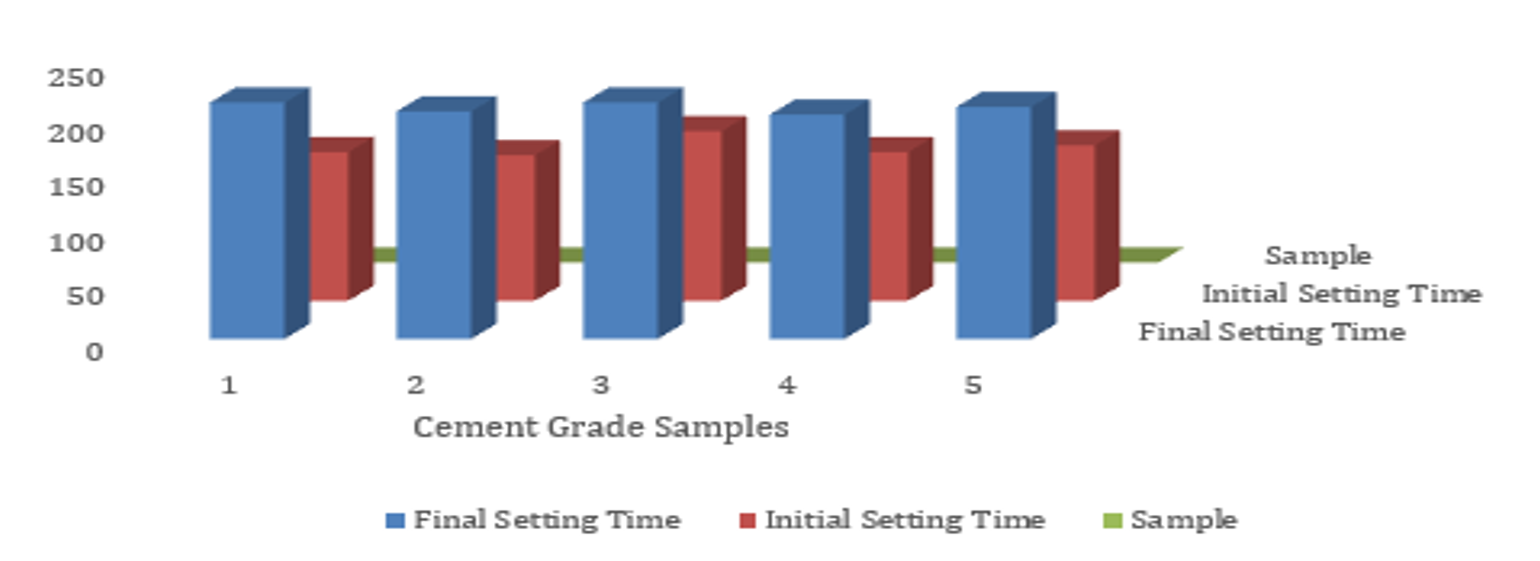
This study presents a comparative assessment and analysis of the hydration properties of Portland cement grades 32.5 and 42.5 marketed in Calabar, Cross River State, Nigeria. The research was motivated by concerns over inconsistent cement quality and its impact on structural performance. Five (5) cement samples (A, B, C, D and E) were analyzed for chemical composition (XRF), physical properties (Blaine fineness, residue, consistency, expansion, and setting times), and mechanical properties (compressive and flexural strength at 2, 7, and 28 days). Results from Blaine values ranged from 3940 to 4480 cm²/g, showed sample D (32.5R) exhibiting the highest fineness. Setting times (initial: 133 to 155 min; final: 205 to 216 min) and expansion values (0.5 to 1.0 mm) were within permissible limits. Strength development increased with curing age, with 42.5R achieving the highest 28-day flexural strength (5.8 MPa), outperforming 32.5R (4.7 to 5.0 MPa).The findings confirm that while both cement grades meet national and international standards, 42.5 grade cements offer superior hydration performance and strength, making them more suitable for high-strength structural applications, whereas 32.5grade cements are better suited for light construction and finishing works. The research result showed analyses that falls within the acceptable range of the National and International Standards, and the coefficient of variation indicate the robustness and reliability of the result. And objectives of the assessment were fully achieved, with empirical data guide in cement selection, improving production quality, and support regulatory enforcement in Nigeria’s construction industry.
References
Abdullahi M. E., Samuel S. S., Enumah A., & Yakubu S. (2023). A Review of the Operational Challenges in the Cement Industry in Nigeria. Journal of Environmental Planning and Sustainable, 8(2), 32–52.
Adeleke, B. O., Olutoge, F. A., & Amusan, L. M. (2023). Evaluation of the quality of selected Portland cement brands in Nigeria. Journal of Building Pathology and Rehabilitation, 8(1), 12-24.
Adeniran, A. A., Olutoge, F. A., & Aderonmu, P. A. (2021). Comparative analysis of the strength characteristics of Nigerian Portland cement brands. Construction and Building Materials, 287, 123045.
Adesina, A., & Awoyera, P. (2022). Durability performance of concrete made with different grades of Nigerian Portland cement. Case Studies in Construction Materials, 16, e00921.
Alabadan, B. A., Olutoge, F. A., & Fapohunda, C. A. (2020). Hydration and strength characteristics of Portland cement in tropical climatic conditions. Nigerian Journal of Technology, 39(2), 345-354.
Aniweteli, J. N. (2023). Effects of Selected Brands of Portland Cement on Compressive Strength of Concrete. NAU Department of Civil Engineering Final Year Project & Postgraduate Portal, 2(1).
Barbhuiya, S., Nepal, J., & Das, B. B. (2023). Properties, compatibility, environmental benefits and future directions of limestone calcined clay cement (LC3) concrete. A review Journal of Building Engineering, 79, Article 107794, https://doi.org/10.1016/j.jobe.2023.107794
Briki, Y., Zajac, M., Ben Haha, M., & Scrivener, K. (2021). Impact of limestone fineness on cement hydration at early age. Cem. Concr. Res., 147, Article 106515, https://doi.org/10.1016/J.CEMCONRES.2021.106515
Dangote Industries. (2023). Nigeria Cement Market Report.
Ettu, L. O., Ajoku, C. A., & Nwachukwu, K. C. (2019). Quality assessment of some commercially available Portland cement brands in Nigeria. Journal of Civil Engineering and Construction Technology, 10(3), 45-53.
Gartner, E. (2020). Eco-efficient cements: Potential economically viable solutions for a low-CO₂ cement-based materials industry. Cement and Concrete Research, 114, 2–26.
Harris, B., Matthews, H. S., & Grant, J. A. (2021). The environmental impact of cement production: A global assessment. Environmental Science & Technology, 45(22), 9079-9085.
International Energy Agency (IEA). (2020). Cement technology roadmap: Carbon emissions reductions in the cement sector.
Joshua, O., Olusola, K. O., & Ogunde, A. O. (2021). Comparative evaluation of the mechanical properties of Nigerian Portland cement brands. International Journal of Civil Engineering and Technology, 12(4), 112-125.
Juenger, M.C.G., Snellings, R., & Bernal, S.A. (2019). Supplementary cementitious materials. New sources, characterization, and performance insights. Cement and Concrete Research, 122. pp. 257-273.
Kindi, H.A., Abdel-Gawwad, H.A., Meddah, M. S., Jabri, K. A., & Mohamedzein, Y. (2024). An overview of the critical influential parameters on the performance of limestone calcined clay cement paste, mortar, and concrete. Constr. Build. Mater., 444, Article 137615,
Lea, M, F., & Mason, O, T. (2025, April 7). Cement - Definition, Composition, Manufacture, History and Facts. Encyclopedia Britannica.
Mohammed, S., Jimoh, A., Evuti, A. M., Giwa, A., & Ibrahim, A. A. (2025). Pretreatment and Characterization of Selected Precursors for Chitin/Chitosan Production’’: FUDMA Journal of Engineering and Technology., vol. 1, no.2, Pp. 885-897.
Montgomery, D. C. (2020). Design and analysis of experiments (10th ed.). Wiley.
Müller, D., Clift, R., & Chen, G. (2019). Sustainable development in cement production: Assessing environmental impacts and future strategies. Journal of Cleaner Production, 220, 484-494.
Odewale, S. A., Oladunni, A. A., & Oyewale, B. O. (2020). Chemical Characterization of Nine Locally Made Cement Products for Quality Assurance in Nigeria Cement Industry. European Journal of Engineering and Technology Research, 5(6), 1-7.
Onyelowe, K. C., Onyia, M. E., & Onukwugha, E. (2021). Hydration kinetics and compressive strength development of Nigerian cement blends. Journal of Materials in Civil Engineering, 33(7), 04021145.
Onyelowe, K. C., Kontoni, D. N., Ebid, A. M., Dabbaghi, F., Soleymani, A., Jahangir, H., & Nehdi, M. L. (2022, July 7). Multi-objective optimization of sustainable concrete containing fly ash based on environmental and mechanical considerations. Journal Buildings, Vol. 12, Issue 7, Pp 948, Pub. MDPI.
Saillio, M., Baroghel-Bouny, V., & Pradelle, S. (2015). Various durability aspects of calcined kaolin-blended Portland cement pastes and concretes. RILEM Bookse, 10 (2015), pp. 491-499.
Scrivener, K. L., Juilland, P., & Monteiro, P. J. M. (2015, December). Advances in understanding hydration of Portland cement. Cement and Concrete Research. Vol. 78, Part A, Pp 38-56.
Scrivener, K., Ben-Haha, M., Juilland, P., & Levy, C. (2023). Research Needs for Cementitious Building Materials with Focus on Europe. RILEM Tech Lett 2023, 7, 220-252.
Sharma, M., Bishnoi, S., Martirena, F., & Scrivener, K. (2021). Limestone calcined clay cement and concrete: a state-of-the-art review Cem. Concr. Res., 149, Article 106564, https://doi.org/10.1016/j.cemconres.2021.106564
Snellings, R. (2022). Cement and Concrete Research, 152, 106682.
Taylor, H. F. W. (1997). Cement chemistry (2nd ed.). Pearson Education Limited.
Taylor, H. F. W. (2020). Cement chemistry (3rd ed.). Thomas Telford Publishing.
Techflow, (2020). Clearing the Air: Dust Collection & Emission Control Technologies for Global Cement Industry.
Wang, L., Ur-Rehman,N., Curosu, I., Zhu, Z., Beigh, M.A.B., Liebscher, M., & Mechtcherine, V. (2021). On the use of limestone calcined clay cement (LC3) in high-strength strain-hardening cement-based composites (HS-SHCC). Cem. Concr. Res., Article 106421, https://doi.org/10.1016/j.cemconres.2021.106421
Downloads
Published
Issue
Section
Categories
License
Copyright (c) 2026 Patrick Ushie Adah, Samuel Shamaye Silas, Gloria Irepiaatabuchi Oli, Raymond Rowland Ana, Stanley Nwoziri, Odey Ade Osha

This work is licensed under a Creative Commons Attribution 4.0 International License.


