
The Adolescent Attendance Gap: A Survey-Weighted Analysis of School Attendance among Children in Kogi State, Nigeria (MICS6, 2021)
DOI:
https://doi.org/10.33003/fjs-2026-1020-5760Keywords:
School Attendance, Out-Of-School Children, MICS6, Survey-Weighted Regression, AdolescentsAbstract
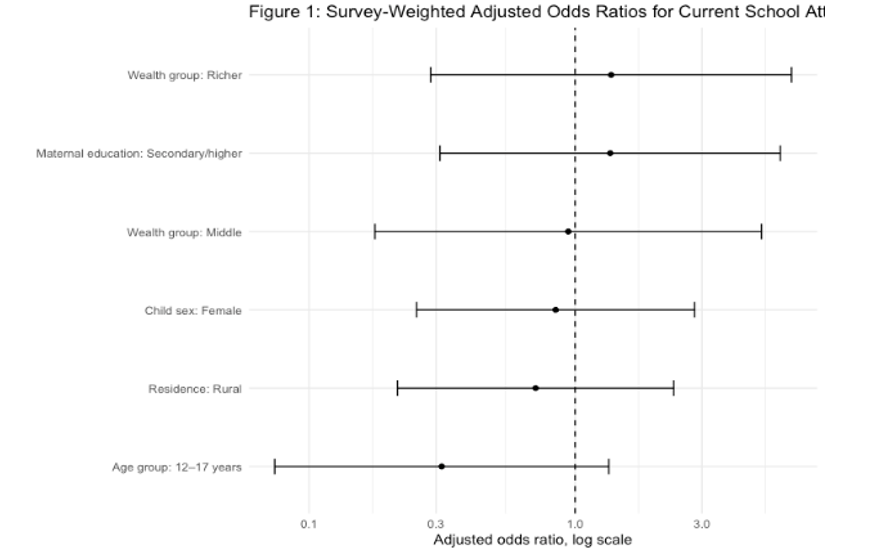
Nigeria has one of the largest populations of out-of-school children in the world, but subnational, state-level evidence on the correlates of school attendance remains limited, particularly for north-central states such as Kogi. This study estimated the prevalence of current school attendance among children aged 5–17 years in Kogi State and examined its sociodemographic correlates using the 2021 Nigeria Multiple Indicator Cluster Survey (MICS6). The analytic sample comprised 583 children nested within 49 primary sampling units (PSUs). A null random-intercept model assessing PSU-level clustering was singular (variance not estimable); survey-weighted logistic regression accounting for stratification, clustering, and weights was therefore the primary analysis, with survey-weighted Poisson regression yielding adjusted prevalence ratios (APRs) as a sensitivity analysis. The weighted prevalence of current school attendance was 95.0% (95% CI: 92.0–96.9%), declining from 98.8% among children aged 5–9 years to 88.2% among adolescents aged 15–17 years. In adjusted models, no covariate was statistically significant at the 5% level, including female sex (adjusted odds ratio [AOR] 0.84, 95% CI 0.25–2.81), age 12–17 years (AOR 0.32, 95% CI 0.07–1.34), and rural residence (AOR 0.71, 95% CI 0.22–2.35); APRs were consistent. The wide confidence intervals are compatible with both negligible and substantial associations, so these results do not demonstrate an absence of sociodemographic differences; only 28 children were not attending school, limiting statistical power. Attendance was high overall, with the largest shortfall among older adolescents; larger or pooled samples are needed to characterise its correlates, and retention measures for older adolescents merit consideration and evaluation.
References
Adeleke, R. (2024). Geographical analysis of gender disparity in out-of-school children in Nigeria. Child Indicators Research, 17, 637–655. https://doi.org/10.1007/s12187-023-10097-z
Baird, S., Ferreira, F. H. G., Özler, B., & Woolcock, M. (2014). Conditional, unconditional and everything in between: A systematic review of the effects of cash transfer programmes on schooling outcomes. Journal of Development Effectiveness, 6(1), 1–43. https://doi.org/10.1080/19439342.2014.890362
Bates, D., Mächler, M., Bolker, B., & Walker, S. (2015). Fitting linear mixed-effects models using lme4. Journal of Statistical Software, 67(1), 1–48. https://doi.org/10.18637/jss.v067.i01
Education Policy and Data Center. (2013). Nigeria: Out-of-school children profile. FHI 360. https://www.epdc.org/sites/default/files/documents/Nigeria_OOSC_Profile.pdf
Firth, D. (1993). Bias reduction of maximum likelihood estimates. Biometrika, 80(1), 27–38. https://doi.org/10.1093/biomet/80.1.27
Gomes, D. G. E. (2022). Should I use fixed effects or random effects when I have fewer than five levels of a grouping factor in a mixed-effects model? PeerJ, 10, Article e12794. https://doi.org/10.7717/peerj.12794
Idikwu, J.S., Kuhe, D.A., & Nyitar, J. A. (2025). A binary logistic regression model for assessing the predisposing factors of malaria fever among farmers in Benue State, Nigeria. FUDMA Journal of Sciences, 9(12), 22-28. https://doi.org/10.33003/fjs-2025-0912-4147
Lumley, T. (2010). Complex surveys: A guide to analysis using R. Wiley.
National Bureau of Statistics & United Nations Children’s Fund. (2022). Nigeria Multiple Indicator Cluster Survey 2021, survey findings report.
Nwoke, C., Oyiga, S., & Cochrane, L. (2024). Assessing the phenomenon of out-of-school children in Nigeria: Issues, gaps and recommendations. Review of Education, 12(3), Article e70011. https://doi.org/10.1002/rev3.70011
Oberpriller, J., de Souza Leite, M., & Pichler, M. (2022). Fixed or random? On the reliability of mixed-effects models for a small number of levels in grouping variables. Ecology and Evolution, 12(7), Article e9062. https://doi.org/10.1002/ece3.9062
Ojuolape, A. M., & Mohd, S. (2024). Determinants of child schooling in Kwara State, North Central Nigeria. Cogent Social Sciences, 10(1), Article 2319377. https://doi.org/10.1080/23311886.2024.2319377
Oyekan, K., Ayorinde, A., & Adenuga, O. (2023). The problem of out-of-school children in Nigeria (RISE Insight Note 2023/058). Research on Improving Systems of Education (RISE) Programme. https://doi.org/10.35489/BSG-RISE-RI_2023/058
Peduzzi, P., Concato, J., Kemper, E., Holford, T. R., & Feinstein, A. R. (1996). A simulation study of the number of events per variable in logistic regression analysis. Journal of Clinical Epidemiology, 49(12), 1373–1379. https://doi.org/10.1016/S0895-4356(96)00236-3
Pezzulo, C., Alegana, V. A., Christensen, A., Bakari, O., & Tatem, A. J. (2022). Understanding factors associated with attending secondary school in Tanzania using household survey data. PLOS ONE, 17(2), Article e0263734. https://doi.org/10.1371/journal.pone.0263734
Talbot, D., Mésidor, M., Chiu, Y., Simard, M., & Sirois, C. (2023). An alternative perspective on the robust Poisson method for estimating risk or prevalence ratios. Epidemiology, 34(1), 1–7. https://doi.org/10.1097/EDE.0000000000001544
UNICEF Data. (2025). Primary school age education. https://data.unicef.org/topic/education/primary-education/
UNICEF Nigeria. (2023). Nigeria education fact sheets: Analyses for learning and equity using MICS data (MICS-EAGLE). https://www.unicef.org/nigeria/reports/nigeria-education-fact-sheets
Usman, U., Waziri, M., Manu, F., Zakari, Y., & Dikko, H.G. (2021). Assessing the performance of some re-sampling methods using logistic regression. FUDMA Journal of Sciences, 5(1), 445-456. https://doi.org/10.33003/fjs-2021-0501-589
Zou, G. (2004). A modified Poisson regression approach to prospective studies with binary data. American Journal of Epidemiology, 159(7), 702–706. https://doi.org/10.1093/aje/kwh090
Downloads
Published
Issue
Section
Categories
License
Copyright (c) 2026 Dolapo Shobanke, Grace Korter, Praise Lawal Molete, Babatunde Sunday Elijah

This work is licensed under a Creative Commons Attribution 4.0 International License.