
Characterisation of Tin, Iron and Zircon ore samples from selected mines in Toro Local Government Area of Bauchi State, Nigeria using X-Ray Fluorescence Analysis
DOI:
https://doi.org/10.33003/fjs-2026-1013-5740Keywords:
Characterization, Ore, Impurities, X-Ray Fluorescence, Beneficiation, Bauchi StateAbstract
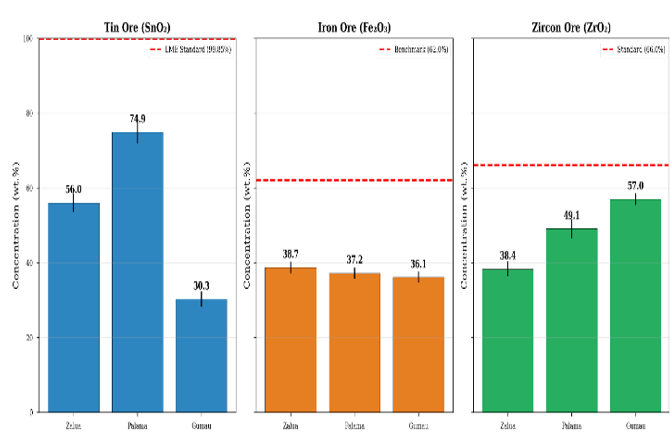
This study characterised tin, iron, and zircon ore samples from three mining sites (Palama, Zalua, and Gumau) in Toro Local Government Area, Bauchi State, Nigeria, using wavelength-dispersive X-ray Fluorescence (WDXRF) analysis. Nine representative ore samples (three per site) were collected, prepared, and analysed to determine their oxide compositions and impurity profiles. The results revealed that SnO₂ concentrations ranged from 30.259 wt.% (Gumau) to 74.926 wt.% (Palama), corresponding to elemental Sn of 23.817–58.966 wt.%; Fe₂O₃ concentrations ranged from 36.145 wt.% (Gumau) to 38.744 wt.% (Zalua), corresponding to elemental Fe of 25.266–27.082 wt.%; and ZrO₂ concentrations ranged from 38.352 wt.% (Zalua) to 57.010 wt.% (Gumau), corresponding to elemental Zr of 28.380–42.187 wt.%. Major impurity oxides identified included SiO₂ (up to 38.120 wt.%), TiO₂ (up to 42.632 wt.%), and Al₂O₃ (up to 7.838 wt.%), while minor impurities included MnO, MgO, and HfO₂. When compared with London Metal Exchange (LME) and ASTM international export-grade specifications, all samples fell below minimum requirements for direct export: tin ores contained 23.82–58.97 wt.% elemental Sn versus the 99.85% standard; iron ores contained 25.27–27.08 wt.% elemental Fe versus the 62.0% minimum; and zircon ores contained 28.38–42.19 wt.% elemental Zr versus the 62.0–66.0% ZrO₂ minimum. The unusually high TiO₂ content (36.1–42.6 wt.%) in the iron ore samples suggests ilmenite or titaniferous magnetite assemblages rather than conventional iron ores. These findings demonstrate that substantial beneficiation is required for these ores to meet international standards. The study provides critical baseline data for mineral processing and industrial utilisation of these Nigerian ore deposits.
References
Adedayo, O.S., Ibrahim, A., & Musa, H.A. (2020). Geochemical analysis of tin ore deposits using XRF and AAS techniques. Journal of Applied Geoscience, 8(2), 45–54.
Adetunji, A.R., Olatunji, M.I., & Bello, T.K. (2021). Chemical characterisation and beneficiation of Itakpe iron ore in Nigeria. Nigerian Journal of Mining and Geology, 57(3), 78–88.
Akinola, A.P., Obams, A., & Ifeanyi, A. (2022). Determination of minerals of cassiterite tailings and its recycling potential using empirical method at Plateau State, Nigeria. International Journal of Advances in Scientific Research and Engineering, 8(3), 18–42.
ASTM International. (2023). Standard specification for tin, iron and zircon ores for metallurgical use. ASTM D4325-23, Philadelphia, USA.
Duan, J., Farrugia, D., Davis, C., & Li, Z. (2022). Effect of impurities on the microstructure and mechanical properties of a low carbon steel. Ironmaking and Steelmaking, 49(2), 140–146. https://doi.org/10.1080/03019233.2021.1982209
Gebreslassie, Y.T., & Gebretnsae, H.G. (2021). Green and cost-effective synthesis of tin oxide nanoparticles: A review on the synthesis methodologies, mechanism of formation, and their potential applications. Nanoscale Research Letters. https://doi.org/10.1186/s11671-021-03510-7
Grabarczyk, M., Wlazłowska, E., & Fialek, M. (2023). Electrochemical methods for the analysis of trace tin concentrations—Review. Molecules, 28(10), 4161. https://doi.org/10.3390/molecules28104161
International Tin Association. (2020). Tin production and usage standards. Retrieved from https://www.internationaltin.org/
Lachance, G.R., & Claisse, F. (1995). Quantitative X-Ray Fluorescence Analysis: Theory and Application. John Wiley & Sons.
Laperche, V., & Lemiere, B. (2021). Possible pitfalls in the analysis of minerals and loose materials by portable XRF, and how to overcome them. Minerals, 11(1), 33. https://doi.org/10.3390/min11010033
London Metal Exchange (LME). (2022). LME Tin Contract Specification. Retrieved from https://www.lme.com
Mallo, S.J. (2000). The younger granite ring complexes of Nigeria and their mineralisation. Journal of Mining and Geology, 36(2), 145–154.
Mohd Hasfarisham, A., Saidin, M., Abdullah, J., & Jusoh, A. (2023). X-ray fluorescence (XRF) analysis of iron ore at the Sungai Batu archaeological complex, Bujang Valley, Kedah, Malaysia. Heliyon, 9(3), e14850. https://doi.org/10.1016/j.heliyon.2023.e14850Add to Jenni
Obaje, N.G. (2009). Geology and Mineral Resources of Nigeria. Springer-Verlag Berlin Heidelberg.
Ogunleye, P.O., Ajayi, T.R., & Gbadebo, A.M. (2019). Elemental composition and impurity profile of tin ores from Jos Plateau, Nigeria. Journal of Mineral Science, 12(1), 33–41.
Okoli, B.I., Agboola, O.A., Onwualu, A.P., Bello, A., Sholiyi, O.S., Anye, V.C., & Yusuf, O.T. (2023). Characterisation of Nigerian zircon sand and its suitability for different industrial applications. Minerals, 13(6), 711. https://doi.org/10.3390/min13060711
Olujobi, O.J., & Irumekhai, O.S. (2024). Strategies and regulatory measures for combating illicit mining operations in Nigeria: A comprehensive legal perspective. Resources Policy, 91, 104876. https://doi.org/10.1016/j.resourpol.2024.104876Add to Jenni
Rousseau, R.M. (2001). Fundamental parameter methods in X-ray fluorescence analysis. Spectrochimica Acta Part B, 56(6), 861–883. https://doi.org/10.1016/S0584-8547(01)00233-6
Sarker, S.K., Haque, N., Bhuiyan, M., Bruckard, W., & Pramanik, B.K. (2022). Recovery of strategically important critical minerals from mine tailings. Journal of Environmental Chemical Engineering, 10(3), 107622. https://doi.org/10.1016/j.jece.2022.107622
Siyanbola, T.O., Adekola, F.A., & Bale, R.B. (2005). Energy-dispersive X-ray fluorescence analysis of samples of Nigerian zircon. Nuclear Instruments and Methods in Physics Research Section B, 239(4), 426–432. https://doi.org/10.1016/j.nimb.2005.06.022
Talan, D., & Huang, Q. (2022). A review of environmental aspects of rare earth element extraction processes and solution purification techniques. Minerals Engineering, 180, 107510. https://doi.org/10.1016/j.mineng.2022.107510
Uduma, A.U., Jacob, A.G., & Uduma, M.B. (2023). Energy-dispersive X-ray fluorescence analysis (EDXFA) of tin content in cassiterite obtained from Ray-Field mining site, Jos. FUDMA Journal of Sciences, 1(1), 185–188.
Wang, Y., Yu, W., Wang, C., Chen, F., Ma, T., & Huang, H. (2024). Defects in photoreduction reactions: Fundamentals, classification, and catalytic energy conversion. eScience, 4(3), 100289. https://doi.org/10.1016/j.esci.2024.100289
Xi, F., Li, S., Ma, W., Chen, Z., Wei, K., & Wu, J. (2021). A review of hydrometallurgy techniques for the removal of impurities from metallurgical-grade silicon. Hydrometallurgy, 201, 105588. https://doi.org/10.1016/j.hydromet.2021.105588
Zhang, B., Shi, J., Jiang, Y.R., Zhou, J.G., & Li, S.Q. (2021). XRF analysis of impurity metal elements in iron-based alloy. Open Access Library Journal, 8, e7846. https://doi.org/10.4236/oalib.1107846
Downloads
Published
Issue
Section
Categories
License
Copyright (c) 2026 Amaechi Christian Sunday, Mathew Nnamdi Agu, Jude OkemsinachI Anaegbu

This work is licensed under a Creative Commons Attribution 4.0 International License.


