
Impact of Industrial Activities on the Distribution of Naturally Occurring Radioactive Materials in Soils from Dantata Road Construction Site in Kaduna State, Nigeria
DOI:
https://doi.org/10.33003/fjs-2026-1016-5530Keywords:
Naturally occurring radioactive materials, gamma spectrometry, Dantata Road Construction, radiological hazard, excess lifetime cancer risk, TENORMAbstract
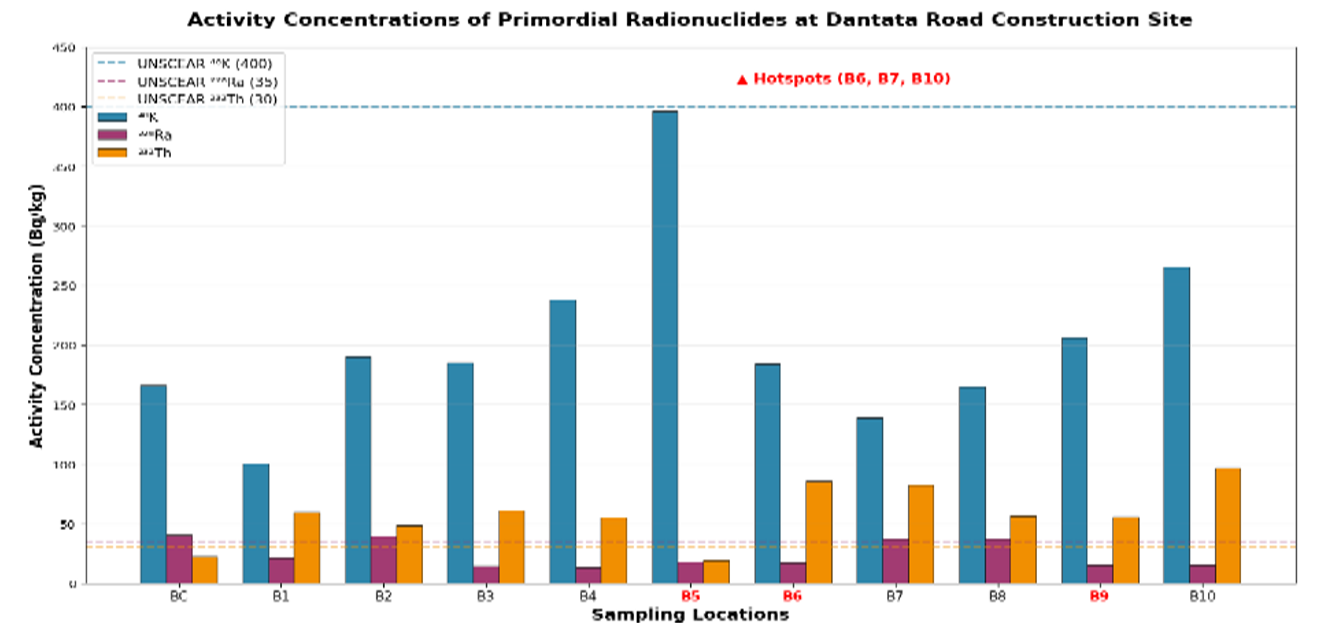
This study assessed the distribution of naturally occurring radioactive materials (NORMs) in soils from the Dantata Road Construction Site, Kaduna State, Nigeria, to evaluate potential industrial influence. Soil samples (n=10) were collected from active operational areas, with one reference sample from a location approximately 500 m away. Activity concentrations of ²²⁶Ra, ²³²Th, and ⁴⁰K were measured using a thallium-activated sodium iodide [NaI(Tl)] gamma spectrometer. In the active zone, mean activity concentrations were 206.80 ± 81.04 Bq/kg (⁴⁰K), 22.78 ± 10.82 Bq/kg (²²⁶Ra), and 61.91 ± 22.02 Bq/kg (²³²Th). The reference sample yielded 165.99 Bq/kg, 40.25 Bq/kg, and 22.18 Bq/kg respectively. The elevated ²³²Th mean exceeds both the reference value and the UNSCEAR worldwide reference mean of 30 Bq/kg. Calculated annual effective dose equivalents ranged from 0.044 to 0.094 mSv/y, below the 1.0 mSv/y public limit. Excess lifetime cancer risk estimates ranged from 0.155 × 10⁻³ to 0.328 × 10⁻³, with some locations exceeding the global average of 0.29 × 10⁻³. Weak to moderate negative correlations among radionuclides suggest possible disruption of natural geochemical equilibrium. However, the limited sample size (n=10) and single reference measurement preclude definitive source attribution. The observed ²³²Th enrichment warrants further investigation with expanded sampling and mineralogical analysis.
References
Adebiyi, F. M., Ore, O. T., Adeola, A. O., Durodola, S. S., Akeremale, O. F., Olubodun, K. O., & Akeremale, O. K. (2021). Occurrence and remediation of naturally occurring radioactive materials in Nigeria: A review. Environmental Chemistry Letters, 19(4), 3243–3262. https://doi.org/10.1007/s10311-021-01237-4
Agbalagba, E. O., & Oghenevovwero Emmanuel, E. (2023). Occupational and public risk assessment of NORMs in soil of the Niger Delta region of Nigeria after six decades of hydrocarbon exploitation. Arabian Journal of Geosciences, 16(5). https://doi.org/10.1007/s12517-022-11151-w
Beretka, J., & Mathew, P. J. (1985). Natural radioactivity of Australian building materials, industrial wastes and by-products. Health Physics, 48(1), 87–95.
Currie, L. A. (1968). Limits for qualitative detection and quantitative determination. Analytical Chemistry, 40(3), 586-593.
Ewona, I. O., Terso, U., Keen, R. B., Udo, S. O., Eka, B. J., Okono, M. A., & Ukam, L. E. (2024). Assessment of the pollution indices of particulate matter trapped in classroom ceiling fans in a tertiary institution in southern Nigeria. International Journal of Research and Scientific Innovation (IJRSI), 11(7), 1260–1275.
Idowu, G. A. (2022). Heavy metals research in Nigeria: A review of studies and prioritization of research needs. Environmental Science and Pollution Research International, 29(44), 65940–65961. https://doi.org/10.1007/s11356-022-22174-x
International Commission on Radiological Protection (ICRP). (2007). Recommendations of the International Commission on Radiological Protection. ICRP Publication 103. Pergamon Press.
Jegede, D. O., Afolabi, T. A., Agunbiade, F. O., Afolabi, T. A., Ogundiran, O. O., Gbadamosi, M. R., Sojinu, S. O., Ojekunle, O. Z., & Varanusupakul, P. (2025). Spatial distribution and radiological hazards assessment of naturally occurring radionuclide materials in soil from quarry sites in Ogun State, Nigeria. Environmental Monitoring and Assessment, 197(5), 575. https://doi.org/10.1007/s10661-025-13988-6
Ohakwere-Eze, M. C., Nafiu, M., Singh, S. K., Rabiu, J. A., & Obingonye, I. A. (2024). Investigation into the geological radiation levels and evaluation of hazard parameters in soil and rock specimens taken from mining sites across North-Eastern Nigeria. Discover Environment, 2(1).
Organisation for Economic Co-operation and Development (OECD). (1979). Exposure to Radiation from the Natural Radioactivity in Building Materials. OECD Nuclear Energy Agency.
Randhawa, J. S., Robin, Kaur, P., & Meehnian, H. (2024). A comprehensive review on health and environmental hazards of uranium: Analytical techniques, mitigation strategies and its toxicity treatments. Journal of Radioanalytical and Nuclear Chemistry, 333(8), 3693–3711. https://doi.org/10.1007/s10967-024-09527-1
Suleiman, M. A., Abdullahi, S. S., & Dauda, M. S. (2021). Assessment of natural radioactivity levels and associated radiological hazards in soils from selected industrial areas in Nigeria. Journal of Radiation Research and Applied Sciences, 14(1), 45-58.
Ujuagu, G. I., Ejeromedoghene, O., Oladoye, P. O., Okoye, C. O., Alli, Y. A., Oladipo, M. E., & Gu, J. (2025). The ecotoxicity and social impacts of industrial pollution: Insights on intervention and bioremediation strategies in Africa. Environmental Pollution and Management, 2, 227–245.
United Nations Scientific Committee on the Effects of Atomic Radiation (UNSCEAR). (2000). Sources and Effects of Ionizing Radiation. United Nations.
Yachiso, G. T. (2022). Sample preparation techniques for gamma spectrometric analysis of environmental samples: A review. Journal of Environmental Radioactivity, 245, 106–118.
Downloads
Published
Issue
Section
Categories
License
Copyright (c) 2026 Jude okemsinachi Anaegbu, Agomuo John Chidowerem, Ige Olumide Oluwasanmi, Hauwau Kulu Shuaibu

This work is licensed under a Creative Commons Attribution 4.0 International License.


