
Prevalence and Predictors of Depression Among People Living with HIV Attending an Outpatient’s Clinic at the Nigerian Institute of Medical Research Yaba Lagos
DOI:
https://doi.org/10.33003/fjs-2026-1012-5719Keywords:
Depression, Prevalence, Predictors, HIV/AIDSAbstract
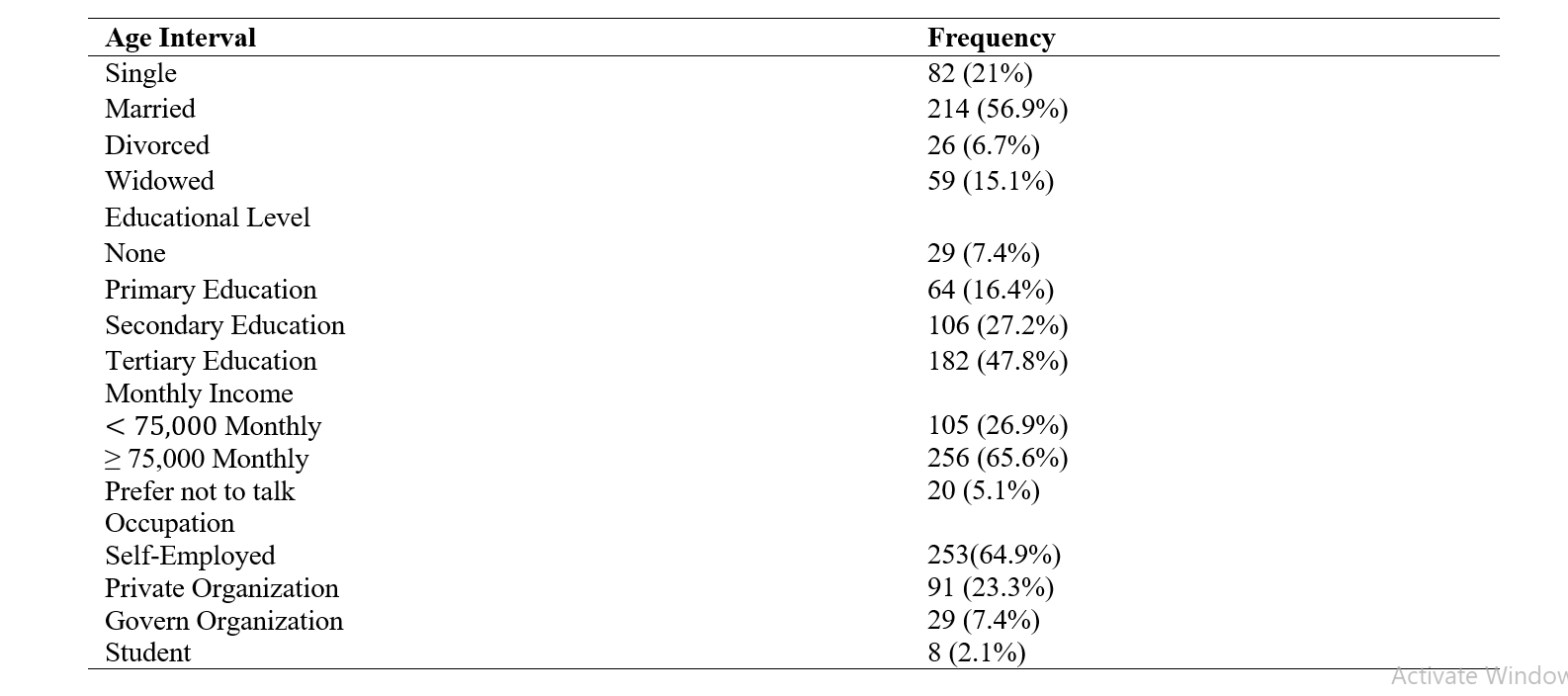
This study assessed the prevalence and predictors of depression among PLHIV attending the outpatient clinic of the Nigerian Institute of Medical Research (NIMR), Yaba, Lagos State. A cross-sectional research design was adopted for the study. A total of 371 adult PLHIV receiving antiretroviral therapy (ART) were selected using purposive sampling. Data were collected using a structured questionnaire which included socio-demographic characteristics, clinical and psychosocial factors, and the Patient Health Questionnaire-9 (PHQ-9) for measuring depressive symptoms. Data analysis was carried out using SPSS. Descriptive statistics was used to determine the prevalence of depression. Non-parametric tests (Mann–Whitney U test and Kruskal–Wallis test) engaged to examine differences in depression scores across gender, marital status, and age groups. Spearman’s rank correlation was applied to assess the relationship between monthly income and depression, while multiple linear regression analysis was used to identify predictors of depression. The findings revealed that the prevalence of depression among the respondents was (17.85%). Significant differences in depression scores were observed across gender, marital status, and age groups (p < 0.001). Monthly income showed a weak but significant negative correlation with depression. Multiple linear regression analysis indicated that age and HIV-related stigma were significant predictors of depression, while other variables such as income, occupation status, duration on ART, substance use, and social support were not statistically significant. The study concludes that depression is prevalent among PLHIV attending NIMR, with younger age and HIV-related stigma being major predictors. Routine depression screening and stigma-reduction interventions where recommended as part of comprehensive HIV care.
References
Abdool Karim, Q., Kharsany.A.B., Leask, K., Ntombela, F., Humphries, H., Samsunder, N., Grobler, A., Dellar, R., Frohlich, J.A., & Abdool Karim, S.S (2022). Prevalence of HIV, HSV-2, and pregnancy among high school students in rural KwaZulu-Natal: A bio-behavioral cross-sectional survey. African Journal of Medicine and Medical Sciences, 11(4), 119-235.
Adebayo, O., & Akande, M. (2020). Socioeconomic predictors of HIV/AIDS prevalence in Lagos. World Health Organisation. https://www.who.int/publications/i/item/9789240051772
Adewuya, A. O., & Makanjuola, A. (2020). Psychiatric disorders among the HIV-positive population in Nigeria: A controlled study. African Journal of Medicine and Medical Sciences, 36(3), 315–321.
Adedeji, W. A., Ma, Q., Raji, A. M., Cha, R., Rasaki, O. M., Hutson, A., et al. (2023). Prevalence of depression among people living with HIV in rural hospitals in South-Western Nigeria: Association with clinico-demographic factors. AIDS Research & Therapy, 20(1), 89. https://doi.org/10.1186/s12981-023-00586-0
Afolabi, O. (2023). Sensitivity and specificity of clinician-administered screening instruments in detecting depression among HIV-positive individuals in Uganda. AIDS Research and Therapy, 11] (5), 84-115.
Amare, A., et al. (2025). Depressive symptoms and their determinants among people living with HIV in Africa: A systematic review and meta-analysis. BMC Psychiatry, 25, Article 325. https://doi.org/10.1186/s12888-025-06766-8
Armoon, B., Bayat, A.-H., Fakhri, Y., Gonabadi-Nezhad, L. (2022). HIV-related stigma associated with social support, alcohol use disorders, depression, anxiety, and suicidal ideation among people living with HIV: A systematic r eview and meta-analysis. International Journal of Mental Health Systems, 16, 17. https://doi.org/10.1186/s13033-022-00527-w
Ayano, G., Demelash, S., Abraha, M., et al. (2021). The prevalence of depression among adolescents with HIV/AIDS: A systematic review and meta-analysis. AIDS Research and Therapy, 18, 23. https://doi.org/10.1186/s12981-021-00351-1
Charles, B., & Joseph, L. (2022). Association between stigma, depression and quality of life among people living with HIV/AIDS in South India: A community-based cross-sectional study. Public Health, 12, 463.
Chen, J., Wang, X., et al. (2024). Sleep quality mediates the effect of medical social support on depression symptoms in patients with HIV/AIDS. BMC Public Health, 24, 1429. https://doi.org/10.1186/s12889-024-18174-w
Collins, P. Y., & Anugwom, H. A. (2020). What is the relevance of mental health to HIV/AIDS care and treatment programs in developing countries: A systematic review. AIDS, 20(12), 200-344.
Desta, F., Zenbaba, D., Sahiledengle, B., Tekalegn, Y., Woldeyohannes, D., Atlaw, D., & Baffa, L. D. (2024). Perceived stigma and depression among HIV-positive adult people in Ethiopia: A systematic review and meta-analysis. BMC Psychiatry, 24, 159. https://doi.org/10.1186/s12888-024-XXXX-X PubMed
Gideon, Y.B., Chinagorom, L.U., and Emeka, D.U. (2026) Seroprevalence and Risk Factors Associated with Hepatitis B Virus Infection among Patient attending Sumas Medical Centre, Igbo-Eno, Enugu State, Nigeria. Fudma Journal of Science. Vol. 10, No. 2 pp 84-88, https://doi.org/10.33003/fjs-2026-1002-4207
Lukumay, G. G., Iseselo, M. K., Ambikile, J. S., & Mosha, I. H. (2022). Prevalence, severity, and associated factors of depression in newly diagnosed PLHIV in Kilimanjaro, Tanzania. BMC Psychiatry, 23, 83. https://doi.org/10.1186/s12888-022-04496-9
Lukumay, G. G., Iseselo, M. K., Ambikile, J. S., & Mosha, I. H. (2023). Prevalence of depression and associated factors among people living with HIV in care and treatment clinics in Dar es Salaam, Tanzania. Tanzania Medical Journal, 33(4), 544.
Melaku, Y. A., Tadesse, K. B., & Tegegne, M. T. (2024). Prevalence of depression and associated factors among HIV/AIDS patients attending antiretroviral therapy clinic at Adama Hospital Medical College, Adama, Ethiopia. Scientific Reports, 14, Article 52142. https://doi.org/10.1038/s41598-024-52142-z Nature
Molapo, D. M., Mokgalaboni, K., & Phoswa, W. N. (2025). Prevalence of depression among PLHIV on ART in Africa: A systematic review and meta-analysis. Healthcare, 13(1), 85. https://doi.org/10.3390/healthcare13010085
Ndenkeh, J. J. N., Nji, A. M., Yumo, H. A., et al. (2022). Depression management and ART outcomes among PLHIV in Cameroon. BMC Infectious Diseases, 22, 732. https://doi.org/10.1186/s12879-022-07711-w
Okafor, A., Nwankwo, U., & Chukwu, K. (2019, 2023). Prevalence of depression among people living with HIV in rural hospitals in South-Western Nigeria. A systematic review. AIDS, 233(23), 343-467.
Onyango, M. A., Odhiambo, F., & Atieno, S. (2021). Behavioural predictors of HIV among PLHIV. A systematic review. AIDS, 13(6), 112-22.
Pustil, R. (2023). Depression among people living with HIV/AIDS. Global AIDS, 11, https://doi.org/10.1186/s12879-022-07711-w
Seid, H., Gebremariam, M. Y., & Workineh, Y. (2023). Prevalence of undernutrition and its association with depression among PLHIV in sub-Saharan Africa. Journal of Health, Population and Nutrition, 42, 5. https://doi.org/10.1186/s41043-023-00327-7
Tesfaw, G. (2022). Prevalence and correlates of depression and anxiety among patients with HIV/AIDS. Journal of Public Health Research, 12(3), 245–259.
UNAIDS. (2020). Ending AIDS: Progress towards the 90-90-90 targets. https://www.unaids.org/en/resources/documents USAID. (2022). HIV/AIDS in Nigeria.
Vezi, L., et al. (2023). Depression among PLHIV at a district hospital in KwaZulu-Natal, South Africa. South African Family Practice, 65(1), Article 5821.
World Health Organiastion. (2023a). Consolidated guidelines on HIV prevention, testing, treatment, service delivery and monitoring. https://www.who.int/publications/i/item/9789240051282
World Health Organisation. (2023b). HIV and mental health: Key facts. https://www.who.int/news-room/fact-sheets/detail/hiv-aids
World Health Organisation. (2023c). Number of women living with HIV. Global Health Observatory.
Yang, C. H., & Huang, Y. F. (2020). Trends of mortality and causes of death among HIV-infected patients in Taiwan. Journal of Public Health Research, 17(3), 225–277.
Ziyaya, A., et al. (2024). Stigma and discrimination faced by adolescents living with HIV and experiencing depression in Malawi. BMC Global and Public Health, 2, 39. https://doi.org/10.1186/s44263-024-00072-3
Downloads
Published
Issue
Section
Categories
License
Copyright (c) 2026 Musa Sanni Ladan, Akeem Blessing Lateef, Ayodele Oyinlola, Imeh Christian

This work is licensed under a Creative Commons Attribution 4.0 International License.