
Charge-Transfer-Resistance-Informed Kinetic Simulation of Pollutant Degradation Using Functionalized Graphene Electrodes in an Electrochemical Batch Reactor: A Dynamic Modelling Framework for Electrode Screening in Water Treatment
DOI:
https://doi.org/10.33003/fjs-2026-1015-5709Keywords:
Electrochemical water treatment, Graphene oxide, Reduced graphene oxide, Nitrogen-doped graphene oxide, pseudo-first-order kinetic, Pollutant degradation, Dynamic simulationAbstract
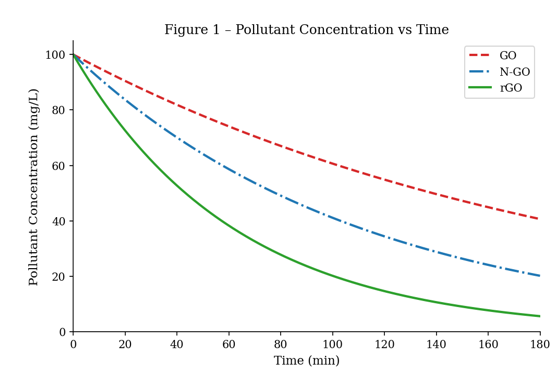
Electrochemical advanced oxidation processes (EAOPs) are increasingly recognised as effective technologies for the degradation of persistent organic pollutants in water, with electrode material selection critically determining treatment performance. Functionalised graphene electrodes including graphene oxide (GO), reduced graphene oxide (rGO), and nitrogen-doped graphene oxide (N-GO) offer tunable surface chemistry and charge-transfer properties relevant to electrochemical pollutant degradation. However, the relationship between electrode electrochemical impedance characteristics and pollutant removal kinetics has not been evaluated through dynamic systems modelling. In this study, a charge-transfer-resistance-informed pseudo-first-order kinetic model was implemented in OpenModelica to simulate pollutant concentration decay and removal efficiency in an electrochemical batch reactor over a 180-minute treatment period. Electrode charge-transfer resistance values were used to derive effective degradation rate constants through an Rct-scaling relationship, enabling direct linkage between electrochemical characterisation data and kinetic performance prediction. The model predicted pollutant concentration, cumulative removal efficiency, and kinetic rate constants for GO, N-GO, and rGO electrodes. Results demonstrated that rGO achieved the highest simulated removal efficiency of 94.39% at 180 minutes, with an effective rate constant of 0.0160 min⁻¹ a 3.2-fold improvement over GO (0.0050 min⁻¹, 59.34% removal). N-GO exhibited intermediate performance (0.0089 min⁻¹, 79.81% removal). Sensitivity analysis confirmed that charge-transfer resistance is the dominant kinetic parameter governing electrode performance, with removal efficiency decreasing sharply as Rct increases from 10 to 120 Ω. A time-to-threshold analysis further demonstrated that rGO achieves 50% pollutant removal 3.2 times faster than GO and is the only electrode to achieve 90% removal within the 180-minute window.
References
United Nations (2023). The United Nations World Water Development Report 2023: Partnerships and Cooperation for Water. UNESCO, Paris.
Martínez-Huitle, C.A.; Rodrigo, M.A.; Sirés, I.; Scialdone, O. (2015). Single and coupled electrochemical processes and reactors for the abatement of organic water pollutants: a critical review. Chemical Reviews, 115(24), 13362–13407.
Brillas, E.; Sirés, I.; Oturan, M.A. (2009). Electro-Fenton process and related electrochemical technologies based on Fenton’s reaction chemistry. Chemical Reviews, 109(12), 6570–6631.
Duan, X.; Sun, H.; Wang, S. (2018). Metal-free carbocatalysis in advanced oxidation reactions. Accounts of Chemical Research, 51(3), 678–687.
Dreyer, D.R.; Park, S.; Bielawski, C.W.; Ruoff, R.S. (2010). The chemistry of graphene oxide. Chemical Society Reviews, 39(1), 228–240.
Pei, S.; Cheng, H.M. (2012). The reduction of graphene oxide. Carbon, 50(9), 3210–3228.
Wang, H.; Maiyalagan, T.; Wang, X. (2012). Review on recent progress in nitrogen-doped graphene: synthesis, characterization, and its potential applications. ACS Catalysis, 2(5), 781–794.
Panizza, M.; Cerisola, G. (2009). Direct and mediated anodic oxidation of organic pollutants. Chemical Reviews, 109(12), 6541–6569.
Fritzson, P. (2014). Principles of Object-Oriented Modeling and Simulation with Modelica 3.3. IEEE Press / Wiley.
Bard, A.J.; Faulkner, L.R. (2001). Electrochemical Methods: Fundamentals and Applications, 2nd edition. Wiley, New York.
Downloads
Published
Issue
Section
Categories
License
Copyright (c) 2026 Abubakar Muhammad Ramalan, Abubakar Sadiq Yusuf, Abdul Dahuru Ardo Buba

This work is licensed under a Creative Commons Attribution 4.0 International License.


