
Conventional Liquid-State Synthesis of Glycine-Benzaldehyde Schiff Base Metal Complexes: Methodological Considerations and Antimicrobial Efficacy
DOI:
https://doi.org/10.33003/fjs-2026-1014-5651Keywords:
glycine-benzaldehyde, antimicrobial activity, spin crossoverAbstract
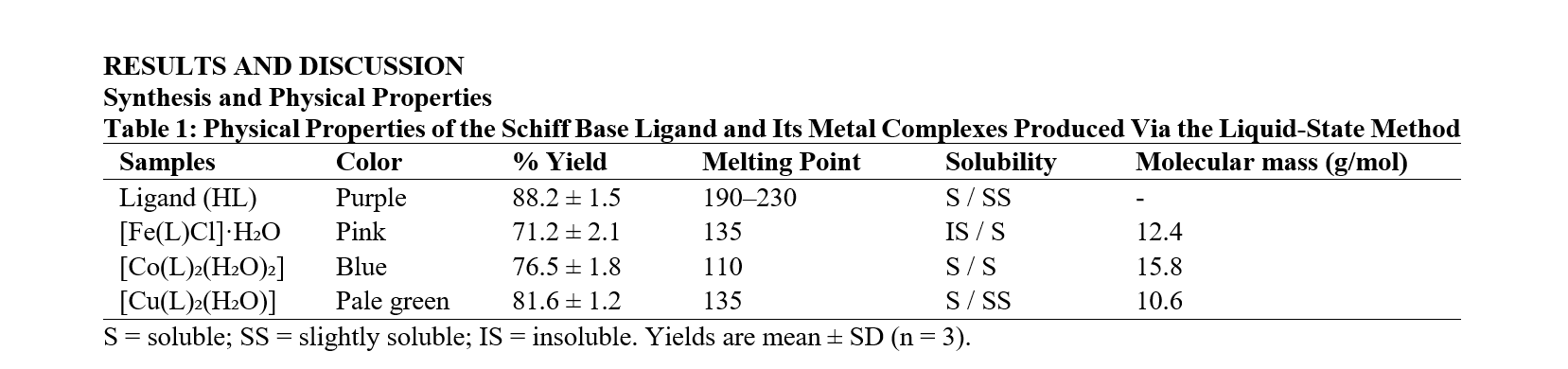
Despite growing interest in the emergent solid-state methods, conventional liquid-state reflux remains the main way to synthesize Schiff base transition metal complexes. This study describes a detailed framework for liquid-state synthesis, using the preparation of a glycine-benzaldehyde Schiff base ligand and its Fe(II), Co(II), and Cu(II) complexes as ingredient. The ligand was made by ethanolic reflux with methylamine as a catalyst, and the metal complexes were prepared in methanol at room temperature (30 °C) for 24 hours with a 2:1 ligand-to-metal ratio. The products were analyzed using FTIR, UV-Visible spectroscopy, X-ray diffraction (XRD), thermogravimetric analysis (TGA), magnetic susceptibility, and antimicrobial screening with agar well diffusion. The ligand was obtained in 88.2% yield and showed a clear azomethine ν(C=N) stretch at 1679.2 cm⁻¹. Complex yields followed the Irving-Williams order: Cu(II) (81.6%), Co(II) (76.5%), and Fe(II) (71.2%). FTIR confirmed bidentate N,O-coordination by shifts in the imine band. XRD showed that the Co(II) complex was highly crystalline (494–1247 Å), while the Fe(II) product was nearly amorphous (~53 Å). Magnetic measurements indicated spin-crossover behavior for Fe(II). TGA showed that Cu(II) and Co(II) decomposed gradually above 200 °C, but Fe(II) broke down rapidly near 400 °C. The Co(II) and Cu(II) complexes showed broad-spectrum antimicrobial activity against Staphylococcus aureus, Escherichia coli, Aspergillus niger, and Candida albicans at 100 µg/mL. Liquid-state synthesis offers clear benefits, such as thermodynamic control, improved crystallinity through Ostwald ripening, and access to spin-crossover materials. The framework described here can guide others using conventional solution-based synthesis in coordination and medicinal inorganic chemistry.
References
Abdel-Rahman, L. H., Abu-Dief, A. M., & El-Khatib, R. M. (2017). Synthesis, characterization, and antimicrobial activity of some new Schiff base metal complexes. Journal of Molecular Structure, 1147, 331–340.
Abu-Dief, A. M., & Mohamed, I. M. A. (2015). A review on varied applications of transition metal complexes incorporating Schiff bases. Beni-Suef University Journal of Basic and Applied Sciences, 4(2), 119–133. https://doi.org/10.1016/j.bjbas.2015.05.004
Al Zoubi, W., Kim, M. J., Kim, Y. G., & Ko, Y. G. (2020). Fabrication of organic-inorganic hybrid materials on metal surfaces for corrosion protection: A review on the role of Schiff base complexes. Chemical Engineering Journal, 393, 124747.
Bello, N. M., Yusif, A., Ebune, A. O., & Ahmad, K. B. (2024). Synthesis, characterization and in vitro anti-microbial activities of 3-nitro-N-(3-nitrobenzylidine) aniline Schiff base complexes of cobalt (II) and Cu (II). Journal of Chemical Society of Nigeria, 49(5).
Bonnett, B. L., & Ilic, S. (2021). Mechanistic investigations into and control of anisotropic metal–organic framework growth. Inorganic Chemistry, 60(14), 10439–10450.
Christiansen, O., Gauss, J., & Schimmelpfennig, B. (2000). Spin-orbit coupling constants from coupled-cluster response theory. Physical Chemistry Chemical Physics, 2(5), 965–971.
Deacon, G. B., & Phillips, R. J. (1980). Relationships between the carbon-oxygen stretching frequencies of carboxylato complexes and the type of carboxylate coordination. Coordination Chemistry Reviews, 33(3), 227–250.
EL-AJAILY, M., & MORAD, F. (2007). Studies on cobalt(II) and copper(II) Schiff base complexes. Asian Journal of Chemistry, 19(6), 4379–4384. https://asianpubs.org/index.php/ajchem/article/view/19941
Fayek, A. A., Mansour, M. S. A., & Abdelrahman, A. A. (2025). Nanostructured metal-Schiff base complexes: Recent advances in synthesis, characterisation, and biomedical applications. Materials Today Chemistry, 48, 102982.
Figgis, B. N., & Hitchman, M. A. (2000). Ligand field theory and its applications. Wiley-VCH. ISBN: 978-0471317763
Garnovskii, A. D., Nivorozhkin, A. L., & Minkin, V. I. (1993). Ligand environment and the structure of Schiff base adducts and tetracoordinated metal-chelates. Coordination Chemistry Reviews, 126(1–2), 1–69.
Geary, W. J. (1971). The use of conductivity measurements in organic solvents for the characterisation of coordination compounds. Coordination Chemistry Reviews, 7(1), 81–122. https://doi.org/10.1016/S0010-8545(00)80009-0
Gütlich, P., & Goodwin, H. A. (Eds.). (2004). Spin crossover in transition metal compounds. Topics in Current Chemistry, 233, 1–47.
Gütlich, P., Garcia, Y., & Goodwin, H. A. (2000). Spin transition phenomena in Fe(II) complexes. Chemical Society Reviews, 29, 419–427.
Gutten, O., & Rulíšek, L. (2013). Predicting the stability constants of metal-ion complexes from first principles. Inorganic Chemistry, 52(17), 10016–10027.
Halcrow, M. A. (2013). Jahn–Teller distortions in transition metal compounds and their importance in functional molecular and inorganic materials. Chemical Society Reviews, 42(4), 1784–1795.
Hancock, B. C., & Zografi, G. (1997). Characteristics and significance of the amorphous state in pharmaceutical systems. Journal of Pharmaceutical Sciences, 86(1), 1–12.
Holder, C. F., & Schaak, R. E. (2019). Tutorial on powder X-ray diffraction for the characterization of nanoscale materials. ACS Nano, 13(7), 7359–7365.
Iorhuna, T. B., Maradona, I., Othniel, M. M., & Fineboy, U. (2025). Synthesis, characterization and biological profiles of Schiff base derived from benzaldehyde and phenylalanine and M³⁺ complexes using conventional method. ChemClass Journal, 9(2), 584–601. https://doi.org/10.33003/chemclas-2025-0902/181
Iqbal, S. S., Khan, M. A., Khan, M. A., & Khan, M. A. (2015). Synthesis, crystal structure and antibacterial activities of mixed ligand copper(II) and cobalt(II) complexes of a NNS Schiff base. Polyhedron, 85, 312–319.
Irving, H., & Williams, R. J. P. (1953). The stability of transition-metal complexes. Journal of the Chemical Society, 3192–3210.
James, S. L., Adams, C. J., Bolm, C., Braga, D., Collier, P., Friščić, T., Grepioni, F., Harris, K. D. M., Hyett, G., Jones, W., Krebs, A., Mack, J., Maini, L., Orpen, A. G., Parkin, I. P., Shearouse, W. C., Steed, J. W., & Waddell, D. C. (2012). Mechanochemistry: Opportunities for new and cleaner synthesis. Chemical Society Reviews, 41(1), 413–447.
Ji, S., Li, S., Zhang, R., Zhang, X., & Zhang, Y. (1998). Studies on infrared spectra of Schiff base ligands and Mn(III) complexes with methylene bridge. Guang Pu Xue Yu Guang Pu Fen Xi (Spectroscopy and Spectral Analysis), 18(3), 298–302.
Ksenofontov, V., Gaspar, A. B., & Gütlich, P. (2004). On the nature of the plateau in two-step dinuclear spin-crossover complexes. Chemistry A European Journal, 10(5), 1291–1298.
Kumar, K. S., Bayeh, Y., Gebretsadik, T., Elemo, F., Gebrezgiabher, M., Thomas, M., & Ruben, M. (2019). Spin-crossover in iron(II)-Schiff base complexes. Dalton Transactions, 48, 15321–15337.
Kumar, R., Seemab, K., Singh, D. K., Jain, P., Manave, N., Gautam, B., & Kumar, S. N. (2023). Synthesis, antibacterial and antifungal activities of Schiff base rare earth metal complexes: A review of recent work. Journal of Coordination Chemistry, 76(9–10), 1065–1093.
Mehmood, A., Akhtar, M. N., & Bano, S. (2023). Schiff base metal complexes: A new class of antimicrobial agents. Journal of Molecular Structure, 1294, 136558. https://doi.org/10.1016/j.molstruc.2023.136558
Miessler, G. L., Tarr, D. A., & Peterson, R. J. (2014). Inorganic Chemistry (5th ed.). Pearson Education. ISBN: 978-0321811059
Nakamoto, K. (2009). Infrared and Raman spectra of inorganic and coordination compounds (6th ed.). Wiley.
Obande, E., Mamman, S., Ojo, S. A., & Ukoha, P. O. (2024). Antimicrobial properties of Cu(I) and Cu(II) complexes of a Schiff base ligand. International Journal of Research and Scientific Innovation (IJRSI), 11(8), 502–513. https://doi.org/10.51244/IJRSI.2024.1108041
Perez, M. (2005). Gibbs–Thomson effects in phase transformations. Scripta Materialia, 52(8), 709–712. https://doi.org/10.1016/j.scriptamat.2004.12.026
Qin, W., Long, S., Panunzio, M., & Biondi, S. (2013). Schiff bases: A short survey on an evergreen chemistry tool. Molecules, 18(10), 12264–12289. https://doi.org/10.3390/molecules181012264
Rafique, S., Idris, M., Nasim, A., Akbar, H., & Athar, A. (2010). Transition metal complexes as possible therapeutic agents. Biotechnology and Molecular Biology Reviews, 5(2), 38–45.
Raman, N., Sakthivel, A., & Rajasekaran, K. (2007). Synthesis and spectral characterization of antifungal sensitive Schiff base transition metal complexes. Mycobiology, 35(3), 150–158. https://doi.org/10.4489/MYCO.2007.35.3.150
Reichardt, C., & Welton, T. (2011). Solvents and solvent effects in organic chemistry (4th ed.). Wiley-VCH. https://doi.org/10.1002/9783527632220
Rogers, N. J., Postings, M. L., Dixon, A. M., Moat, J., Shreeve, G., Stuart, L., Waterfield, N. R., & Scott, P. (2025). Membrane lipid composition directs the cellular selectivity of antimicrobial metallohelices. RSC Medicinal Chemistry, 16(5), 2249–2260. https://doi.org/10.1039/d4md00973h
Sani, S., Siraj, I. T., Kurawa, M., & Abdul Halim, S. N. (2022). An efficient synthetic route, characterisation, and antimicrobial evaluation of Co(II), Ni(II), Cu(II), and Zn(II) Schiff base complexes. Bulletin of the Chemical Society of Ethiopia, 36(4), 831–842. https://doi.org/10.4314/bcse.v36i4.9
Schiff, H. (1864). Mittheilungen aus dem Universitätslaboratorium in Pisa: Eine neue Reihe organischer Basen. Justus Liebigs Annalen der Chemie, 131(1), 118–119. https://doi.org/10.1002/jlac.18641310114
Senthil Kumar, K., & Ruben, M. (2017). Emerging trends in spin crossover (SCO) based functional materials and devices. Coordination Chemistry Reviews, 346, 176–205. https://doi.org/10.1016/j.ccr.2017.03.024
Su, S., Wu, S., Baker, M. L., Bencok, P., Azuma, N., Miyazaki, Y., Nakano, M., Kang, S., Shiota, Y., Yoshizawa, K., Kanegawa, S., & Sato, O. (2020). Quenching and restoration of orbital angular momentum through a dynamic bond in a cobalt(II) complex. Journal of the American Chemical Society, 142(26), 11434–11441. https://doi.org/10.1021/jacs.0c02257
Thakur, S., Jaryal, A., & Bhalla, A. (2024). Recent advances in biological and medicinal profile of Schiff bases and their metal complexes: An updated review. Coordination Chemistry Reviews, 498, 215468. https://doi.org/10.1016/j.ccr.2023.215468
Thermal decomposition and mass spectral studies of cobalt(III) complexes with hexadentate dioxime Schiff bases. (1989). Thermochimica Acta, 154(2), 299–304. https://doi.org/10.1016/0040-6031(89)85467-X
Tümer, M., Ekinci, D., Tümer, F., & Bulut, A. (2007). Synthesis, characterization and properties of some divalent metal(II) complexes: Their electrochemical, catalytic, thermal and antimicrobial activity studies. Spectrochimica Acta Part A: Molecular and Biomolecular Spectroscopy, 67(3–4), 916–929. https://doi.org/10.1016/j.saa.2006.09.019
Tweedy, B. G. (1964). Plant extracts with metal ions as potential antimicrobial agents. Phytopathology, 55, 910–914.
Uba, A. I., Iorungwa, M. S., Wuana, R. A., Eneji, I. S., & Egwim, C. O. (2020). Synthesis, characterisation, and antimicrobial studies of Schiff base ligand derived from 2,4-dinitrophenylhydrazine with benzaldehyde and its Co(II), Ni(II), Cu(II) and Zn(II) complexes. Journal of Chemical Society of Nigeria, 45(3), 512–523.
Vatagude, S. D., Horitani, M., & Gurubasavaraj, P. M. (2026). Ligand-field modulation, Jahn-Teller distortion and redox behavior in Cu(II) Schiff base complexes. Dalton Transactions. https://doi.org/10.1039/d6dt00665e
Vigato, P. A., & Tamburini, S. (2004). The challenge of cyclic and acyclic Schiff bases and related derivatives. Coordination Chemistry Reviews, 248(17–20), 1717–2128. https://doi.org/10.1016/j.ccr.2004.05.012
Voorhees, P. W. (1985). The theory of Ostwald ripening. Journal of Statistical Physics, 38(1), 231–252. https://doi.org/10.1007/BF01012890
Weihermüller, J., Schlamp, S., Dittrich, B., & Weber, B. (2019). Kinetic trapping effects in amphiphilic iron(II) spin crossover compounds. Inorganic Chemistry, 58(2), 1278–1289. https://doi.org/10.1021/acs.inorgchem.8b02763
Xavier, A., & Srividhya, N. (2014). Synthesis and study of Schiff base ligands. Journal of Applied Chemistry, 7(11), 6–15.
Downloads
Published
Issue
Section
Categories
License
Copyright (c) 2026 Abdullahi Adamu Abdullahi, Iorhuna T. Boniface, Ibrahim Bello Mohammed, Othniel Myina, Abubakar Khalid, Naziru Imam, Ahmad Falalu Ladan, Mansur Ibrahim Nakalas

This work is licensed under a Creative Commons Attribution 4.0 International License.


