
Machine Learning-Based Estimation of Surface PM2.5 in Nigeria Using Integration of Satellite, Ground Observations and Reanalysis Data
DOI:
https://doi.org/10.33003/fjs-2026-1013-5627Keywords:
Aerosol Optical Depth (AOD), PM2.5 Random Forest, Machine Learning, Air Quality, West AfricaAbstract
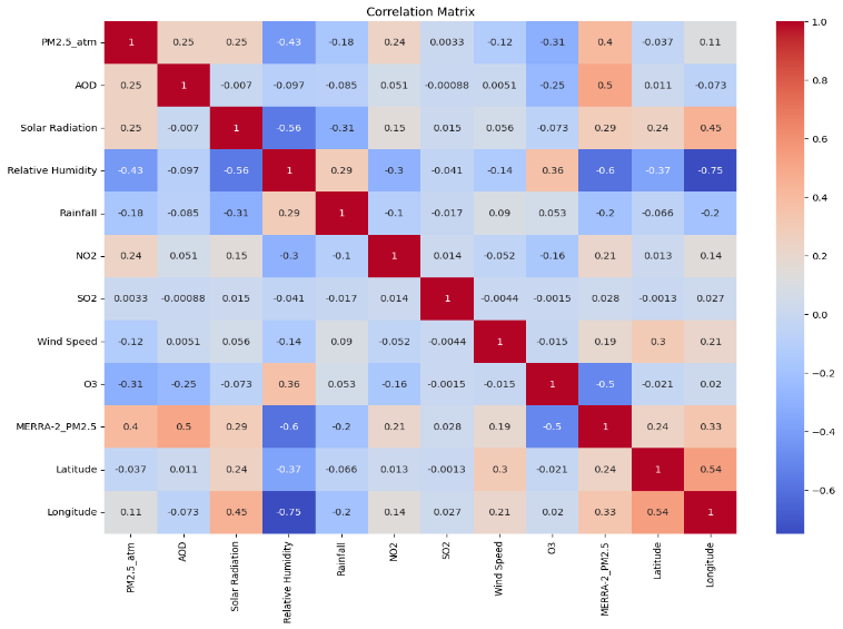
Accurate estimation of surface PM2.5 across Nigeria remains challenging because satellite AOD and global reanalysis products alone cannot adequately represent near-surface particulate concentrations owing to complex aerosol-meteorology interactions, regional transport, and limited ground observations for calibration. This study addresses these limitations by developing a multi-source data fusion framework based on the Random Forest (RF) algorithm that integrates low-cost sensor measurements, satellite observations, atmospheric composition, meteorological variables, and reanalysis data to improve PM2.5 estimation. Ground-based observations from Purple Air and Clarity sensors were combined with satellite-derived aerosol optical depth, atmospheric trace gases, meteorological variables, and MERRA-2 reanalysis products. The RF model was trained and evaluated using a spatial cross-validation (leave location out) framework and assessed using RMSE, MAE, coefficient of determination (R²), Index of Agreement (IOA), and correlation coefficient. The RF model consistently outperformed MERRA-2 across all monitoring stations, yielding substantially lower prediction errors (RMSE: 14-35 µg m⁻³ versus 30-126 µg m⁻³; MAE: 9-31 µg m⁻³ versus 18-89 µg m⁻³) and stronger agreement with observations (IOA up to 0.68). Whereas MERRA-2 produced large negative R² values at several locations, the RF model achieved improved predictive performance, including a positive R² of 0.29 in Lagos and higher correlation coefficients across most stations. Feature importance analysis identified relative humidity as the dominant predictor, followed by MERRA-2 PM2.5, O3, NO2, and AOD, highlighting the combined influence of aerosol hygroscopic growth, atmospheric chemistry, and regional transport. These findings demonstrate that multi-source machine learning data fusion substantially improves surface PM2.5 estimation over Nigeria with scalable framework...
References
Abuouelezz, W., Ali, N., Aung, Z., Altunaiji, A., Shah, S. B., & Gliddon, D. (2025). Exploring PM2.5 and PM10 ML forecasting models: A comparative study in the UAE. Scientific Reports, 15(1), 9797. https://doi.org/10.1038/s41598-025-94013-1
Aladodo, S. S., Akoshile, C. O., Ajibola, T. B., Sani, M., Iborida, O. A., & Fakoya, A. A. (2022). Seasonal Tropospheric Aerosol Classification Using AERONET Spectral Absorption Properties in African Locations. Aerosol Science and Engineering, 6(3), 246–266. https://doi.org/10.1007/s41810-022-00140-x
Alani, R. A., Ayejuyo, O. O., Akinrinade, O. E., Badmus, G. O., Festus, C. J., Ogunnaike, B. A., & Alo, B. I. (2019). The level PM2.5 and the elemental compositions of some potential receptor locations in Lagos, Nigeria. Air Quality, Atmosphere & Health, 12(10), 1251–1258. https://doi.org/10.1007/s11869-019-00743-3
Amegah, A. K., & Agyei-Mensah, S. (2017). Urban air pollution in Sub-Saharan Africa: Time for action. Environmental Pollution, Part A, 220, 738–743. https://doi.org/10.1016/j.envpol.2016.09.042.
Amooli, J. A., Hackman, K. O., Nana, B., & Westervelt, D. M. (2024). Fine particulate air pollution estimation in Ouagadougou using satellite aerosol optical depth and meteorological parameters. Environmental Science: Atmospheres, 4(9), 1012–1025. https://doi.org/10.1039/D4EA00057A
Ardon-Dryer, K., Dryer, Y., Williams, J. N., & Moghimi, N. (2020). Measurements of PM2.5 with PurpleAir under atmospheric conditions. Atmospheric Measurement Techniques, 13(10), 5441–5458. https://doi.org/10.5194/amt-13-5441-2020
Awokola, B. I., Okello, G., Dobson, R., Amusa, G. A., Johnson, O., Erhart, A., Mortimer, K., Jewell, C., Semple, S., & Ma3 Study Group. (2022). Measuring Air Quality for Advocacy in Africa (MA3): Ambient PM 2.5 Concentrations Over One-Year in 15 Locations in Eight Sub-Saharan African Countries Using Low-Cost Sensors. D25. The View Ahead: Exposure Assessment, Communication, And Early Life Impact, A5170–A5170. https://doi.org/10.1164/ajrccm-conference.2022.205.1_MeetingAbstracts.A5170
Awokola, B., Okello, G., Johnson, O., Dobson, R., Ouédraogo, A. R., Dibba, B., Ngahane, M., Ndukwu, C., Agunwa, C., Marangu, D., Lawin, H., Ogugua, I., Eze, J., Nwosu, N., Ofiaeli, O., Ubuane, P., Osman, R., Awokola, E., Erhart, A., … Semple, S. (2022). Longitudinal Ambient PM2.5 Measurement at Fifteen Locations in Eight Sub-Saharan African Countries Using Low-Cost Sensors. Atmosphere, 13(10), 1593. https://doi.org/10.3390/atmos13101593
Breiman, L. (2001). Random Forests (Machine Learning, Vol. 45). Kluwer Academic Publishers.
Buchard, V., Da Silva, A. M., Colarco, P. R., Darmenov, A., Randles, C. A., Govindaraju, R., Torres, O., Campbell, J., & Spurr, R. (2015). Using the OMI aerosol index and absorption aerosol optical depth to evaluate the NASA MERRA Aerosol Reanalysis. Atmospheric Chemistry and Physics, 15(10), 5743–5760. https://doi.org/10.5194/acp-15-5743-2015
Buchard, V., Randles, C. A., Da Silva, A. M., Darmenov, A., Colarco, P. R., Govindaraju, R., Ferrare, R., Hair, J., Beyersdorf, A. J., Ziemba, L. D., & Yu, H. (2017). The MERRA-2 Aerosol Reanalysis, 1980 Onward. Part II: Evaluation and Case Studies. Journal of Climate, 30(17), 6851–6872. https://doi.org/10.1175/JCLI-D-16-0613.1
Castell, N., Dauge, F. R., Schneider, P., Vogt, M., Lerner, U., Fishbain, B., Broday, D., & Bartonova, A. (2017). Can commercial low-cost sensor platforms contribute to air quality monitoring and exposure estimates? Environment International, 99, 293–302. https://doi.org/10.1016/j.envint.2016.12.007
Chen, Z.-Y., Zhang, T.-H., Zhang, R., Zhu, Z.-M., Ou, C.-Q., & Guo, Y. (2018). Estimating PM2.5 concentrations based on non-linear exposure-lag-response associations with aerosol optical depth and meteorological measures. Atmospheric Environment, 173, 30–37. https://doi.org/10.1016/j.atmosenv.2017.10.055
Colarco, P., Silva, A. da, Chin, M., & Diehl, T. (2010). Online simulations of global aerosol distributions in the NASA GEOS‐4 model and comparisons to satellite and ground‐based aerosol optical depth. Journal Of Geophysical Research, 115(D14207). https://doi.org/10.1029/2009JD012820
Di, Q., Amini, H., Shi, L., Kloog, I., Silvern, R., Kelly, J., Sabath, M. B., Choirat, C., Koutrakis, P., Lyapustin, A., Wang, Y., Mickley, L. J., & Schwartz, J. (2019). An ensemble-based model of PM2.5 concentration across the contiguous United States with high spatiotemporal resolution. Environment International, 130, 104909. https://doi.org/10.1016/j.envint.2019.104909
Emery, C., Liu, Z., Russell, A. G., Odman, M. T., Yarwood, G., & Kumar, N. (2017). Recommendations on statistics and benchmarks to assess photochemical model performance. Journal of the Air & Waste Management Association, 67(5), 582–598. https://doi.org/10.1080/10962247.2016.1265027
Gelaro, R., McCarty, W., Suárez, M. J., Todling, R., Molod, A., Takacs, L., Randles, C. A., Darmenov, A., Bosilovich, M. G., Reichle, R., Wargan, K., Coy, L., Cullather, R., Draper, C., Akella, S., Buchard, V., Conaty, A., Da Silva, A. M., Gu, W., … Zhao, B. (2017). The Modern-Era Retrospective Analysis for Research and Applications, Version 2 (MERRA-2). Journal of Climate, 30(14), 5419–5454. https://doi.org/10.1175/JCLI-D-16-0758.1
Geng, G., Xiao, Q., Liu, S., Liu, X., Cheng, J., Zheng, Y., Tong, D., Zheng, B., Peng, Y., Huang, X., He, K., & Zhang, Q. (2021). Tracking Air Pollution in China: Near Real-Time PM2.5 Retrievals from Multiple Data Sources. Atmospheric and Oceanic Physics. https://doi.org/10.48550/arXiv.2103.06520
Gupta, P., Khan, M., da Silva, A., & Patadia, F. (2013). MODIS aerosol optical depth observations over urban areas in Pakistan: Quantity and quality of the data for air quality monitoring. Atmospheric Pollution Research, 4(1), 43–52. https://doi.org/10.5094/apr.2013.005
Hammer, M. S., Van Donkelaar, A., Li, C., Lyapustin, A., Sayer, A. M., Hsu, N. C., Levy, R. C., Garay, M. J., Kalashnikova, O. V., Kahn, R. A., Brauer, M., Apte, J. S., Henze, D. K., Zhang, L., Zhang, Q., Ford, B., Pierce, J. R., & Martin, R. V. (2020). Global Estimates and Long-Term Trends of Fine Particulate Matter Concentrations (1998–2018). Environmental Science & Technology, 54(13), 7879–7890. https://doi.org/10.1021/acs.est.0c01764
Horowitz, H. M., Garland, R. M., Thatcher, M., Landman, W. A., Dedekind, Z., Van Der Merwe, J., & Engelbrecht, F. A. (2017). Evaluation of climate model aerosol seasonal and spatial variability over Africa using AERONET. Atmospheric Chemistry and Physics, 17(22), 13999–14023. https://doi.org/10.5194/acp-17-13999-2017
Idris, M., Sani, M., & Aliyu, R. (2025). Comparison OF Particulate Matter (PM2.5) Ground Data And Satellite Data in Kano State, Nigeria. Fudma Journal of Sciences (FJS), 9(12), 621–628. https://doi.org/10.33003/fjs-2025-0912-4318
Jenkins, G. S., Freire, S. M., Ogunro, T., Niang, D., Andrade, M., Drame, M. S., Huvi, J. B., Pires, E. E. S., Toure, E. N., & Camara, M. (2023). COVID‐19 New Cases and Environmental Factors During Wet and Dry Seasons in West and Southern Africa. GeoHealth, 7(8), e2022GH000765. https://doi.org/10.1029/2022GH000765
Kelly, K. E., Whitaker, J., Petty, A., Widmer, C., Dybwad, A., Sleeth, D., Martin, R., & Butterfield, A. (2017). Ambient and laboratory evaluation of a low-cost particulate matter sensor. Environmental Pollution, 221, 491–500. https://doi.org/10.1016/j.envpol.2016.12.039.
Knippertz, P., & Todd, M. C. (2012). Mineral dust aerosols over the Sahara: Meteorological controls on emission and transport and implications for modeling. Reviews of Geophysics, 50(1), 2011RG000362. https://doi.org/10.1029/2011RG000362
Kunjir, G. M., Tikle, S., Das, S., Karim, M., Roy, S. K., & Chatterjee, U. (2025). Assessing particulate matter (PM2.5) concentrations and variability across Maharashtra using satellite data and machine learning techniques. Discover Sustainability, 6(1), 238. https://doi.org/10.1007/s43621-025-01082-3
Liousse, C., Assamoi, E., Criqui, P., Granier, C., & Rosset, R. (2014). Explosive growth in African combustion emissions from 2005 to 2030. Environmental Research Letters, 9(3), 035003. https://doi.org/10.1088/1748-9326/9/3/035003
Malings, C., Knowland, K. E., Keller, C. A., & Cohn, S. E. (2021). Sub‐City Scale Hourly Air Quality Forecasting by Combining Models, Satellite Observations, and Ground Measurements. Earth and Space Science, 8(7), e2021EA001743. https://doi.org/10.1029/2021EA001743
Malings, C., Westervelt, D. M., Hauryliuk, A., Presto, A. A., Grieshop, A., Bittner, A., Beekmann, M., & R. Subramanian. (2020). Application of low-cost fine particulate mass monitors to convert satellite aerosol optical depth to surface concentrations in North America and Africa. Atmospheric Measurement Techniques, 13(7), 3873–3892. https://doi.org/10.5194/amt-13-3873-2020
Marais, E. A., & Wiedinmyer, C. (2016). Air Quality Impact of Diffuse and Inefficient Combustion Emissions in Africa (DICE-Africa). 4(50(19)), 10739–10745. https://doi.org/10.1021/acs.est.6b02602
Mathew, A., Gokul, P. R., Raja Shekar, P., Arunab, K. S., Ghassan Abdo, H., Almohamad, H., & Abdullah Al Dughairi, A. (2023). Air quality analysis and PM2.5 modelling using machine learning techniques: A study of Hyderabad city in India. Cogent Engineering, 10(1), 2243743. https://doi.org/10.1080/23311916.2023.2243743
Muhammad, N. A. A. A., & Ahmad, M. Y. (2025). PM2.5 Concentration Prediction Model in Jakarta Area Using Random Forest Algorithm. Journal of Computation Physics and Earth Science, 5(1), 31–39. https://journal.physan.org/index.php/jocpes/index
Nobell, S., Majumdar, A., Mukherjee, S., Chakraborty, S., Chatterjee, S., Bose, S., Dutta, A., Sethuraman, S., Westervelt, D., Sengupta, S., Basu, R., & McNeill, V. F. (2023). Validation of In-field Calibration for Low-Cost Sensors Measuring Ambient Particulate Matter in Kolkata, India [Preprint]. Chemistry. https://doi.org/10.26434/chemrxiv-2023-8lhrq-v2
Ogunjobi, K. O., & Awoleye, P. O. (2019). Intercomparison and Validation of Satellite and Ground-Based Aerosol Optical Depth (AOD) Retrievals over Six AERONET Sites in West Africa. Aerosol Science and Engineering, 3(1), 32–47. https://doi.org/10.1007/s41810-019-00040-7
Ouarma, I., Nana, B., Haro, K., Béré, A., & Koulidiati, J. (2020). Assessment of Pollution Levels of Suspended Particulate Matter on an Hourly and a Daily Time Scale in West African Cities: Case Study of Ouagadougou (Burkina Faso). Journal of Geoscience and Environment Protection, 08(11), 119–138. https://doi.org/10.4236/gep.2020.811007
Pedregosa, F., Varoquaux, G., Gramfort, A., Michel, V., Thirion, B., Grisel, O., Blondel, M., Prettenhofer, P., Weiss, R., Dubourg, V., Vanderplas, J., Passos, A., & Cournapeau, D. (2011). Scikit-learn: Machine Learning in Python. Machine Learning in Python.
Pendergrass, D. C., Zhai, S., Kim, J., Koo, J.-H., Lee, S., Bae, M., Kim, S., Liao, H., & Jacob, D. J. (2022). Continuous mapping of fine particulate matter (PM2.5) air quality in East Asia at daily 6 × 6 km2 resolution by application of a random forest algorithm to 2011–2019 GOCI geostationary satellite data. Atmospheric Measurement Techniques, 15(4), 1075–1091. https://doi.org/10.5194/amt-15-1075-2022
Petkova, E., Jack, D. W., Volavka-Close, N. H., & Kinney, P. L. (2013). Particulate matter pollution in African cities. Air Quality, Atmosphere and Health, 6, 603–614. https://doi.org/10.1007/s11869-013-0199-6
Ploton, P., Mortier, F., Réjou-Méchain, M., Barbier, N., Picard, N., Rossi, V., Dormann, C., Cornu, G., Viennois, G., Bayol, N., Lyapustin, A., Gourlet-Fleury, S., & Pélissier, R. (2020). Spatial validation reveals poor predictive performance of large-scale ecological mapping models. Nature Communications, 11(1), 4540. https://doi.org/10.1038/s41467-020-18321-y
Prospero, J. M., Ginoux, P., Torres, O., Nicholson, S. E., & Gill, T. E. (2002). Environmental Characterization Of Global Sources of Atmospheric Soil Dust Identified With The Nimbus 7 Total Ozone Mapping Spectrometer (TOMS) Absorbing Aerosol PRODUCT. Reviews of Geophysics, 40(1). https://doi.org/10.1029/2000RG000095
Raheja, G., Nimo, J., Appoh, E. K.-E., Essien, B., Sunu, M., Nyante, J., Amegah, M., Quansah, R., Arku, R. E., Penn, S. L., Giordano, M. R., Zheng, Z., Jack, D., Chillrud, S., Amegah, K., Subramanian, R., Pinder, R., Appah-Sampong, E., Tetteh, E. N., … Westervelt, D. M. (2023). Low-Cost Sensor Performance Intercomparison, Correction Factor Development, and 2+ Years of Ambient PM 2.5 Monitoring in Accra, Ghana. Environmental Science & Technology, 57(29), 10708–10720. https://doi.org/10.1021/acs.est.2c09264
Randles, C. A., Da Silva, A. M., Buchard, V., Colarco, P. R., Darmenov, A., Govindaraju, R., Smirnov, A., Holben, B., Ferrare, R., Hair, J., Shinozuka, Y., & Flynn, C. J. (2017). The MERRA-2 Aerosol Reanalysis, 1980 Onward. Part I: System Description and Data Assimilation Evaluation. Journal of Climate, 30(17), 6823–6850. https://doi.org/10.1175/JCLI-D-16-0609.1
Rienecker, M. M., Suarez, M. J., Gelaro, R., Todling, R., Bacmeister, J., Liu, E., Bosilovich, M. G., Schubert, S. D., Takacs, L., Kim, G.-K., Bloom, S., Chen, J., Collins, D., Conaty, A., Da Silva, A., Gu, W., Joiner, J., Koster, R. D., Lucchesi, R., … Woollen, J. (2011). MERRA: NASA’s Modern-Era Retrospective Analysis for Research and Applications. Journal of Climate, 24(14), 3624–3648. https://doi.org/10.1175/JCLI-D-11-00015.1
Roberts, D. R., Bahn, V., Ciuti, S., Boyce, M. S., Elith, J., Guillera-Arroita, G., Wintle, B. A., Hartig, F., & Dormann, C. F. (2017). Ecography—2016—Roberts—Cross‐validation strategies for data with temporal spatial hierarchical or phylogenetic.pdf. Ecography, 40, 913–929. https://doi.org/10.1111/ecog.02881
Sayeed, A., Lin, P., Gupta, P., Tran, N. N. M., Buchard, V., & Christopher, S. (2022). Hourly and Daily PM2.5 Estimations Using MERRA‐2: A Machine Learning Approach. Earth and Space Science, 9(11), e2022EA002375. https://doi.org/10.1029/2022EA002375
Sharafa, S. B., Aliyu, R., Ibrahim, B. B., Tijjani, B. I., Darma, T. H., Gana, U. M., Ayedun, F., & Sulu, H. T. (2020). Model prediction and climatology of aerosol optical depth (τ550) and angstrom exponent (α470-660) over three aerosol robotic network stations in Sub-Saharan Africa using moderate resolution imaging spectroradiometer data. Nigerian Journal of Technology, 39(1), 255–268. https://doi.org/10.4314/njt.v39i1.29
Suriano, D., Akinnusotu, A., Abulude, F. O., & Oluwagbayide, S. D. (2024). Assessment of Particulate Matter (PM2.5) and Air Quality Index (AQI) in Eight Locations of Lagos State, Nigeria. https://doi.org/10.20944/preprints202409.1991.v1
Van Donkelaar, A., Martin, R. V., Brauer, M., Hsu, N. C., Kahn, R. A., Levy, R. C., Lyapustin, A., Sayer, A. M., & Winker, D. M. (2016). Global Estimates of Fine Particulate Matter using a Combined Geophysical-Statistical Method with Information from Satellites, Models, and Monitors. Environmental Science & Technology, 50(7), 3762–3772. https://doi.org/10.1021/acs.est.5b05833
Van Donkelaar, A., Martin, R. V., & Park, R. J. (2006). Estimating ground-level PM 2.5 using aerosol optical depth determined from satellite remote sensing. Journal of Geophysical Research, 111(D21), D21201. https://doi.org/10.1029/2005JD006996
Vignesh, P. P., Jiang, J. H., & Kishore, P. (2023). Predicting PM2.5 Concentrations Across USA Using Machine Learning. Earth and Space Science, 10(10), e2023EA002911. https://doi.org/10.1029/2023EA002911
Wilks, D. S. (2006). Statistical methods in the atmospheric sciences (2nd ed). Academic Press.
Willmott, C. J. (1981). ON THE VALIDATION OF MODELS. Physical Geography, 2(2), 184–194. https://doi.org/10.1080/02723646.1981.10642213
Willmott, C., & Matsuura, K. (2005). Advantages of the mean absolute error (MAE) over the root mean square error (RMSE) in assessing average model performance. Climate Research, 30, 79–82. https://doi.org/10.3354/cr030079
Yahaya, T., Umar, F. M., Zanna, A. M., Abdulmalik, A., Ibrahim, B. A., Bilyaminu, M., & Joseph, A. (2023). Concentrations and health risks of particulate matter (PM2.5) and associated elements in the ambient air of Lagos, Southwestern Nigeria. Bio-Research, 21(3), 2141–2149. https://doi.org/10.4314/br.v21i3.9
Yan, X., Shi, W., Li, Z., Li, Z., Nana, L., Wenji, Z., Wang, H., & Yu, X. (2017). Satellite-based PM2.5 estimation using fine-mode aerosol optical thickness over China. Atmospheric Environment, 170, 290–302. https://doi.org/10.1016/j.atmosenv.2017.09.023.
Zhang, D., Du, L., Wang, W., Zhu, Q., Bi, J., Scovronick, N., Naidoo, M., Garland, R. M., & Liu, Y. (2021). A machine learning model to estimate ambient PM2.5 concentrations in industrialized highveld region of South Africa. Remote Sensing of Environment, 266, 112713. https://doi.org/10.1016/j.rse.2021.112713
Zhang, Y., Li, Z., Bai, K., Wei, Y., Xie, Y., Zhang, Y., Hong, J., Xu, H., Guang, J., Lv, Y., Li, K., & Li, D. (2021). Satellite remote sensing of atmospheric particulate matter mass concentration: Advances, challenges, and perspectives. Fundamental Research, 1(3), 240–258. https://doi.org/10.1016/j.fmre.2021.04.007
Zhou, Q., Nizamani, M. M., Zhang, H.-Y., & Zhang, H.-L. (2023). The Air We Breathe: An In-Depth Analysis of PM2.5 Pollution in 1312 Cities from 2000 to 2020. 4. https://doi.org/10.21203/rs.3.rs-2740958/v1
Downloads
Published
Issue
Section
Categories
License
Copyright (c) 2026 Muawiya Sani, Anas Houdou, Rabia Salihu Sa'id

This work is licensed under a Creative Commons Attribution 4.0 International License.


