
COMPARISON OF PARTICULATE MATTER (PM2.5) GROUND DATA AND SATELLITE DATA IN KANO STATE, NIGERIA
DOI:
https://doi.org/10.33003/fjs-2025-0912-4318Keywords:
Ground-based measurements, Harmattan (dry season), Meteorological parameters particulate matter, Satellite-derived dataAbstract
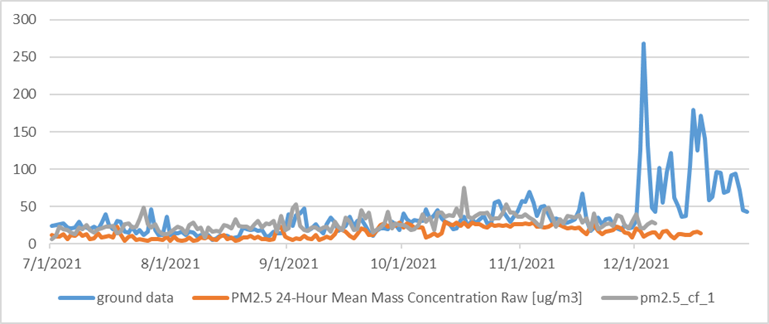
Air pollution, particularly fine particulate matter (PM₂.₅), poses significant environmental and health risks. This study compares satellite-derived PM₂.₅ data with ground-based measurements at different heights (2m, 5m, and 10m) to evaluate their accuracy and seasonal variations. Results indicate that during the dry season (Harmattan), PM₂.₅ concentrations reached 270 µg/m³, 117.11µg/m³ and 90µg/m³ highlighting increased pollution due to dust transport and atmospheric stability. In contrast, during the rainy season, PM₂.₅ levels dropped significantly to 6.59µg/m³, 12.5µg/m³, 14.2µg/m³ and 15.42µg/m³ demonstrating the effect of wet deposition. The study underscores the importance of integrating satellite and ground-based PM₂.₅ data for accurate air quality assessments and policy-making. It delves into the effects of particulate matter, sources of particulate matter on satellite data and elucidates meteorology and meteorological parameters used for describing and quantifying atmospheric conditions.
References
REFERENCES
Adejuwon, J. O. (2004). Climate and vegetation in Nigeria. Journal of Agricultural and Rural Development, 2(1), 1-13.
Arowosegbe, A., Adekunle, A., & Ojo, T. (2024). Seasonal variability of PM₂.₅ and meteorological influences in Minna, Nigeria. International Journal of Environmental Sciences, 15(3), 78-92.
Buchhorn, M., Dierckx, S., & Dufour, F. (2020). Sentinel-3 products for air quality monitoring. Copernicus Atmosphere Monitoring Service. https://www.copernicus.eu/en
Cai, S., Lu, X., & Song, Y. (2020). Estimating aerosol optical depth and fine particulate matter (PM 2.5) from satellite data: A review. Science of the Total Environment, 712, 136611. https://doi.org/10.1016/j.scitotenv.2019.136611
Cao, J., Xu, B., & Zhang, L. (2020). Satellite-based monitoring of PM 2.5 using aerosol optical depth. Environmental Pollution, 266, 115094. https://doi.org/10.1016/j.envpol.2020.115094
Cheng, T., Chen, C., & Xu, L. (2018). Air quality monitoring from satellite: Challenges and applications. Remote Sensing, 10(12), 2006. https://doi.org/10.3390/rs10122006
Cohen, A. J., Brauer, M., & Burnett, R. (2017). Estimates and 25-year trends of the global burden of disease attributable to ambient air pollution: An analysis of data from the Global Burden of Diseases Study. The Lancet, 389(10082), 1907–1918. https://doi.org/10.1016/S0140-6736(17)30505-6.
Dey, S., & Di Girolamo, L. (2018). Aerosol optical depth retrieval from satellite measurements: Advances and challenges. Remote Sensing, 10(7), 1121. https://doi.org/10.3390/rs10071121
Eck, T. F., Holben, B. N., Sinyuk, A., Pinker, R. T., Goloub, P., Chen, H., … Xia, X. (2010). Climatological aspects of the optical properties of fine/coarse mode aerosol mixtures. Journal of Geophysical Research Atmospheres, 115(19).
Gao, Y., Wang, Z., & Zhang, W. (2015). Monitoring aerosol optical depth and PM 2.5 concentrations from satellite: A case study in China. Environmental Science & Technology, 49(16), 9899–9906. https://doi.org/10.1021/acs.est.5b02444
Google Map (2025). Map of Kano State Nigeria. https://maps.app.goo.gl/W1qwbmrkrm2o9mv96.
Han, Y., Zheng, Y., & Wang, X. (2019). Long-term trends of PM 2.5 concentrations: Satellite-based estimates. Atmospheric Chemistry and Physics, 19(4), 2485–2497. https://doi.org/10.5194/acp-19-2485-2019
He, J., Wang, Y., & Zhang, X. (2020). Recent advances in continuous PM 2.5 monitoring techniques: A review. Science of the Total Environment, 732, 139315. https://doi.org/10.1016/j.scitotenv.2020.139315
Holben, N., Tanr, D., Smirnov, A., Eck, T. F., Slutsker, I., Newcomb, W. W. & Zibordi, G. (2001). An emerging ground-based aerosol climatology: Aerosol optical depth from AERONET. 106(Dll).
Idris, M., Muhammad, G.A., Said, R.S and Akpootu, O.D. (2022) “Effect of Meteorological Parameters on the Dispersion of Vehicular Emission in some Selected Areas in Kano State-Nigeria” Bayero Journal of Pure and Applied Sciences, Volume13, No.1, pp517-524, ISSN: 2006-6996
Idris, M., Darma, T.H., Koki, F.S., Suleiman, A., Ali, M.H., Yarima, S.U. and Aliyu, A. (2020) “An analysis of air Pollution at some Industrial areas of Kano using the AERMOD model” Bayero Journal of Pure and Applied Sciences (BAJOPAS), Special Conference Edition Volume12, No.1, pp117-127, ISSN: 2006-6996, https://doi.org/10.4314/bajopas.v12i1.20S.
Koelemeijer, R. B. A. Ã., Homan, C. D., & Matthijsen, J. (2006). Comparison of spatial and temporal variations of aerosol optical thickness and particulate matter over Europe. 40, 5304–5315. https://doi.org/10.1016/j.atmosenv.2006.04.044
Lawal, H.A., Muhammad, M.I. & Bulus, I. (2023). Atmosphere Hemispheric Analysis of Particulates Pollution over Africa. FUDMA Journal of Sciences 7(4), 272-277. https://doi.org/10.33003/fjs-2023-0704-1924.
Lazrak, N., Zahir, J., & Mousannif, H. (2019). Air Quality Monitoring Using Deterministic and Statistical Methods. https://doi.org/10.1007/978-3-030-12048-1
Li, B., Hou, L., Delta, Y. R., & Area, B. (2015). Discuss On Satellite-Based Particulate Matter Monitoring. Xl(May), 11–15. https://doi.org/10.5194/isprsarchives-XL-7-W3-219-2015
Liu, Y., Xia, Y., & Yin, X. (2019). Exposure to PM 2.5 and human health: A review of the global and regional health risks. Environmental Pollution, 254, 113037. https://doi.org/10.1016/j.envpol.2019.113037
Liu, Y., Sarnat, J. A., Coull, B. A., Koutrakis, P., & Jacob, D. J. (2004). Validation of Multiangle Imaging Spectroradiometer (MISR) aerosol optical thickness measurements using Aerosol Robotic Network (AERONET) observations over the contiguous United States. Journal of Geophysical Research: Atmospheres, 109(6), 1–9. https://doi.org/10.1029/2003jd003981
Muhammad, M. Said, R.S, Tijjani B.I., Idris, M., Sani, M. (2022). Investigating the effect of altitude and meteorological parameters on the concentration of particulate matter at an urban area of Kano state, Nigeria. Bayero journal of pure and applied sciences, 13(1): 400 – 408, ISSN 2006 – 6996. http://dx.doi.org/10.4314/bajopas.v13i1.61s.
Musa, A. (2010). Principles of Photovoltaic Energy Conversion. Ahmadu Bello University Press Limited, Zaria.
Ostro, B. D., Broadwin, R., & Green, S. (2019). Fine particulate air pollution and mortality in 20 US cities: A report from the American Cancer Society. Environmental Health Perspectives, 127(10), 107009. https://doi.org/10.1289/EHP4747
Okoro, C. A., Nwankwo, E. O., & Eke, P. C. (2019). Assessment of PM₂.₅ and PM₁₀ concentrations in Port Harcourt: Meteorological influences. Journal of Atmospheric Pollution Research, 10(2), 157-169.
Olatunde, J. A., & Adedeji, A. (2022). Effects of seasonal variation on air quality: A case study of Akure, Southwestern Nigeria. Atmospheric Science Journal, 14(7), 543-558.
Ouedraogo, S., Kouadio, A., & Mensah, A. (2024). Long-term variability of PM₂.₅ concentrations in Abidjan and Accra: The role of Harmattan dust transport. Environmental Advances, 12, 104-118.
Shaibu, S., & Weli, V. (2017). Satellite-based assessment of PM₂.₅ distribution in the Niger Delta region. International Journal of Research in Environmental Science, 3(2), 1-12.
Xu, X., & Id, C. Z. (2020). Concentration using MODIS AOD and corrected regression model over Beijing, 1–15. https://doi.org/10.1371/journal.pone.0240430
Zhang, L., Nin, Y., Ghau, F. (2021). Validation of satellite-derived PM2.5 estimates over different regions. Atmospheric Research, 248, 105213.
Downloads
Published
Issue
Section
Categories
License
Copyright (c) 2025 Maryam Idris, Muawiya Sani, Rakiya Aliyu

This work is licensed under a Creative Commons Attribution 4.0 International License.


