
Seroprevalence and Influences of Echinococcus granulosus infection among owned dogs in Lokoja, Kogi State, Nigeria
DOI:
https://doi.org/10.33003/fjs-2026-1011-5516Keywords:
Echinococcus granulosus sensu lato, Seroprevalence, Dogs, NigeriaAbstract
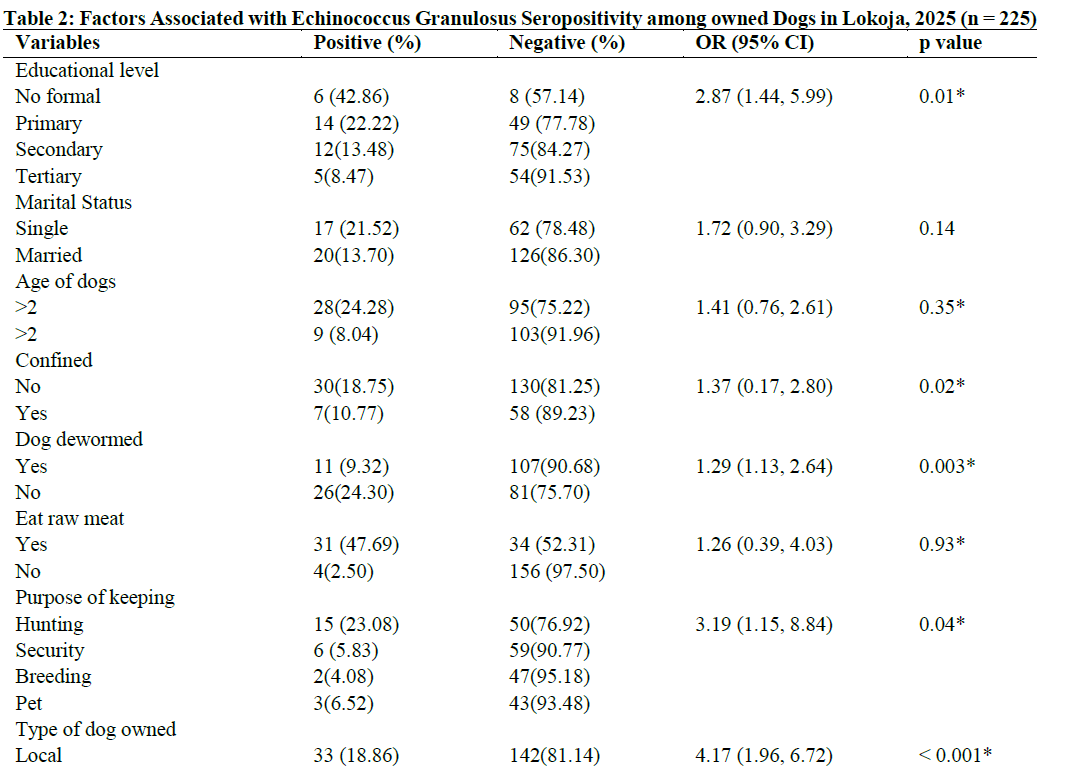
Human beings acquire cystic echinococcosis via fortuitous ingestion of Echinococcus granulosus (EG) eggs introduced into the surrounding by infected dogs. This research aimed to find out the presence of EG antibodies and the influencing factors responsible for their prevalence in owned dogs in Lokoja, Kogi State, Nigeria. Serum was extracted from the whole blood collected from 225 dogs within Lokoja metropolis were analyzed by indirect ELISA. The data on the demography, environmental factors and management of the dogs was obtained through a questionnaire administered to owners. Data were analyzed using descriptive statistics, univariate analysis, and logistic regression at α 0.05. The seroprevalence of Echinococcus granulosus infection was found to be 16.44% (37/225). Significant risk factors associated with seropositivity included poor educational background of dog owners [Odd Ratio (OR): 2.87; 95% CI: 1.44–5.99], native dog breeds (OR: 4.17; 95% CI: 1.96–6.72), range management system (OR: 1.37; 95% CI: 0.17–2.80), and deworming status, with dogs that were either inadequately dewormed or never dewormed showing increased risk (OR: 1.29; 95% CI: 1.13–2.64). Our findings indicate that local breeds generally receive less care compared to exotic breeds, and the absence of proper deworming practices constitutes a major driver of transmission. These factors may serve as predictors of E. granulosus seropositivity in the study area. Our study provides evidence of E.gronulosus infection in owned dogs, especially in those medicated by owners. Deworming practices should be based on the recommendations of a veterinarian to effectively prevent EG transmission from dogs to humans.
References
Abdel-Moein, K. A., Hamza, D. A. (2016). Norway rat (Rattus norvegicus) as a potential reservoir for Echinococcus granulosus: A public health implication. Acta Parasitologica, 61(4), 815–819. https://doi.org/10.1515/ap-2016-0110
Acosta-Jamett, G., Weitzel, T., Boufana, B., Adones, C., Bahamonde, A., Abarca, K., Craig, P. S., & Reiter-Owona, I. (2014). Prevalence and risk factors for echinococcal infection in a rural area of northern Chile: A household-based cross-sectional study. PLoS Neglected Tropical Diseases, 8(6), e3090. https://doi.org/10.1371/journal.pntd.0003090 (doi.org in Bing).
Adebudo, L. I., Ndiaye, S., Ajayi, I., Olugasa, B. O., Bonelli, P., & Awosanya, E. J. (2023). Seroprevalence and determinants of Echinococcus granulosus sensu lato infection among owned dogs in Ibadan, Nigeria. Journal of Infection in Developing Countries, 17(12), 1814–1820. https://doi.org/10.3855/jidc.18518
Adediran, O. A., Kolapo, T. U., & Uwalaka, E. C. (2014). Echinococcus granulosus prevalence in dogs in southwest Nigeria. Journal of Parasitological Research, 2014, Article 124358. https://doi.org/10.1155/2014/124358
Awosanya, E. J., Ligali, Z., Duedu, K. O., Peruzzu, A., Masala, G., & Bonelli, P. (2021). Prevalence of Echinococcus granulosus sensu lato in owned dogs in Lagos State, Nigeria. Veterinary Sciences, 8(6), 101. https://doi.org/10.3390/vetsci8060101.
Budke, C. M., Deplazes, P., & Torgerson, P. R. (2006). Global socioeconomic impact of cystic echinococcosis. Emerging Infectious Diseases, 12(2), 296–303. https://doi.org/10.3201/eid1202.050499
Budke, C. M., Campos-Ponce, M., Qian, W., & Torgerson, P. R. (2005). A canine purgation study and risk factor analysis for echinococcosis in a high endemic region of the Tibetan plateau. Veterinary Parasitology, 127(1), 43–49. https://doi.org/10.1016/j.vetpar.2004.08.024
Deplazes, P., van Knapen, F., Schweiger, A., & Overgaauw, P. A. M. (2011). Role of pet dogs and cats in the transmission of helminthic zoonoses in Europe, with a focus on echinococcosis and toxocarosis. Veterinary Parasitology, 182(1), 41–53. https://doi.org/10.1016/j.vetpar.2011.07.014
Hambolu, S. E., Dzikwi, A. A., Kwaga, J. K., Kazeem, H. M., Umoh, J. U., & Hambolu, D. A. (2014). Dog ecology and population studies in Lagos State, Nigeria. Global Journal of Health Science, 6(2), 209–220. https://doi.org/10.5539/gjhs.v6n2p209 (doi.org in Bing)
Liu, C. N., Xu, Y. Y., Cadavid-Restrepo, A. M., Lou, Z. Z., Yan, H. B., Li, L., Fu, B., Gray, D. J., Clements, A. A., Barnes, T. S., & Jia, W. Z. (2018). Estimating the prevalence of Echinococcus granulosus in domestic dogs in highly endemic areas for echinococcosis. Infectious Diseases of Poverty, 7(1), 77. https://doi.org/10.1186/s40249-018-0462-0 (doi.org in Bing)
Mastin, A., Van Kesteren, F., Torgerson, P. R., Ziadinov, I., Mytynova, B., Rogan, M. T., Tursunov, T., & Craig, P. S. (2015). Risk factors for Echinococcus coproantigen positivity in dogs from the Alay Valley, Kyrgyzstan. Journal of Helminthology, 89(6), 655–663. https://doi.org/10.1017/S0022149X15000590
Ohiolei, J. A., Li, L., Ebhodaghe, F., Yan, H. B., Isaac, C., Bo, X. W., Fu, B., & Jia, W. Z. (2020). Prevalence and distribution of Echinococcus spp. in wild and domestic animals across Africa: A systematic review and meta-analysis. Transboundary and Emerging Diseases, 67(6), 2345–2364. https://doi.org/10.1111/tbed.13592
Oluwaseyi, O. (2014). Classification of Ibadan as a city region. Academia.edu. https://www.academia.edu/7911033/Classification_of_Ibadan_As_A_City_Region
Otero-Abad, B., & Torgerson, P. R. (2013). A systematic review of the epidemiology of echinococcosis in domestic and wild animals. PLoS Neglected Tropical Diseases, 7(6), e2249. https://doi.org/10.1371/journal.pntd.0002249
Pal, M., & Dutta, J. B. (2013). Echinococcosis: An emerging and re-emerging cyclozoonosis of global importance. International Journal of Livestock Research, 3(1), 5–13.
Pereira, M. T., Nowaszyk, R., Payan-Carreira, R., Miranda, S., Aslan, S., Kaya, D., & Kowalewski, M. P. (2021). Selected uterine immune events associated with the establishment of pregnancy in the dog. Frontiers in Veterinary Science, 7, 1–16. https://doi.org/10.3389/fvets.2020.613953
Pukuma, M. S., Anaaticha, M., & Nuwanyada, E. (2023). Seroprevalence of human cystic echinococcosis in some local government areas in Adamawa State, Nigeria. Journal of Animal Research International, 20(1), 4827 https://www.ajol.info/index.php/ari/articl/view/247056
Romig, T., Omer, R. A., Zeyhle, E., Hüttner, M., Dinkel, A., Siefert, L., Elmahdi, I. E., Magambo, J., Ocaido, M., Menezes, C. N., Ahmed, M. E., Mbae, C., Grobusch, M. P., & Kern, P. (2011). Echinococcosis in sub-Saharan Africa: Emerging complexity. Veterinary Parasitology, 181(1), 43–47. https://doi.org/10.1016/j.vetpar.2011.04.022 (doi.org in Bing).
Rojo-Vazquez, F. A., Pardo-Lledias, J., Francos-Von Hunefeld, M., Cordero-Sanchez, M., Alamo- Sanz, R., Hernandez-Gonzalez, A., Brunetti, E., & Siles-Lucas, M. (2011). Cystic echinococcosis in Spain: Current situation and relevance for other endemic areas in Europe. PLoS Neglected Tropical Diseases, 5(1), e893. https://doi.org/10.1371/journal.pntd.0000893 (doi.org in Bing).
Thrusfield, M., Christley, R., Brown, H., Diggle, P. J., French, N., Howe, K., Kelly, L., O’Connor, A., Sargeant, J., & Wood, H. (2018). Veterinary epidemiology (pp. 270–295). John Wiley & Sons.
World Health Organization. (2021, May 17). Echinococcosis. World Health Organization. https://www.who.int/news-room/fact-sheets/detail/echinococcosis (who.int in Bing)
WHO (2010) First WHO report on neglected tropical diseases: Working to overcome the global impact of neglected tropical diseases. Available: https://apps.who.int/iris/handle/10665/44440 Accessed: 10 May 2023
Zhang, W., Zhang, Z., Wu, W., Shi, B., Li, J., Zhou, X., Wen, H., & McManus, D. P. (2015). Epidemiology and control of echinococcosis in Central Asia, with particular reference to the People’s Republic of China. Acta Tropica, 141, 235–243. https://doi.org/10.1016/j.actatropica.2014.03.014 (doi.org in Bing) (bing.com in Bing).
Downloads
Published
Issue
Section
Categories
License
Copyright (c) 2026 Jacob Ngwamah, Simon Wilson Barguma, An’aaticha Mathias, Kefas Babale Shitta, Mohammed Nusirudeen Suleiman, Grace O. AboveGodwin, Joy Cecilia Atawodi

This work is licensed under a Creative Commons Attribution 4.0 International License.


