
Influence of Socio-Demographic Characteristics on Attitude of People towards Mental Health Disorders at Abuja Municipal Area Council
DOI:
https://doi.org/10.33003/fjs-2026-1010-5502Keywords:
Influence, Socio-Demographic Characteristics, Mental Health Attitudes, AMAC, NigeriaAbstract
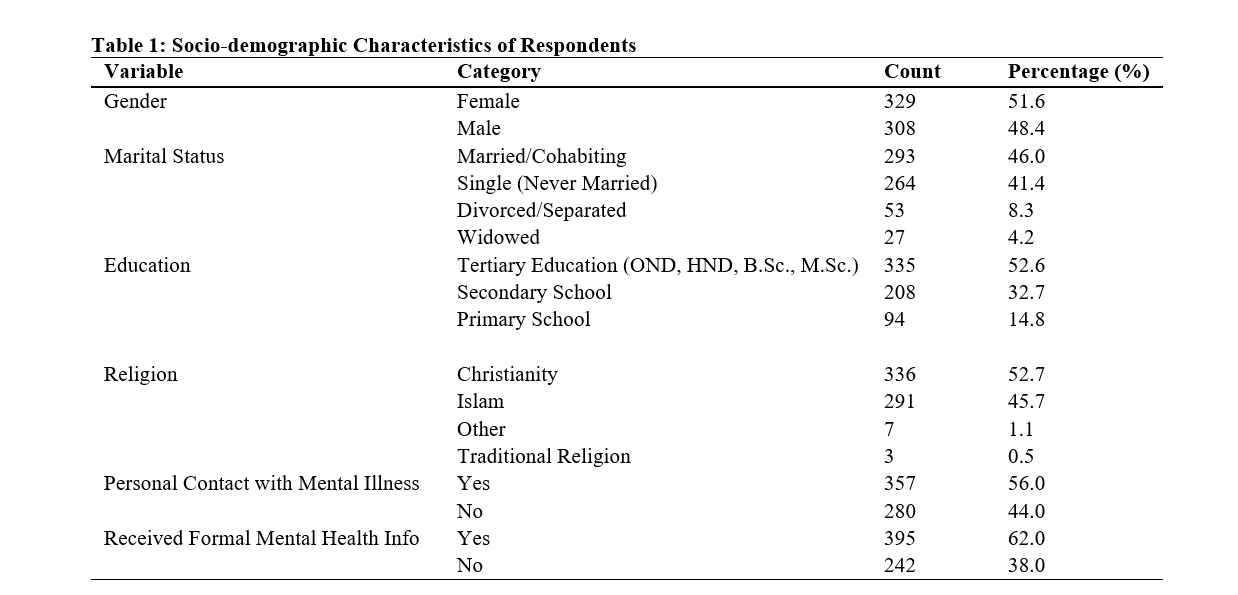
Mental health disorders represent a growing global public health burden, with Low- and Middle-Income Countries bearing a disproportionate share. In Nigeria, an estimated 20–30% of the population live with some form of mental health disorder. The study aims to determine the influence of sociodemographic characteristics on attitude of people towards mental health disorders at AMC. A community-based descriptive cross-sectional design was employed among 640 adult residents of AMAC aged ≥ 18 years, recruited through multistage sampling. A structured, pre-tested, self-administered questionnaire covering mental health awareness, cultural and religious beliefs, attitudes, stigma, and help-seeking intentions was administered. Data were analysed using SPSS with descriptive and inferential statistics; significance was set at p < 0.05. The mean age of respondents was 51.1 years (SD = 19.1), with a slight female majority (51.6%) and 52.6% having tertiary education. Based on the result, the scores in gender (female: 6.00; male: 5.95) as well as the education levels (primary: 6.15; secondary: 6.00; tertiary: 5.92) and ages showed no statistically significant differences (gender: kh2 = 0.10, p = 0.75; education: kh2 = 1.98, p = 0.37; age: F = 0.26, p = 0.91). In a similar fashion, the scores of attitudes did not differ significantly among all demographic groups, with values that were closed around 0.16 and 0.00. These findings underscore the urgent need for culturally sensitive mental health literacy programmes, strategic engagement with religious leaders, and structural interventions to reduce the financial cost of formal mental health services in AMAC.
References
Adewuya, A. O., Abimbola, S., Abdulmalik, J., Shettima, F., Dahiru, A., Oladipo, O. E., Fasawe, A. (2025). A paradox of readiness: Diagnosing strategic implementation gaps for digital mental health in Lagos, Nigeria. International Health, ihaf129. https://doi.org/10.1093/inthealth/ihaf129
Adewuya, A. O., Atilola, O., Ola, B. A., Coker, O. A., Zachariah, M. P., Olugbile, O., Fasawe, A., Idris, O. (2018). Current prevalence, comorbidity and associated factors for symptoms of depression and generalised anxiety in the Lagos State Mental Health Survey (LSMHS), Nigeria. Comprehensive Psychiatry, 81, 60–65. https://doi.org/10.1016/j.comppsych.2017.11.010
Afolabi, L. (2025, June 3). Nigeria's silent epidemic: Mental health crisis grows amid national inaction. Punch Newspapers. https://punchng.com/nigerias-silent-epidemic-mental-health-crisis-grows-amid-national-inaction/
American Psychiatric Association. (2026). Myths and facts about mental health. https://www.psychiatry.org/news-room/apa-blogs/myths-and-facts-about-mental-health
Audu, I. A., Idris, S. H., Olisah, V. O., Sheikh, T. L. (2013). Stigmatization of people with mental illness among inhabitants of a rural community in northern Nigeria. International Journal of Social Psychiatry, 59(1), 55–60. https://doi.org/10.1177/0020764011423180
Fan, Y., Fan, A., Yang, Z., Fan, D. (2025). Global burden of mental disorders in 204 countries and territories, 1990–2021: Results from the Global Burden of Disease Study 2021. BMC Psychiatry, 25(1), 486. https://doi.org/10.1186/s12888-025-06932-y
Healthnika. (2025). World Mental Health Day: 85% unreached as Nigeria buckles under massive care gap. https://healthnika.com/2025/10/10/world-mental-health-day-85-unreached-as-nigeria-buckles-under-massive-care-gap/
Idoko, L. O., Okafor, K. C., Ameerah, A. A. (2023). Adolescent perception and attitude toward mental disorders: A survey among adolescents in an urban area in the Federal Capital Territory, Abuja. British Journal of Healthcare and Medical Research, 10 (3), 402–414. https://doi.org/10.14738/bjhmr.103.14860
Jidong, D. E., Bailey, D., Sodi, T., Gibson, L., Sawadogo, N., Ikhile, D., Musoke, D., Madhombiro, M., Mbah, M. (2021). Nigerian cultural beliefs about mental health conditions and traditional healing: A qualitative study. Journal of Mental Health Training, Education and Practice, 16(4), 285–299. https://doi.org/10.1108/JMHTEP-08-2020-0057
Jidong, D. E., Ike, T. J., Tribe, R., Tunariu, A. D., Rohleder, P., & Mackenzie, A. (2022). Berom cultural beliefs and attitudes towards mental health problems in Nigeria: A mixed-methods study. Mental Health, Religion and Culture, 25(5), 504–518. https://doi.org/10.1080/13674676.2021.2019205
Komu, C. K., Kaaya, S., Mbwambo, J., Outwater, A. H. (2025). Barriers and facilitators to accessing mental health services for adults in sub-Saharan Africa: A systematic review. Mental Health Science. https://doi.org/10.1002/mhs2.70006
Okafor, I. P., Oyewale, D. V., Ohazurike, C., Ogunyemi, A. O. (2022). Role of traditional beliefs in the knowledge and perceptions of mental health and illness amongst rural-dwelling women in western Nigeria. African Journal of Primary Health Care & Family Medicine, 14(1), e1–e8. https://doi.org/10.4102/phcfm.v14i1.3547
Sabi Abuja. (2024, April 22). Navigating the capital city: Local government areas in Abuja FCT. SabiAbuja. https://sabiabuja.com/local-government-areas-in-abuja-fct/
Thornicroft, G., Sunkel, C., Alikhon Aliev, A., Baker, S., Brohan, E., el Chammay, R., Davies, K., Demissie, M., Duncan, J., Fekadu, W., Gronholm, P. C., Guerrero, Z., Gureje, O., Hanlon, C. (2022). The Lancet Commission on ending stigma and discrimination in mental health. The Lancet, 400, 1438–1480. https://doi.org/10.1016/S0140-6736(22)01470-2
Downloads
Published
Issue
Section
Categories
License
Copyright (c) 2026 Bilal Bashir Dausayi, Umar Lawal Bello, Amina Sulaiman Rajah, Mahmood, Abdulrahman Chiroma, Damian Declan, Dike Franklin Ugochukwu, Dike Sophia Oshiorenoya, Daya Aminu Saidu, Ogechi David Eze

This work is licensed under a Creative Commons Attribution 4.0 International License.


