
PREVALENCE AND DETERMINANTS OF RELAPSE AMONG PATIENTS WITH SUBSTANCE USE DISORDERS AT FEDERAL NEUROPSYCHIATRIC HOSPITAL DAWANAU, KANO
DOI:
https://doi.org/10.33003/fjs-2026-1003-3994Keywords:
Determinants, Relapse, Patients, Substance use disorderAbstract
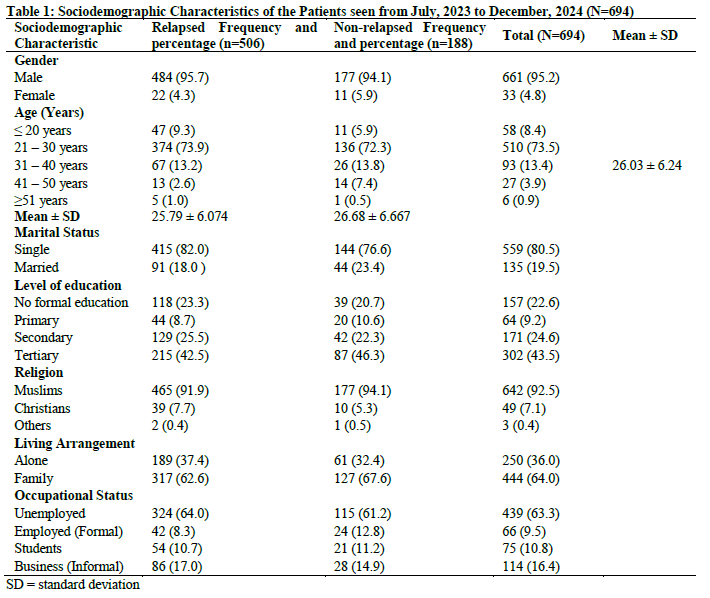
Substance use disorders (SUD) are pattern of substance use that cause damage to physical or mental health. Relapse in SUD results in high cost of treatment and decline in functionality. The study determined the prevalence and examined the determinants of relapse among patients with SUD at Federal Neuropsychiatric Hospital Dawanau, Kano (FNPHDK). A convergent parallel mixed method was used. Total enumerative sampling techniques was used to select 694. The Quantitative data was collected using a checklist and analyzed, while a focused group discussion guide was used to collect the qualitative data which was analyzed thematically. The result revealed that, the prevalence of relapse among patients with SUD from July, 2023 to December, 2024 was 72.9%. The logistic regression analysis indicated that, Sadness (AOR: 1.707, CI: 1.193 – 2.443), stressful life events (AOR: 2.243, CI: 1.394 – 3.610) lack of adherence to medication (AOR: 1.459, CI: 1.030 – 2.065), failure to follow up (AOR: 1.783, CI: 1.212 – 2.625) and, family conflict (AOR: 1.641, CI: 1.092 – 2.466) were the significant triggers of relapse (P<0.05) among patients with SUD. However, sociodemographic attributes were not significant determinants of relapse (P>0.05). Findings for both quantitative and qualitative data sets converged with lack of medication adherence as the determinant of relapse The researcher concludes that there is need to consider medication adherence during treatment, therefore recommends that, new policies/ strategies such as educating the patients and the caregivers on the importance of medication to decrease the risk of relapse.
References
Barati, M., Bandehelahi, K., Nopasandasil, T., Jormand, H., & Keshavarzi, A. (2021). Quality of life and its related factors in women with Substance Use Disorders referring to Substance Abuse Treatment Centers. BMC Womens Health, 21, 16.
Castaldelli-maia, J. M., & Bhugra, D. (2022). Analysis of global prevalence of mental and substance use disorders within countries: Focus on sociodemographic characteristics and income levels. International Review of Psychiatry, 34, 6-15
Chinyere, C. O., Maria-chidi, C. O., Ngozi, A. O., & Benedict, C. A. (2020). Prevalence and Sociodemographic factors of relapse among patients with Substance Use Disorder in Lagos, Southwest Nigeria. Nigerian Journal of Psychological Research, 16(1)
Dunn, T. (2018). The Association Between Medication Adherence in Mental Illness and Substance Use Disorder Relapse in patients with Dual Diagnosis [Master’s thesis, Dequesne University]. University of Dequesne. https://dsc.duq.edu/etd/1436
Ilze, S., Stephan, G., & Gretel, C. (2016). Risk factors for Relapse among Young African Adults following in-patients’ treatment for drug abuse in the Gauteng Province. Stellenbosch, 52(3). http://dx.doi.org/10.15270/52-2-617.
Kabisa, E., Emmanual, B., Jean, Habagusenga & Aline, U. (2021). Substance abuse treatment, prevention and policy: Determinants and prevalence of relapse among patients with substance use disorders; a case of lcyizere psychotherapeutic center. Substance Abuse Treatment, Prevention, and Policy, 16,13
Liyew, A., & Chalachew, K. (2020). The life time prevalence and factors associated with relapse among mentally ill patients at Jimma University Medical Center. Ethiopia
Mousali, A. A., Bashirian, S., & Barati, M. (2021). Factors affecting substance use relapse among Iranian addicts. Journal of Education Health and Promotion, 10,129
Nagy, N. E. S., Ella, E. I. A., & Shorab, E. M. (2022). Assessment of Addiction Management Program and Predictors of Relapse among in-patients of the psychiatric institute at Ain shams University Hospital. Middle East Current Psychiatry, 29, 80
Nahla, E. N., Eman, I. A., Eman, M. S., Mohamed, H. E., & Arwa, A. T. (2022). Assessment of Addiction Management Program and Predictors of Relapse among in-patients of the Psychiatric Institutte at Ain-Shams University Hospital. Middle East Current Psychiatry, 29 (80).
Poznyak, V., Read, G. M., &Medina-More, M. E. (2018). Aligning the ICD-11 Classification of Disorders due to Subsatance Use with global services’ needs. Epidemiology and Psychiatric Sciences, 27 (3),212-218. Doi:10.1017/s2045796017000622.
Rahman, M. M., Rahaman, M., Hamadani, J., Mustafa, K., & Shariful Islam, S. M. (2016). Psycho- Social Factors Associated with Relapse to Drug Addiction in Psychosocial factors associated with relapse to drug addiction in Bangladesh. J Subst Use, 2–7. https://doi.org/10.3109/ 14659891.2015.1122099.
Sanni, M. M., Bolu-Steve, F.N., Durosaro, I. A & Adigun, A. A. (2021) Prevalence of Drug Relapse among Clients in Rehabilitation Centres in North Central Nigeria: Implications for School Counsellors. Canadian Journal of Family and Youth, 13 (2), 14-25. https://doi.org/10.29173/cjfy29668
Shirley, L., Steve, J., Jordan, A. T., & Natalie, A. L. (2023 November). The Relationship between medication adherence to Medication for opioid use disorder and health care costs and health care events in a claim dataset. Journal of substance use and addiction treatment, 154, 209139. https//doi.org/10.101016/j.Josat.2023.209139
Suwanchatchai, C., Buaphan, S., & KKhuancharee, K. (February, 2024). Determinants and Prevalence of Relapse among patients with substance use disorder in a rural population: A retrospective observational study. J Subst Use Addict Treat, 157, 209244. https://doi.org/10.1016/j.josat.2023.209244
Tabea, S., Natalia, P., Marta, D., Ewa, K. Enrico, F., Robin M. & Sagnik, B. (2017) Poor medication adherence and risk of relapse associated with continued cannabis use in patients with first-episode psychosis: a prospective analysis. The Lancet Psychiatry 4 (8), 627-633
Thompson, K., Kulkarni, J., & Sergejew, A. A. (2000). Reliability and Validity of a new Medication Adherence Rating Scale (MARS) for the psychosis. Schizophr Res, 42, 241-7.
Umoh, E. O., & Inuk, E. B. (2021). Prevalence of Relapse amongst Substance Abused Patients in Federal Neuro Psychiatric Hospital Calabar Between 2015 to 2019. International Journal of Research and Innovation in Social Sciences, 5(5), 31-41
World Health Organization (2021). International classification of disease 11th revision. Geneva.
World Health Organization. (2022). Mental Health and Substance Use. https://www.who.int/teams/mentalhealth-and-substance-use/overview .
Xia, Y., Gong, Y., Wang, H., Li, S., & Mao, F. (2022) Family function impacts Relapse Tendency in Substance Use Disorder: Mediated Through Self-Esteem and Resilience. Front Psychiatry, 13, 815118. Doi:10.3389/fpsyt.2022.815118
Downloads
Published
Issue
Section
Categories
License
Copyright (c) 2026 Bilal Bashir Dausayi, Mahfuz Muhammad Haddad, Abdullahi Haruna Ibrahim, Umar Lawal Bello, Umar Yunusa, Muhammad Awwal Ladan, Ahmed Suberu, Abdulmaleek Musa Aliyu, Murtala Hassan Hassan, Idris Abdulrashid

This work is licensed under a Creative Commons Attribution 4.0 International License.


