
Hybrid Machine Learning-Bayesian Vector Error Correction Model for Forecasting of Exchange Rate and Inflation Volatility Dynamics in Nigeria
DOI:
https://doi.org/10.33003/fjs-2026-1014-5487Keywords:
Hybrid forecasting model, Random Forest, Gradient boosting, Macroeconomic forecastingAbstract
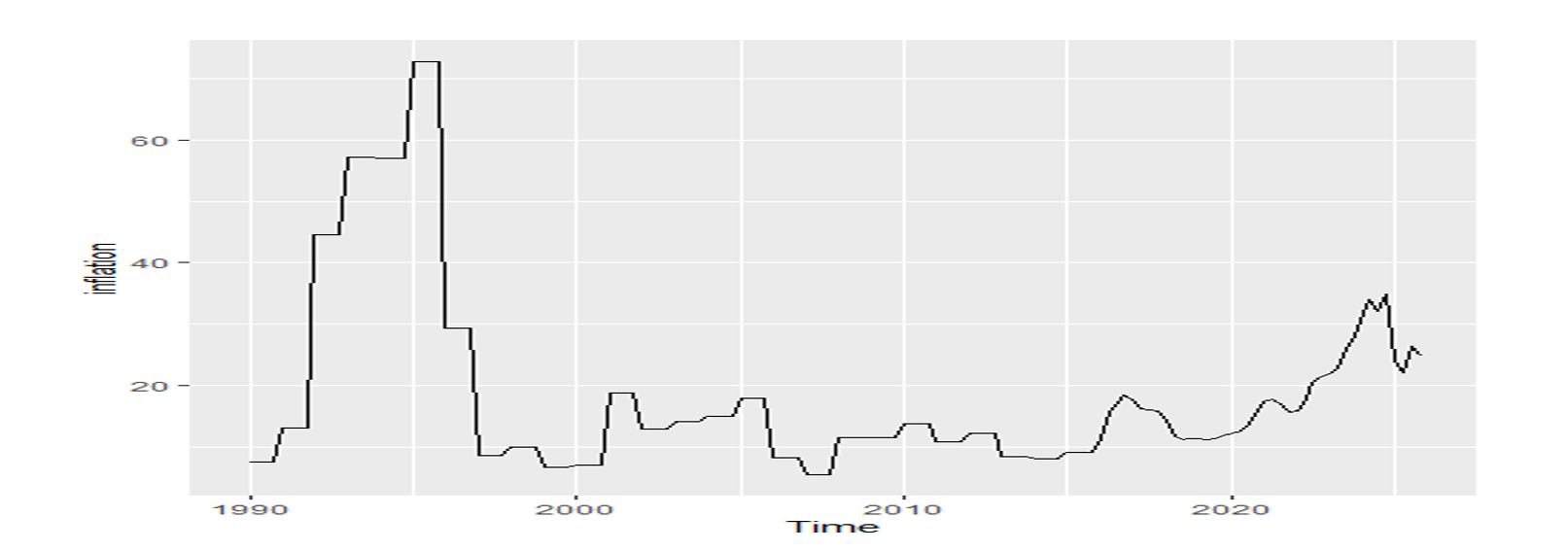
This study develops and evaluates a hybrid Machine Learning-Bayesian Vector Error Correction Model (ML-BVECM) for forecasting exchange rate and inflation volatility dynamics in Nigeria using quarterly data from 1990 to 2025. The Unit root tests (ADF, PP, and KPSS) reveal that both inflation and the nominal exchange rate are integrated of order one (I(1)), while Johansen cointegration analysis confirms a stable long-run equilibrium relationship between the two variables. The structural component of the model, the BVECM, reveals a strong exchange rate pass-through to domestic prices, where a 1% increase in the Naira-Dollar exchange rate results in a 0.62% rise in inflation. The error correction coefficients highlight a rapid quarterly adjustment back to equilibrium: 31% for inflation and 28% for the exchange rate while the use of Bayesian priors stabilizes the parameters against extreme structural shocks such as the 2016 foreign exchange crisis and the 2023 currency float. To capture remaining short-term nonlinearities and volatility clustering, the BVECM residuals were modeled using Random Forest (RF) and Gradient Boosting (GB) algorithms. Specifically, the Random Forest hybrid framework yields the highest accuracy for forecasting inflation, whereas the Gradient Boosting hybrid variant is superior for exchange rate predictions, driving overall error reductions by over 20%. Diagnostic and stability tests confirm the model's structural integrity and robustness. The findings offer a potent toolkit for the Central Bank of Nigeria and other policy makers to proactively target inflation and navigate market volatility.
References
Alemho J. E.and Adenomon M. O. (2021a). Simulation study of Error Correction Model and Autoregressive Distributed Lag Model for Non-normally Distributed Data. BIMA Journal of Science and Technology 5(2): 36-48.
Alemho J. E.and Adenomon M. O. (2021b). Paradigm Shift in Main Macroeconomic Variables’ Analysis. BIMA Journal of Science and Technology 5(2): 56-67.
Alemho J. E.and Adenomon M. O. (2022). Forecasting Some Selected Macroeconomic Variables with BVAR Models under Natural Conjugate Prior. Benin Journal of Statistics, 5 (1): 107-121.
Alemho J. E. (2022). Statistical Investigation of the Effects of Main Macroeconomic Variables on Stock Market Performance in Nigeria using ARDL model. BIMA Journal of Science and Technology, 5 (3): 108-119.
Alemho J. E. (2026). Hybrid Modeling of Nigerian Crude Oil Prices under Structural Breaks and Volatility. Journal of the Royal Statistical Society Nigeria Group (JRSS-NIG Group). 3(1): 197-204.
Alemho, J. E,Deebom, Z. D., and Lekara-Bayo (2026). Forecasting Efficacy of Hybrid ARFIMA-FIGARCH Model: An Application to Returns and Volatility of the Nigerian All Share Index. FUDMA Journal of Science. 10(13): 220-226. https://doi.org/10.33003/fjs-2026-1013-5327.
Aribatise, A. (2023). Exchange rate pass through and inflation dynamics in Nigeria: Evidence from a vector error correction model. African Journal of Economic Policy, 30(3), 211–229. https://doi.org/10.1080/11174523.2023.00456.
Chejarla, S., et al. (2026). Integrating panel econometrics with explainable machine learning in financial modeling. Journal of Advanced Financial Research, 18(1), 45–67.
Ezekwube, E. C., Okonkwo, O. C., & Ume, K. A. (2026). Dynamic relationships between exchange rate volatility, inflation, and foreign direct investment in Nigeria. Journal of Economic Policy Research, 14(2), 133–150. https://doi.org/10.1007/s11408-026-0045-9.
Ibrahim, Y. A., Nweze, N. O., Adehi, M. U., & Chaku, S. E. (2025). Development of a hybrid macroeconomic model for forecast of economic indicators. Science World Journal, 20(1), 45–62. https://doi.org/10.5897/SWJ2025.0201.
Johansen, S. (1991). Estimation and hypothesis testing of cointegration vectors in Gaussian vector autoregressive models. Econometrica, 59(6), 1551–1580. https://doi.org/10.2307/2938278
Nguyen, T. H. (2022). Hybrid econometric–machine learning models for forecasting in emerging markets. Economic Modelling, 108, 105743.https://doi.org/10.1016/j.econmod.2022.105743.
Nikolenko, S. I., Panov, M., & Petrov, A. (2022). Machine learning in macroeconomic forecasting: Challenges and opportunities. Journal of Forecasting, 41(5), 789–804. https://doi.org/10.1002/for.2789
Pajor and Wróblewska (2022). Forecasting Performance of Bayesian VEC-MSF Models for Financial data in the presence of long-run relationships.Eurasian Economic Review. 12:427-448. https://doi.org/10.1007/s40822-022-0023-x
Zhang, Y., Li, W., & Sun, X. (2020). Challenges of machine learning in commodity price forecasting: Evidence from oil markets. Journal of Forecasting, 39(5), 750–767.
Hauzenberger, N., Huber, F., Pfarrhofer, M., &Zörner, T. O. (2021). Stochastic model specification in Markov switching vector error correction models. Studies in Nonlinear Dynamics and Econometrics, 1(2), 1–17. https://doi.org/10.1515/SNDE-2018-0069
Downloads
Published
Issue
Section
Categories
License
Copyright (c) 2026 Joseph Elekhekhatse Alemho, Abdullahi Damisa Jemilu, Vincent Abiodun Micheal

This work is licensed under a Creative Commons Attribution 4.0 International License.


