
Forecasting Efficacy of Hybrid ARFIMA-FIGARCH Model: An Application to Returns and Volatility of the Nigerian All Share Index
DOI:
https://doi.org/10.33003/fjs-2026-1013-5327Keywords:
Dual Long Memory, ARFIMA-FIGARCH, Nigerian All Share Index, Volatility ForecastingAbstract
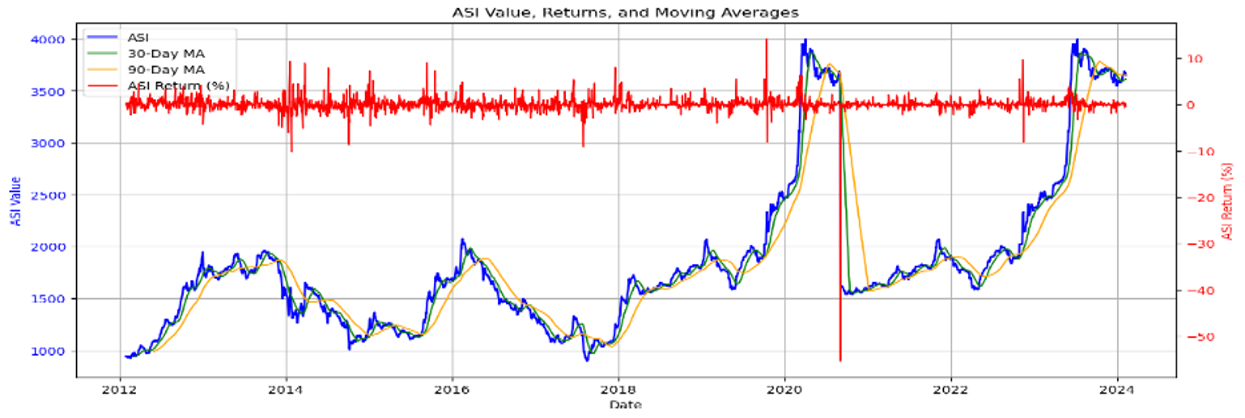
This study investigates the forecasting efficacy of a hybrid AFIMA-FIGARCH model within a fractional integration framework for capturing dual long-memory dynamics: persistence in both returns (conditional mean) and volatility (conditional variance) of the Nigerian All Share Index (ASI) using daily data spanning from January 30th, 2012, to February 7th, 2024 (in 3,138 observations). Initial diagnostics confirmed significant heteroskedasticity (ARCH LM test, p < 0.05) and non-stationarity at levels, justifying the use of volatility-oriented and fractional differencing approaches. Empirical findings reveal extreme persistence characterized by a Hurst exponent (H≈1.13) and an ARFIMA fractional differencing parameter approaching unity (d ≈ 0.999), indicating hyper-persistent dynamics that substantially exceed typical long-memory estimates (d = 0–0.4) reported in African and global financial markets. The ARFRIMA-FIGARCH model demonstrates superior forecasting performance relative to standalone ARFRIMA-GARCH and FIGARCH alternatives, exhibiting curvilinear mean forecasts that reflect mean-reverting tendencies with escalating uncertainty over longer horizons. Diagnostic tests confirmed the model adequacy and stability, with no residual autocorrelation or heteroskedasticity. The near-unit root fractional parameters provided compelling evidence against weak-form market efficiency, indicating that the ASI exhibited prolonged, hyperbolically decaying impacts. These findings underscore the necessity of hybrid long-memory frameworks for risk management, portfolio allocation, and regulatory policy in Nigeria’s emerging financial market.
References
Adewole, A. (2024). Modeling long memory volatilities of Nigeria selected macroeconomic variables with ARFIMA and ARFIMA–FIGARCH. Cumhuriyet Science Journal, 45(1), 1–20.
Alemho, J. E. (2022). Statistical Investigation of the Effects of Main Macroeconomic Variables on Stock Market Performance in Nigeria using ARDL Model. BIMA Journal of Science and Technology, 5(3), 108–119.
Alemho, J. E., & Adenomon, . O. (2022). Forecasting Some Selected Macroeconomic Variables with BVAR Models under Natural Conjugate Prior. Benin Journal of Statistics, 5(1), 108–122.
Baillie, R. T., Bollerslev, T., & Mikkelsen, H. O. (1996). Fractionally Integrated Generalized Autoregressive Conditional Heteroskedasticity. Journal of Econometrics, 74(1), 13–30.
Basira, M., Taheri, S., & Farrokhi, S. (2024). Forecasting long-memory volatility in emerging markets using FIGARCH models. International Journal of Financial Studies, 12(3), 1–22.
Benbachir, S. (2025). Assessing informational efficiency in largest African stock markets by modeling dual long memory: An ARFIMA–FIGARCH approach. Investment Management and Financial Innovations, 22(3), 1–18.
Deebom, Z. D., & Essi, I. O. (2017). Volatility modeling of Nigerian crude oil prices using GARCH models. Nigerian Journal of Economic and Social Studies, 59(2), 245–268.
Deebom, Z, D., Kumar, M., Carmen, B., Lucia, P., Thomas, G., Igboye, S., Carina, S., & Ion, F. (2023). Investigating the Efficacy of ARIMA and ARFIMA Models in Nigeria All Share Index Markets. Economic Computation & Economic Cybernetics Studies & Research, 57(3)
Dufitinema, J. (2021). Forecasting the Finnish house price returns and volatility: a comparison of time series models. International Journal of Housing Markets and Analysis.
Granger, C. W. J., & Joyeux, R. (1980). An Introduction to Long‐Memory Time Series Models and Fractional Differencing. Journal Of Time Series Analysis, 1(1), 15–29.
Hosking, J. R. M. (1981). Fractional Differencing. Biometrika, 68(1), 165–176.
Kasman, A., Kasman, S., & Torun, E. (2009). Dual long memory property in returns and volatility: Evidence from the CEE countries’ stock markets. Emerging Markets Review, 10(2), 122–139.
Lahmiri, S., & Bekiros, S. (2021). Long memory and persistence in financial returns: Evidence from emerging markets. Physica A: Statistical Mechanics and its Applications, 563, 125–143.
Magaji, U., & Garba, M. (2023). Persistence and volatility dynamics in Nigerian stock returns. African Journal of Economic Modeling, 15(2), 77–92.
Subair, T., & Arewa, O. (2020). Market efficiency and persistence in Nigerian stock returns. International Journal of Financial Research, 11(2), 45–61.
Tripathy, P. (2022). Stylized facts of stock returns in developing economies. Emerging Market Finance Journal, 8(1), 33–51.
Tuaneh, G, L, Deebom, Z, D and Akah, V, M (2025). Exploring Long-Memory Dynamics In Nigerian Commercial Banks’ Lending Rates: A Comparative Analysis Of ARIMA, ARFIMA, And FIGARCH Models”. Asian Journal of Probability and Statistics 27 (2):112-123
Downloads
Published
Issue
Section
Categories
License
Copyright (c) 2026 Joseph Elekhekhatse Alemho, Zorle Dum Deebom, Ifeoma Lekara-Bayo

This work is licensed under a Creative Commons Attribution 4.0 International License.


