
Prevalence and Intensity of Gastrointestinal Helminths in Captive Birds at FUNAAB Zoological Park, Abeokuta, Nigeria
DOI:
https://doi.org/10.33003/fjs-2026-1014-5459Keywords:
Gastrointestinal Helminths, Captive Birds, Prevalence, Infection Intensity, Zoological Park, NigeriaAbstract
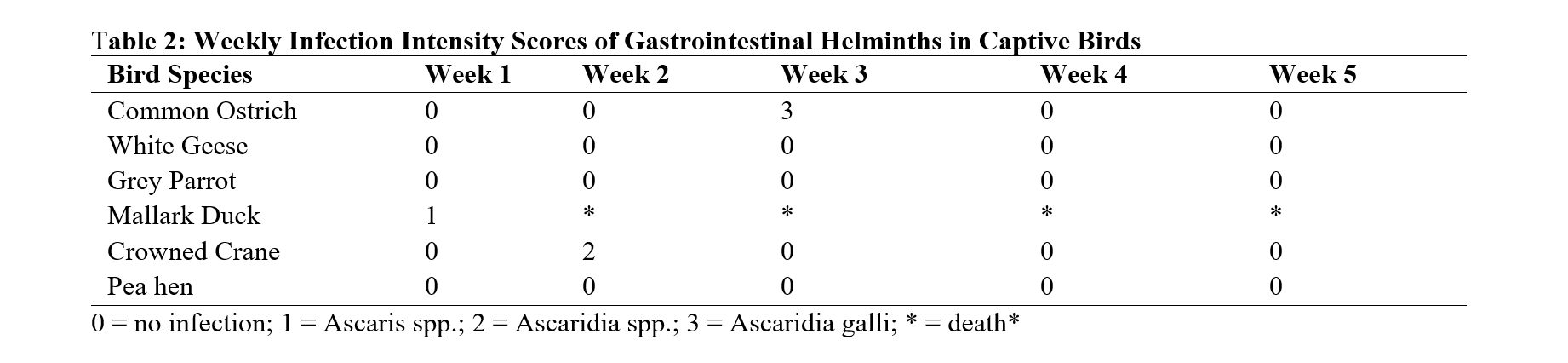
Gastrointestinal helminth infections pose significant health challenges to captive avian species, particularly in zoological settings where confinement may enhance exposure to parasitic stages. This study assessed the prevalence and intensity of gastrointestinal helminths among selected captive birds at the Federal University of Agriculture, Abeokuta (FUNAAB) Zoological Park, Nigeria. Six avian species; Common Ostrich (Struthio camelus), White Geese (Chen caerulescens), Grey Parrot (Psittacus erithacus), Mallard Duck (Anas platyrhynchos), Crowned Crane (Balearica pavonina), and Pea Hen (Pavo cristatus), were monitored for 5 week. Fresh fecal samples were collected weekly and examined using standard flotation techniques to detect helminth eggs. Helminth infections were recorded in three of the six bird species: Mallard Duck (100%), Common Ostrich (20%), and Crowned Crane (20%), indicating a substantial level of gastrointestinal parasitism within the population. Ascaridia galli was identified in the Common Ostrich during the third week of sampling, while Ascaris spp. eggs were detected in the Mallard Duck during the first week, after which the bird died. Ascaridia eggs were also detected in the Crowned Crane during the second week. No helminth infections were observed in the White Goose, Grey Parrot, or Pea Hen throughout the study period. Infection intensity varied among the infected species, with the highest egg count recorded in the Common Ostrich. The occurrence of helminth‑associated mortality highlights the potential health risks posed by gastrointestinal parasites in captive birds. Continuous parasitological surveillance, improved enclosure hygiene, and species‑specific deworming programmes are recommended to reduce infection risks and enhance avian health management in zoological parks.
References
Abdu, P. A., Sa’idu, L., & Oladele, S. B. (2022). Parasites and parasitic diseases of birds: An overview. Nigerian Veterinary Journal, 43(1), 1–12.
Abd El-Ghany, W.A. (2023). Avian haemosporidian parasites: An updated review. Veterinary Sciences Research Journalal; 28(2):18-2. http://dx.doi.org/10.5380/avs.v28i2.91244
Adegbulu, Y. T., Mogaji, H. O., Oluwole, A. S., Alabi, O. M., Adeniran, A. A., & Ekpo, U. F. (2015). A preliminary survey of gastrointestinal parasites of animals in the Federal University of Agriculture Abeokuta Zoological Park, Ogun State, Nigeria. Journal of Biology, Agriculture and Healthcare, 5(11), 195–202.
Ballweber, L.R., Beugnet, F., Marchiondo, A.A., & Payne, P. A. (2014). American Association of Veterinary Parasitologists' review of veterinary fecal flotation methods and factors influencing their accuracy and use--is there really one best technique? Veterinary Parasitology. 204(1-2):73-80. https://doi.org/10.1016/j.vetpar.2014.05.009.
Epub 2014 May 17. PMID: 24893692.
Bonsu, F. A., Asante, R., & Nartey, E. K. (2020). Parasite load in captive and free-ranging avian species in Ghana. Ghana Journal of Science; 61(2), 112–120.
Cordon, G. P., Prados, A. H., Romero, D., Moreno, M. S., Pontes, A., & Osuna, A. (2008). Intestinal parasitism in animals of the zoological garden Peña Escrita (Almuñécar, Spain). Veterinary Parasitology, 156, 302–309. https://doi.org/10.1016/j.vetpar.2008.05.023
Dimander, S. O., Höglund, J., Spörndly, E., & Waller, P. J. (2000). The impact of internal parasites on the productivity of birds. Veterinary Parasitology; 90, 271–284. https://doi.org/10.1016/S0304-4017(00)00225-7
Egbetade, A., Akinkuotu, O., Jayeola, O., Niniola, A., Emmanuel, N., & Olugbogi, E. (2014). Gastrointestinal helminths of resident wildlife at the Federal University of Agriculture Zoological Park, Abeokuta, Nigeria. Sokoto Journal of Veterinary Sciences, 12(3), 26–31.
Garcia, L. S. (2016). Diagnostic medical parasitology (6th ed.). Washington, DC: ASM Press.
Mohebati M., Lotfalizadeh, N., Khedri, J., Borji, H. & Ebrahimzadeh E., (2024). An Investigation into the Prevalence of Gastrointestinal Helminths in Pigeons from Zabol, Iran. Archives Razi Institute; 79(5):949-954. https://doi.org/10.32592/ARI.2024.79.5.949
PMID: 40292053; PMCID: PMC12018739.
McCreesh, K., Guthrie, A. L., Spiro, S. & Patterson, S. A. (2024). Systematic review of retrospective morbidity and mortality studies on captive wildlife species. The Journal of Zoo and Wildlife Medicine; 55(1):1-12. https://doi.org/10.1638/2023-0093
PMID: 38453482.
Nnadi, P. A., & George, S. O. (2018). A cross-sectional study of parasites of ducks in Southeast Nigeria. Journal of Parasitology Research; 1(3): 1–6. https://doi.org/10.1155/2018/3845938
Ola-Fadunsin, S. D., Ganiyu, I. A., & Abdullah, D. A. (2021). Gastrointestinal parasites of captive birds in a zoological garden in Ilorin, Nigeria. Veterinary World; 14(5), 1290–1296. https://doi.org/10.14202/vetworld.2021.1290-1296
Pfukenyi, D. M., & Mukaratirwa, S. (2013). A review of the epidemiology and control of gastrointestinal nematode infections in ruminants. Onderstepoort Journal of Veterinary Research; 80(1), 1–9. https://doi.org/10.4102/ojvr.v80i1.539
Rahman, M. S., Tasnim, J., Supto, Md. S. M., Siddiki, T., Shahadat, H. M. & Nath, T.C. (2026). Gastrointestinal Helminth Infections in Captive Wild Animals of Bangladesh: Implications for Zoo Health Management and Zoonotic Risk. Journal of Parasitology Research; 1(1056182): 1-8. https://doi.org/10.1155/japr/1056182.
Sam-Wobo, S. O., Innocent, N. P., Oyatogun, I., Surakat, O. A., and Mogaji, H. O. (2017). Status of helminths in birds kept in a zoological park, Abeokuta, Nigeria. Journal of Entomology and Zoology Studies; 5(6), 390–394.
Downloads
Published
Issue
Section
Categories
License
Copyright (c) 2026 Ofoma Cornelius Amoke, Ahmed, Somoye, Balarab-Musa, Sam-Wobo

This work is licensed under a Creative Commons Attribution 4.0 International License.


